Local News
New Judson Stadium transforms RIT outdoor athletics complex into a modern hub for student athletes and campus life

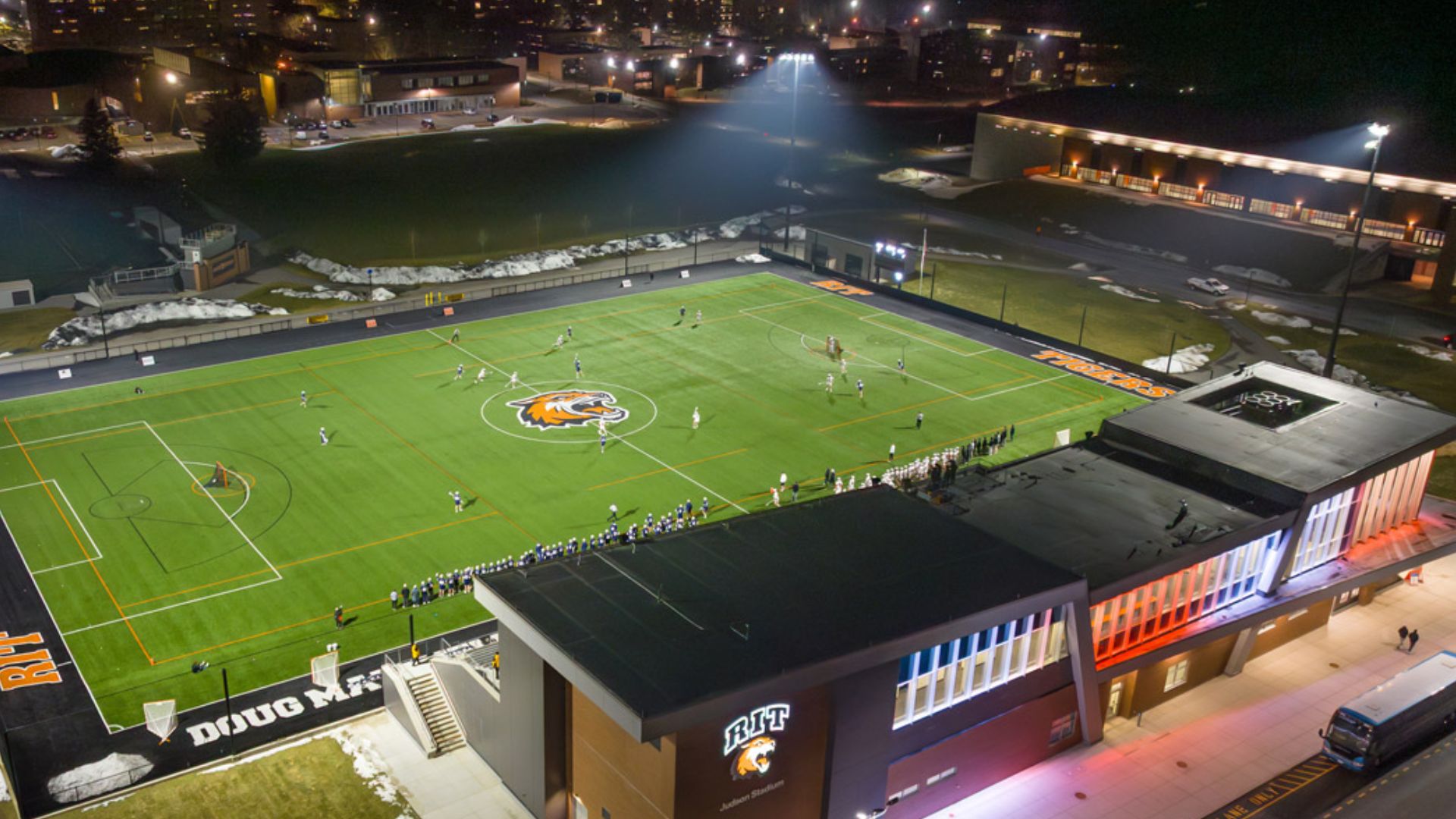
Rochester, New York – A new chapter has quietly taken shape on the campus of Rochester Institute of Technology, where the unveiling of Judson Stadium now stands as both a physical landmark and a symbol of long-term ambition. After years of planning, construction, and steady transformation, the university’s outdoor athletics complex has reached its most visible milestone yet—one that reshapes not just how games are played, but how the campus feels.
The stadium, now the home ground for men’s and women’s lacrosse and soccer, did not appear overnight. Its arrival marks the final phase of a broader, five-year effort to modernize and unify athletic spaces across the university. What began back in 2021 as a practical rethinking of facilities has gradually evolved into something far more cohesive—a corridor that welcomes athletes, students, alumni, and visitors with a clearer sense of identity and purpose.
Though the first whistles already echoed through the venue during lacrosse season earlier this year, the official dedication is set to unfold ahead of a men’s lacrosse game this weekend. The moment carries added weight, not only because it celebrates a completed project, but because it recognizes the legacy behind its name. Judson Stadium honors a significant contribution from the Judson family—Thomas Fearey Judson Jr., his wife Ebets, their son Rufus, and their company, Pike Construction Services.
Their ties to the university run deep, stretching across generations. The family’s involvement in RIT governance and development reflects a continuity that few institutions experience. From John D. Pike’s early role in the 20th century to Thomas F. Judson Sr., and later Thomas Fearey Judson Jr., the connection has remained steady. Now, with Rufus Judson serving as CEO of Pike, that lineage continues into a fourth generation, blending leadership with philanthropy in a way that has left a lasting imprint on campus.
“Judson Stadium is more than a venue — it’s the culmination of a vision,” said RIT President Bill Sanders. “Over several years, RIT has invested with intention in facilities that support excellence, build community, and reflect who we are as a university. This stadium brings all of that together in one place—right at the front door of campus.”
That “front door” description is not accidental. The stadium’s placement near the main entrance off Jefferson Road was a deliberate choice, turning it into a kind of architectural welcome point. Designed by LaBella Associates with support from Populous and constructed by Pike Construction Services, the structure does more than host games—it frames first impressions.
The facility itself spans nearly 39,000 square feet, offering seating for over a thousand spectators, with additional standing areas and hospitality spaces woven into its layout. Inside, the details reflect a focus on performance and comfort alike. Locker rooms tailored for lacrosse and soccer teams, a modern training room, a media suite, and concession areas all come together under one coordinated vision. A partially covered outdoor concourse overlooks the field, blending movement and gathering into a single experience.
Yet, the story of Judson Stadium is inseparable from the transformation that came before it. The journey began with the relocation and rebuilding of the outdoor track facility, followed by upgrades to baseball and softball fields, including the addition of all-weather turf. Each step added momentum, setting the stage for what would become a $30 million centerpiece project—initially known as Tiger Stadium before taking on its current name.
For university leaders, the impact extends beyond infrastructure. It is, at its core, about people.
“This complex was built with students in mind—how they train, how they compete, and how they experience campus,” said Jacqueline Nicholson, executive director of Intercollegiate Athletics. “Judson Stadium completes an environment that supports performance, pride, and connection for our student athletes and for the entire RIT community.”
Sanders echoed that sentiment, pointing to the intangible value that spaces like this can create. “This stadium is a place where RIT Tigers will come together as a team, learn the lessons of perseverance and sportsmanship, and create lifelong memories. It is a place where athletes will strive for excellence, push the boundaries of what is possible, and discover their true potential.”
There is also a broader spotlight beginning to form. The National Collegiate Athletic Association has already taken notice, selecting Judson Stadium as the host site for the 2026 Division II and III women’s lacrosse semifinals and national championship games. Scheduled for Memorial Day Weekend, the event will bring national attention—and a surge of visitors—to the campus.
In many ways, that upcoming championship serves as both a test and a showcase. It will highlight not just the quality of the facility, but the vision behind it—a vision that has been years in the making and is now, finally, fully visible.
What stands today is more than steel, seating, and turf. It is a statement about direction, about investment, and about the kind of experience Rochester Institute of Technology aims to offer. The lights of Judson Stadium do more than illuminate a playing field—they signal a campus that has steadily, and deliberately, redefined the role of athletics within its community.


-

 Local News2 years ago
Monroe County announces legal proceedings against properties listed in official public notice of foreclosure
-

 Local News2 years ago
New ALDI store close to Rochester to begin construction in late 2025 or early 2026
-

 Local News2 years ago
County Executive Adam Bello and members of the county legislature celebrate exceptional young leaders and advocates at the 2025 Monroe County Youth Awards
-

 Local News1 year ago
The 2025 Public Market Food Truck Rodeo series will begin this Wednesday with live music by the Royal Bromleys