Local News
RIT joins $37.5 million NSF-funded Quantum Leap Challenge Institute focused on advancing practical quantum error correction and education

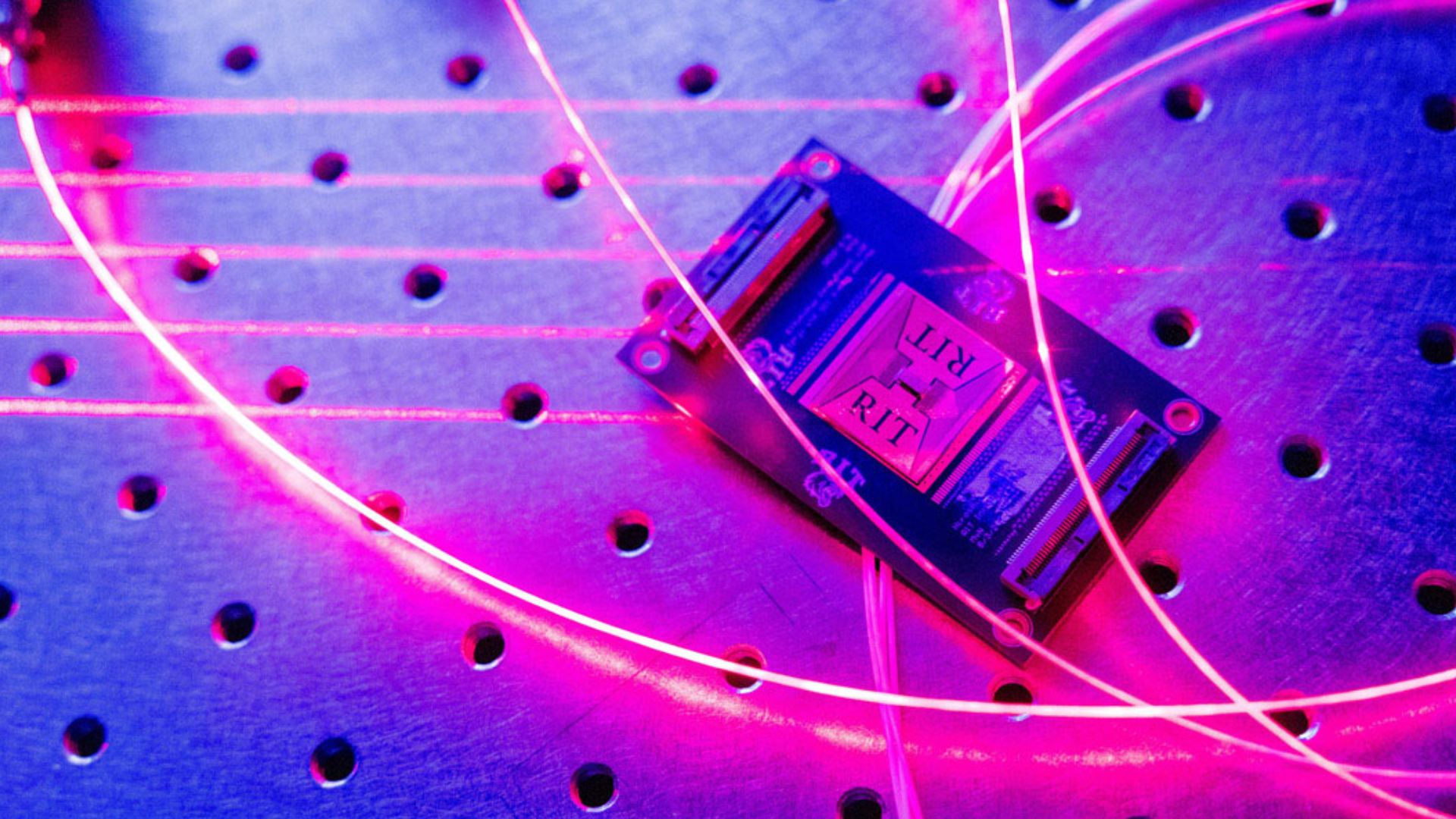
Rochester, New York – Rochester Institute of Technology is taking part in a major national effort to advance quantum science, joining researchers from universities across the country in a new National Science Foundation-funded initiative focused on making quantum technology more practical and reliable.
RIT is part of the NSF Quantum Leap Challenge Institute for Physics and Engineering of Practical Quantum Error Correction, known as NSF PRACTIQAL. The initiative is backed by a $37.5 million NSF award and brings together researchers from several fields with the goal of addressing one of the biggest challenges facing the development of useful quantum computers: quantum errors.
The project is led by Yale University and includes researchers from RIT, Virginia Tech and the University of California San Diego. It is one of eight large-scale interdisciplinary research centers selected for funding through the NSF’s Quantum Leap Challenge Institutes program.
Rather than focusing on a single area of science, the institute is designed to bring different disciplines together. Physicists, engineers, computer scientists and chemists will work as part of a broader research community seeking ways to develop large-scale quantum hardware that can operate with error correction.
Quantum systems are extremely sensitive to errors, and controlling those errors is an important step toward building machines capable of carrying out useful calculations at a large scale. The PRACTIQAL project will focus on the physics and engineering needed to make practical quantum error correction possible.
RIT’s role will center on education and workforce development. The university’s work will be led by Ben Zwickl, a professor of physics, who will work with a team responsible for several education-related activities across the institute.
The RIT team will manage professional development opportunities for undergraduates, graduate students, postdoctoral researchers and faculty members. It will also oversee exchange programs within the institute while conducting education research and helping develop curriculum connected to quantum error correction.
The work will not be limited to teaching technical concepts. RIT will also examine the broader societal benefits of quantum technology and how education can prepare people to understand and participate in the development of the field.
“I’m excited to work with such an outstanding team of scientists and engineers at Yale, Virginia Tech, and elsewhere,” said Zwickl. “Our work at RIT will help take their advanced ideas about quantum error correction and make them accessible for a wide range of learners. We also want to shift the dialog around quantum education to include the people and communities impacted by the practical quantum technologies envisioned by PRACTIQAL. The QLCI will support the expansion of our minor in quantum information science and technology to include a new hands-on interdisciplinary quantum technology laboratory course, as well as provide support for undergraduate, graduate, and postdoctoral researchers.”
The effort builds on work already taking place at RIT in quantum education and workforce preparation. Zwickl has conducted extensive research in the area, with previous support from both the NSF and the Department of Defense.
He also serves as an adviser for RIT’s interdisciplinary minor in quantum information science and technology. The program was launched in fall 2022 and has continued to grow since then, reflecting increasing interest in quantum technologies among students from different academic backgrounds.
RIT also added a general education immersion in quantum information science and technology, which began in fall 2026. The new NSF-supported work is expected to further expand opportunities for students to gain practical experience in the field.
One of the planned developments is a new hands-on interdisciplinary quantum technology laboratory course. The course is intended to give students an opportunity to work across disciplinary boundaries, an approach that reflects the way quantum technology itself is being developed.
Quantum computing has attracted growing interest because of its potential to tackle certain problems that are extremely difficult for traditional computers. While the technology remains an emerging field, researchers are exploring possible applications in areas such as materials science and drug design.
If these technologies become practical at scale, they could contribute to scientific advances, improve the development of new materials and medicines, and create new opportunities for economic growth. But reaching that point requires not only advances in hardware and software, but also a workforce capable of designing, building and using quantum systems.
That is where RIT’s role in NSF PRACTIQAL is expected to be especially important. The university will focus on preparing students and researchers who can contribute to the growing quantum field while also exploring better ways to teach complex quantum concepts.
The institute will provide support over the next five years for the education and training work led by Zwickl and his team. The effort will include opportunities for students at different stages of their academic and research careers, from undergraduates beginning to explore quantum information to postdoctoral researchers already working in advanced research environments.
The interdisciplinary nature of the project is also expected to create opportunities for participants to learn from researchers working in other fields. Quantum technology brings together ideas from physics, engineering, computer science and chemistry, making collaboration an important part of the effort to develop practical systems.
The broader Quantum Leap Challenge Institutes program represents a significant federal investment in quantum research. The NSF is providing a total of $290 million across eight institutes, each led by a major research university.
The eight institutes are led by Harvard University, the University of Illinois, Princeton University, Yale University, the University of California-Berkeley, the University of Chicago, the University of Colorado and the University of Maryland.
The funding reflects the federal government’s continued effort to support research in quantum science while helping build the educational and professional infrastructure needed to turn research discoveries into practical technologies.
For RIT, participation in NSF PRACTIQAL adds another major component to its growing involvement in quantum information science. The university’s existing academic programs, research efforts and workforce initiatives provide a foundation for the new project, while the NSF award creates an opportunity to connect that work with a much larger national research effort.
The emphasis on education also gives RIT a role beyond traditional laboratory research. By developing courses, supporting researchers and studying how quantum concepts can be taught effectively, the university will help prepare people who may eventually work in a field that is expected to influence computing, science and industry.
Over the five-year period, the institute will bring together research and education in an effort to move quantum error correction closer to practical use. RIT’s contribution will focus on making that work accessible to learners while helping develop the skills and knowledge needed by the next generation of quantum scientists and engineers.
As quantum technology continues to develop, the need for trained researchers and professionals is likely to grow alongside the technology itself. Through its participation in NSF PRACTIQAL, RIT is positioning its students and faculty to be part of that development while contributing to a national effort aimed at solving some of the most difficult challenges in quantum computing.


-
 Local News2 years ago
Monroe County announces legal proceedings against properties listed in official public notice of foreclosure
-

 Local News2 years ago
New ALDI store close to Rochester to begin construction in late 2025 or early 2026
-

 Local News1 year ago
County Executive Adam Bello and members of the county legislature celebrate exceptional young leaders and advocates at the 2025 Monroe County Youth Awards
-

 Local News1 year ago
The 2025 Public Market Food Truck Rodeo series will begin this Wednesday with live music by the Royal Bromleys