Local News
RIT industrial design student turns classroom skills into new fingerboarding products during Teak Tuning internship

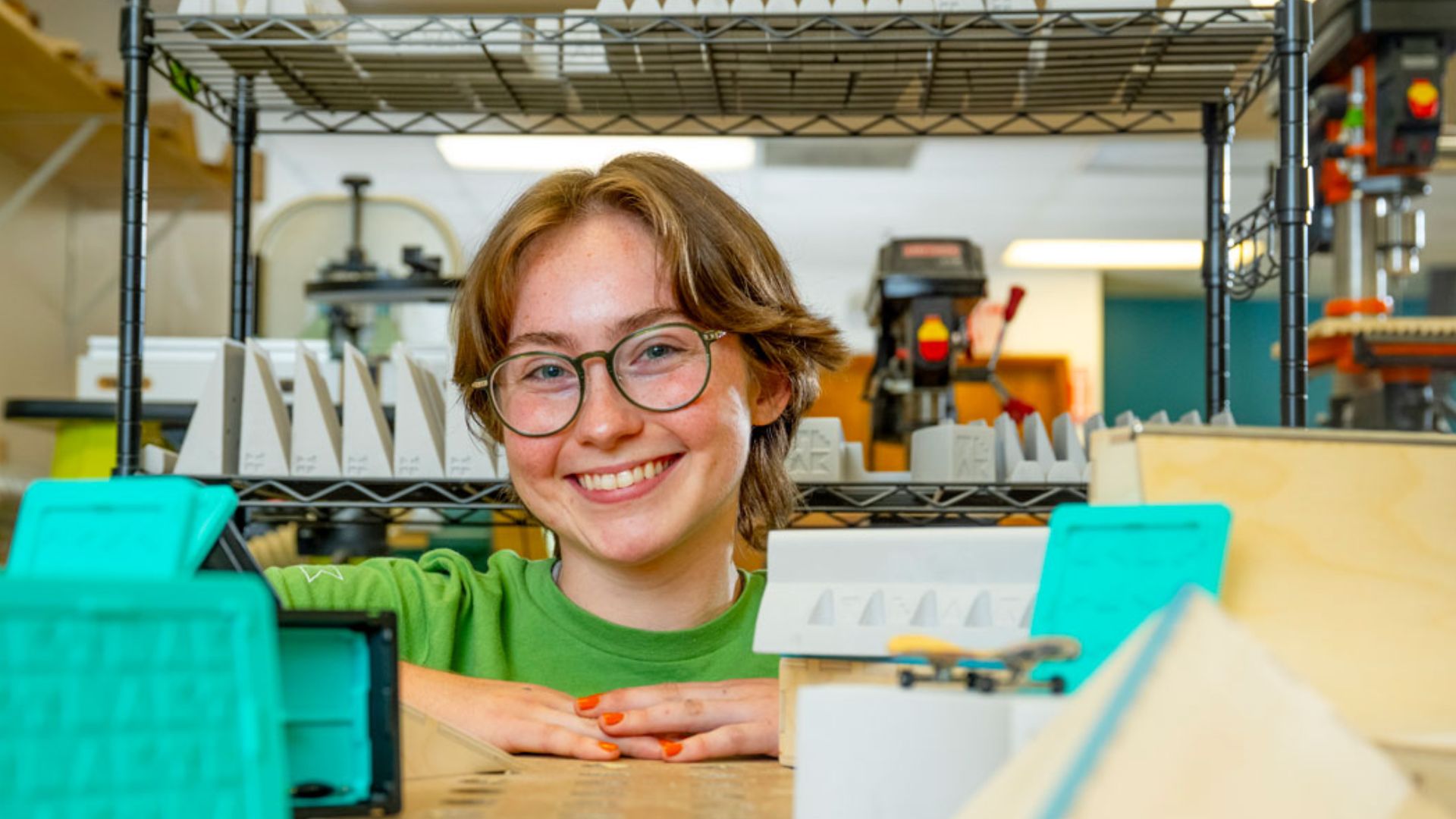
Rochester, New York – For Rochester Institute of Technology industrial design student Maggie Wagner, an internship at Teak Tuning offered a chance to take the skills she had developed in the classroom and apply them to a very small, very unusual product world.
Wagner, a fourth-year industrial design BFA student from Nashua, N.H., had little experience with fingerboarding when she first joined the company. She did not come to Teak Tuning as a professional fingerboarder. Instead, she brought something the company needed just as much — experience in design, materials and production methods.
What began as a part-time job for a few hours a week during the spring semester eventually became a full-time summer internship. At Teak Tuning, a professional fingerboard designer and manufacturer, Wagner worked on products that may be miniature, but require many of the same kinds of design decisions found in larger-scale industrial design.
Her work included helping produce and assemble products sold through the company’s website. Those products include obstacles and monuments used by fingerboarders, as well as wooden decks made in-house. She also worked with urethane rods that are later cut by an outside partner into the brightly colored wheels used on fingerboards.
One of Wagner’s biggest projects came when Teak Tuning needed to update its monument inventory. The company wanted to introduce its newer logo and, at the same time, improve the quality and efficiency of the production process.
Ashley Landon, Teak Tuning’s product development and production manager, assigned Wagner a major role in redesigning the molds used to make the monuments.
“The purpose of remaking the monument molds was to improve the surface quality, reduce the post processing time, and replace the old logo with the new one,” Wagner said.
The project gave Wagner an opportunity to use techniques and knowledge she had developed through her studies at RIT. She created new 3D molds for silicone casting and worked on ways to speed up the curing process.
The changes made a major difference in production. A task that once required several minutes of finishing work for each piece could now be completed in a fraction of the time.
“It used to take 3-to-4 minutes a piece to do the post-processing, and now it takes 15-to-25 seconds after Maggie did this redesign,” Landon said. “It’s been a phenomenal change and massively increased our output.”
The mold redesign was not simply about making production faster. Wagner also made adjustments to several monuments after receiving feedback from professional fingerboarders. That meant thinking about how the products would actually be used and what experienced riders might want from them.
She also took a creative approach to one of Teak Tuning’s popular designs, known as the “Loaf.” Wagner developed her own interpretations of the obstacle by adding a wave to its side profile.
“I met with the president of Teak Tuning and my manager a lot to talk about obstacles and what’s most popular in the market,” Wagner said. “I thought of ways that we could alter the side profile to make it more interesting and fun.”
The company is considering turning those ideas into a larger product family. Depending on how customers respond, Wagner’s designs could become a group of three obstacles featuring a wave, an arc and a U-shaped profile.
Her work was not limited to obstacles, either. Matt Bertrand, president of Teak Tuning, asked Wagner to develop another product aimed at helping fingerboarders keep their equipment organized.
The idea was based on a storage tote commonly associated with skateboarders. Wagner scaled the concept down for the miniature world of fingerboarding, creating a small tote that eventually went into production.
Another assignment allowed her to design an entire fingerboarding environment rather than a single product. Landon was working on a skate park concept made from modular 2-foot-by-2-foot squares. The squares could contain open areas or obstacles and could be combined to create different layouts.
Wagner designed a platform featuring a long-banked side, stairs, a railing and edges for fingerboarders to use. The skate park is expected to launch on the Teak Tuning website in the fall.
For Wagner, the internship also became a lesson in how to design for a community she was still learning about. Fingerboarding developed from skateboarding culture, but it has grown into its own international activity, with professional competitors and a global following.
Teak Tuning sponsors professional fingerboarders, and Landon said company founder and co-owner Geraldine Stack is considered one of the best fingerboarders in the world.
Wagner quickly discovered that the sport was more demanding than it might appear from the outside.
“It’s a lot harder than it looks,” Wagner said.
Even without years of experience in fingerboarding, Wagner found ways to understand what might interest its participants. She began looking at ordinary objects and structures differently, searching for shapes and ideas that could be transformed into miniature obstacles.
“I’ll find inspiration through photos or just from driving around,” Wagner said. “I’ll look at the profiles of the roofs of buildings and the shopping malls, and think, ‘Oh that’s a cool shape. I could probably fingerboard on that.’”
That approach reflects the broader value of the internship. Rather than simply learning how to manufacture existing products, Wagner was able to take an idea, study how it might work, consider its materials and production requirements, and then turn it into something tangible.
Experiences like this are a major part of RIT’s cooperative education and internship opportunities. The university is ranked fifth among cooperative education and internship programs by U.S. News & World Report, and internships give students opportunities to work with professionals while still completing their education.
Teak Tuning’s parent company, Eisco Labs, which manufactures educational laboratory equipment, has previously hired other RIT students for cooperative learning experiences. Wagner, however, is the first industrial designer hired to work specifically with the fingerboarding affiliate.
Landon, who is also an industrial designer, said Wagner’s broad experience made her especially valuable to the company. Her ability to understand different materials and production processes allowed her to move between different assignments and contribute beyond a single area.
“Maggie is so well-rounded in her skill set and is a perfectionist that I know I can trust her with a task,” Landon said. “She just picks up and runs with an idea.”
That ability became a defining part of Wagner’s internship. What started with a few hours of work between classes turned into a summer filled with mold redesigns, product development, manufacturing improvements and new ideas for the growing fingerboarding market.
The experience also showed how industrial design can apply almost anywhere. In Wagner’s case, the products happened to fit in the palm of a hand. The design challenges, however, were anything but miniature.


-

 Local News2 years ago
Monroe County announces legal proceedings against properties listed in official public notice of foreclosure
-

 Local News2 years ago
New ALDI store close to Rochester to begin construction in late 2025 or early 2026
-

 Local News1 year ago
County Executive Adam Bello and members of the county legislature celebrate exceptional young leaders and advocates at the 2025 Monroe County Youth Awards
-

 Local News1 year ago
The 2025 Public Market Food Truck Rodeo series will begin this Wednesday with live music by the Royal Bromleys