Local News
Undergraduate students from colleges across the U.S. gather at RIT to tackle cutting-edge summer research in AI, science, and mathematics

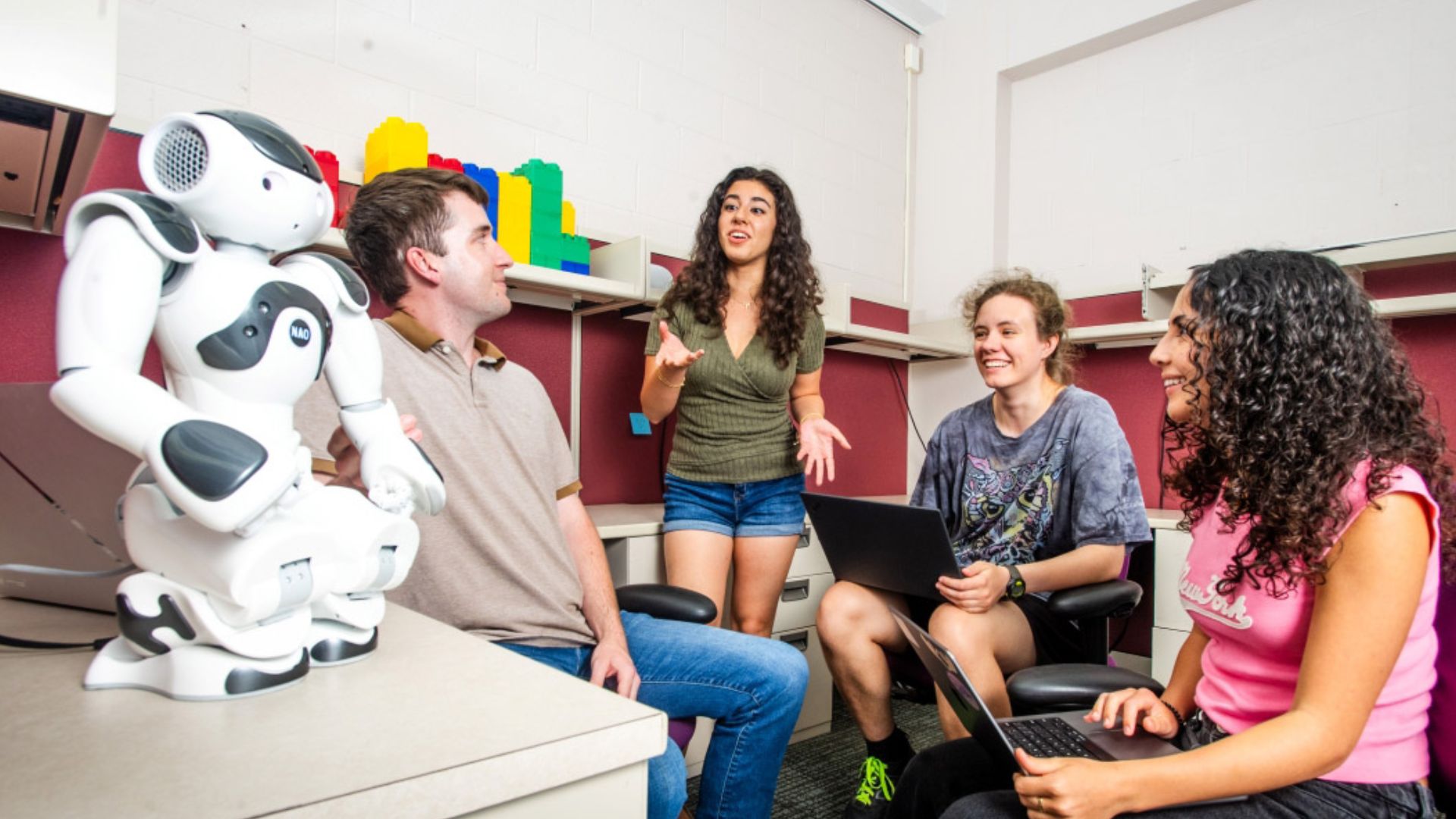
Rochester, New York – Students from colleges and universities across the United States are spending their summer at Rochester Institute of Technology, trading traditional vacation plans for laboratories, research meetings, and hands-on scientific discovery. Through the university’s nationally supported Research Experience for Undergraduates (REU) program, dozens of aspiring researchers are gaining practical experience while exploring questions that could shape the future of artificial intelligence, astronomy, mathematics, and human-centered technology.
This year, RIT is hosting four National Science Foundation-funded REU sites led by faculty members from the Golisano College of Computing and Information Sciences and the College of Science. The 2026 research themes include Computational Sensing for Human-centered AI, Trustworthy AI, Multimessenger Astrophysics, and Extremal Graph Theory and Dynamical Systems.
Altogether, 37 undergraduate participants are taking part in the summer programs. The group includes students from universities around the country as well as RIT undergraduates, all receiving financial support that covers housing, travel expenses, and a research stipend while they focus on their projects.
For many participants, the opportunity offers far more than a summer internship. It provides an introduction to the realities of academic research, where experiments rarely unfold exactly as expected and meaningful discoveries often emerge from persistence, collaboration, and curiosity.
One student embracing that challenge is Emily Taylor, a computer science major at Florida State University. Taylor arrived at RIT looking for a way to merge two personal interests—artificial intelligence and American Sign Language—and found a project that brings both together.
Taylor is part of a multidisciplinary research team investigating how generative AI and robotic technology might support deaf and hard-of-hearing individuals in classroom environments. The project combines expertise from several fields and reflects the increasingly collaborative nature of modern scientific research.
Working alongside Taylor are Hazal Sahin, a neuroscience student from the University of Pittsburgh, and Nickolas Slayter, an electrical engineering student at San Diego Miramar College. Together, they are designing and testing a robotic companion intended to improve situational awareness and encourage greater social inclusion for deaf and hard-of-hearing students during classroom activities.
The team is using a programmable humanoid robot known as Nao, capable of processing visual and auditory information while interacting with people through multiple communication methods.
As part of the study, participants will engage with the robot in a classroom setting while researchers observe how different forms of communication influence awareness and engagement. Rather than relying on a single notification method, the robot is being programmed to deliver a variety of interactive signals, including colored lights, pointing gestures, and tactile stomp vibrations.
Researchers will expose study participants to different classroom scenarios, including emergency alarms, someone calling their name, conversations related to the lesson, and unrelated background discussions. By comparing reactions across these situations, the team hopes to determine which communication methods users prefer and whether they develop trust in the robotic assistant.
The findings could eventually extend well beyond educational settings. Researchers believe similar systems might one day support accessibility in workplaces, manufacturing facilities, and other environments where awareness of surrounding events is essential.
“There’s no doubt about it—robots are going to be in our lives,” said Sahin. “It’s important to do research that looks at how they can be applied in beneficial ways for everyone.”
The project is also introducing the undergraduate researchers to an entirely new aspect of scientific work. For each member of the team, conducting research involving human participants is a first-time experience, adding another layer of learning beyond the technical challenges of programming and experimentation.
Inclusivity has remained a central focus throughout the research process. The students have spent time speaking directly with members of the deaf and hard-of-hearing community to better understand their experiences and ensure the technology reflects real-world needs rather than assumptions.
“We’ve been talking with many deaf and hard-of-hearing people and there have been times where technology was invented without them in mind,” said Slayter. “As technology like AI progresses, companies want to move forward as fast as possible. But it’s important to make sure that no populations are left behind.”
Graduate students from Gallaudet University, Joe Merino and Paige DeVries, are also contributing to the project, working alongside faculty mentors Jamison Heard, Cecilia Alm, and Reynold Bailey.
Read also: Monroe County launches community survey to support nonstop flights between Rochester and San Juan
For Bailey, who serves as principal investigator for the Computational Sensing for Human-centered AI REU site and is a professor in RIT’s Department of Computer Science, research education is about much more than producing technical results.
“Through research, students learn how to ask meaningful questions, navigate uncertainty, learn from unexpected results, and solve open-ended problems where there may not be a single correct answer,” said Reynold Bailey, principal investigator for the REU site in Computational Sensing for Human-centered AI and professor in the Department of Computer Science. “REUs also provide opportunities that many students may not have at their home institutions, exposing them to cutting-edge research, advanced facilities, and close mentorship from faculty and graduate students.”
That philosophy reflects the broader mission of the National Science Foundation’s REU program, which is designed to introduce undergraduate students to research while encouraging them to pursue graduate education and careers in science, technology, engineering, and mathematics. By helping students build research skills early in their academic careers, the initiative aims to strengthen the nation’s future STEM workforce.
The summer experience extends beyond laboratory work. Throughout the program, participants attend professional development sessions intended to prepare them for future research careers. Workshops cover topics such as grant writing and research communication, while question-and-answer sessions with professors provide insight into graduate school and academic life.
Students also participate in mentoring activities, visit industry partners, and take part in team-building events that allow them to connect outside the laboratory. One highlight of the summer includes a group trip to Niagara Falls, offering participants a chance to strengthen friendships formed during weeks of collaborative research.
Helping guide many of the students is Sophia Caruana, a cognitive science doctoral student at RIT and member of the university’s Computational Linguistics and Speech Processing Lab. Serving as a graduate research assistant, Caruana understands the experience from both perspectives.
Earlier in her academic journey, she participated in a summer REU at the University of Rochester, an opportunity that helped shape her own career path. Now, she hopes to develop as both a mentor and future faculty member while supporting this new generation of researchers.
“I hope the students take away something personal from this experience and learn how being a researcher reflects on who they are,” said Caruana. “These experiences in research are great for developing character and learning how to work hard and how to have patience.”
For many participants, the summer may represent only the beginning of their research careers. Previous REU students have continued developing their projects after returning to their home institutions, with some expanding their work into published papers and conference presentations.
This year’s cohort will conclude the program by presenting its findings during RIT’s 35th annual Undergraduate Research Symposium on July 30. The public event, held at the Student Hall of Exploration and Development, highlights research and creative projects completed by undergraduate students from across the university.
As students prepare to share months of work with faculty, peers, and visitors, the experience represents more than the completion of a summer project. It marks an important step toward becoming the next generation of scientists, engineers, and innovators—individuals learning not only how to answer difficult questions, but also how to ask the right ones in the first place.


-
 Local News2 years ago
Monroe County announces legal proceedings against properties listed in official public notice of foreclosure
-

 Local News2 years ago
New ALDI store close to Rochester to begin construction in late 2025 or early 2026
-

 Local News1 year ago
County Executive Adam Bello and members of the county legislature celebrate exceptional young leaders and advocates at the 2025 Monroe County Youth Awards
-
 Local News1 year ago
The 2025 Public Market Food Truck Rodeo series will begin this Wednesday with live music by the Royal Bromleys