Local News
Rochester 2034 Report highlights community vision driving City investments

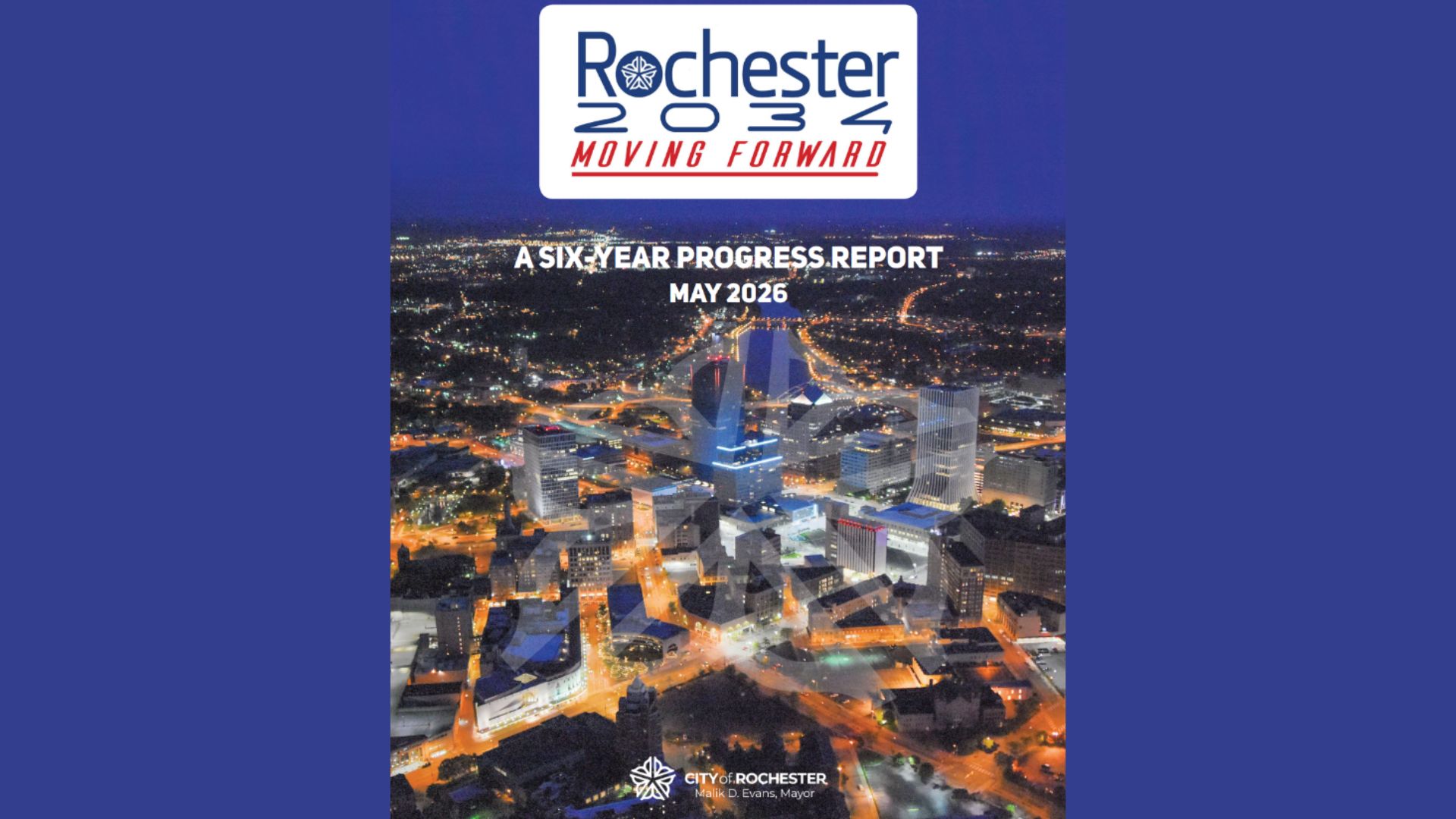
Rochester, New York – The City of Rochester has released its latest Rochester 2034 Progress Report, offering a detailed look at how long-term planning is shaping real changes across neighborhoods, infrastructure, and public life. The update reflects six years of implementation of the city’s comprehensive vision plan and shows steady movement on a wide range of goals set nearly a decade ago.
Adopted in 2019 after extensive public engagement, Rochester 2034 was built as a flexible roadmap meant to guide development through the city’s 200th anniversary in 2034. Rather than acting as a static policy document, it was designed to evolve with the city’s needs, helping leaders align investments with what residents identified as priorities during years of community input.
City officials say the plan is now deeply embedded in how decisions are made. According to the report, work has officially started on all 88 goals outlined in Rochester 2034, while 504 of its 630 strategies are already underway. That level of progress is being highlighted as evidence that the plan is not just aspirational, but actively shaping day-to-day governance.
“Rochester 2034 continues to serve as our roadmap for building a more equitable, vibrant, and resilient city,” said Malik D. Evans. “This report demonstrates how the community’s vision is directly shaping investments in neighborhoods, housing, infrastructure, arts and culture, and quality of life across Rochester.”
Read also: Edison Tech students build mosaic mural honoring Supreme Court Justice
A major focus of the report is how physical spaces in the city are changing. One of the most visible examples is the completion of Austin Steward Plaza, a $20 million ROC the Riverway project that transformed the former Charles Carroll Plaza into a major public gathering space along the Genesee River. The redevelopment is presented as part of a broader effort to reconnect residents with the waterfront while strengthening downtown activity.
Environmental improvements are also highlighted. The City’s Tree Expansion Initiative has already surpassed its original target of planting 6,000 new trees by 2025. Officials say this effort is helping improve neighborhood shade, air quality, and overall livability while also strengthening Rochester’s long-term climate resilience.
Housing and neighborhood investment remain another central theme. Programs like Buy the Block, along with other mixed-income housing developments, are expanding opportunities for homeownership. The approach is intended to stabilize neighborhoods, encourage long-term investment, and create more pathways for residents to build equity in the communities where they live.
Transportation planning is also evolving under the same framework. The city has expanded its bicycle infrastructure through protected lanes, multi-use trails, and planning for a 63-mile “bike spine” network. These projects are part of a larger push to support active transportation, reduce car dependency, and improve connections between neighborhoods.
Arts and culture investments are growing as well. The ArtsBloom funding program, a new online map tracking public art installations, and the development of a joint Arts & Culture Plan for both the city and county all point to a stronger institutional focus on creative development. Officials describe these efforts as part of building a more vibrant public environment where art is visible and accessible.
Planning policy is another area of major change. A new zoning code and updated map, expected for adoption later this year, was developed with direct guidance from Rochester 2034. The updated framework is designed to simplify land use rules and better match future development with community goals.
Read also: More than 200 students compete in Rochester math event
Grassroots involvement is also being strengthened through the Neighbors In Action (NIA) program. It provides funding to local groups for small-scale, community-led projects such as public art, beautification, park upgrades, and streetscape improvements. The idea is to give residents more direct influence over the spaces they use every day.
Libraries and public facilities are also part of the progress narrative. Recent investments include the reopening and expansion of the Maplewood Library Branch and restoration work on the Rundell Library facade and exterior windows. These projects are presented as part of a broader effort to maintain neighborhood anchors and improve access to public resources.
The report also highlights financial alignment between federal support and long-term planning. It details how $202.1 million in American Rescue Plan Act funding was directed toward initiatives consistent with Rochester 2034 goals. City officials say this alignment helped ensure that short-term recovery funds also contributed to long-term development strategies.
Taken together, the report paints a picture of a city steadily building toward its 2034 vision. While challenges remain, officials emphasize that the framework created in 2019 continues to guide decisions in housing, infrastructure, environment, and community development—turning long-term planning into visible, on-the-ground change.


-
 Local News2 years ago
Monroe County announces legal proceedings against properties listed in official public notice of foreclosure
-

 Local News2 years ago
New ALDI store close to Rochester to begin construction in late 2025 or early 2026
-

 Local News2 years ago
County Executive Adam Bello and members of the county legislature celebrate exceptional young leaders and advocates at the 2025 Monroe County Youth Awards
-
 Local News1 year ago
The 2025 Public Market Food Truck Rodeo series will begin this Wednesday with live music by the Royal Bromleys