Local News
Imaging science Ph.D. student develops new method to protect historic photographs from chemical deterioration

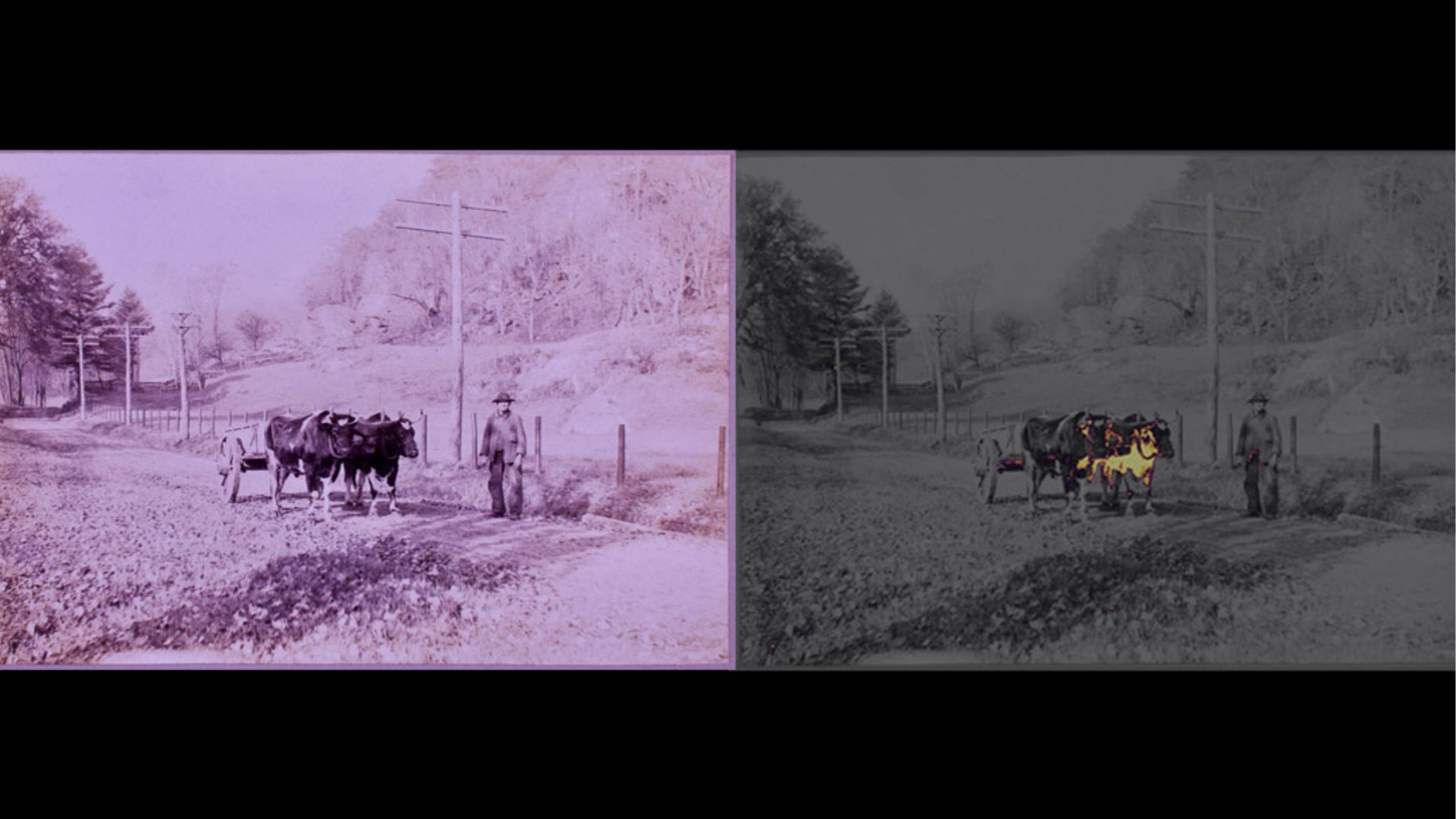
Rochester, New York – In a quiet lab filled with old photographs and specialized imaging equipment, a doctoral student is working on a problem that has troubled archivists and conservators for generations. Diane Knauf, a Ph.D. candidate in imaging science, is developing a new way to better understand and track a common form of deterioration that affects historic black-and-white photographs. Her work, supported by a grant from the National Park Service, is opening fresh possibilities for preserving fragile visual records from the past.
The issue she is studying is known as silver mirroring, a chemical process that gradually damages older photographic prints. This form of deterioration occurs in silver gelatin photographs, which were widely used from the late 19th century until the mid-20th century. Over time, silver particles inside the print migrate toward the surface, forming a shiny, metallic layer that can distort or obscure the original image.
For museums, archives, and historical collections, silver mirroring is a persistent challenge. It does not just change how photographs look; it also signals chemical instability that can worsen if conditions such as humidity or storage environments are not properly controlled. Yet despite its importance, consistently measuring where and how much silver mirroring is present has long been difficult.
Knauf’s research focuses on solving that problem through the use of polarized light. By carefully positioning linear polarization filters on both a light source and a camera, she can capture images that reveal subtle changes invisible to the human eye. These specialized images allow her to calculate and map exactly where silver mirroring appears across a photograph’s surface.
“What I am doing is trying to set up a protocol to image photographs that have silver mirroring so you can document where the silver mirroring is and get a percent surface coverage of the silver mirroring on the photograph,” explained Knauf. “It helps document the condition of the object so it can be known and maintained, and you can know if the condition is changing because of the storage conditions and such.”
Her approach aims to provide something that conservators have lacked for years—a consistent, repeatable way to measure the damage and monitor its progression over time. Instead of relying solely on visual inspection, experts could use precise data to track whether conservation efforts are working or if environmental conditions need adjustment.
Knauf’s academic path uniquely prepared her for this work. She first earned a bachelor’s degree in chemistry, followed by a master’s degree in art conservation. That combination gave her both scientific expertise and an understanding of cultural heritage preservation. When she later joined the imaging science doctoral program at Rochester Institute of Technology, she saw an opportunity to connect those two worlds in a practical way.
The imaging science Ph.D. program itself has a long history. Established in 1989, it is the oldest doctoral program at RIT and was the first of its kind in the United States. Over the years, it has produced research spanning fields such as medical imaging, remote sensing, and digital preservation.
For Knauf, the spark that led to her current research came from an unexpected place—a class assignment. While studying human vision, she explored how animals and insects perceive polarized light. That project led her to wonder whether similar principles could reveal hidden information in works of art or historical objects.
Later, when she was required to prepare a grant proposal for a seminar course, she decided to submit her idea for real funding opportunities. The result was support from the National Park Service, which enabled her to pursue the research beyond the classroom.
A key partner in her work is RIT’s Image Permanence Institute, which provides access to historic photographic materials. These resources allow her to test and refine her imaging techniques on real examples of aged prints, giving her research practical relevance for conservators in the field.
“Knowing where the silver mirroring is is important and knowing how it’s progressing is important,” said Knauf. “And there’s not really a good and consistent way to do that. This gives a quantified number that you compare over time. That’s the hope, that it can be used by conservators for that purpose.”
As her research continues, its potential impact extends far beyond a single laboratory. Historic photographs document everything from family histories to national events, making them vital cultural records. By improving how deterioration is measured and monitored, Knauf’s work could help institutions better protect these visual memories for future generations.
In the end, her project represents more than a technical achievement. It is also a reminder that science and history often intersect in unexpected ways—sometimes through a beam of polarized light shining gently across the surface of a fading photograph.


-

 Local News12 months ago
New ALDI store close to Rochester to begin construction in late 2025 or early 2026
-

 Local News12 months ago
Rochester Lilac Festival announces exciting 127th edition headliners
-

 Local News10 months ago
County Executive Adam Bello and members of the county legislature celebrate exceptional young leaders and advocates at the 2025 Monroe County Youth Awards
-

 Local News10 months ago
The 2025 Public Market Food Truck Rodeo series will begin this Wednesday with live music by the Royal Bromleys