Local News
RIT freshman imaging project gives first-year students hands-on experience with real-world innovation

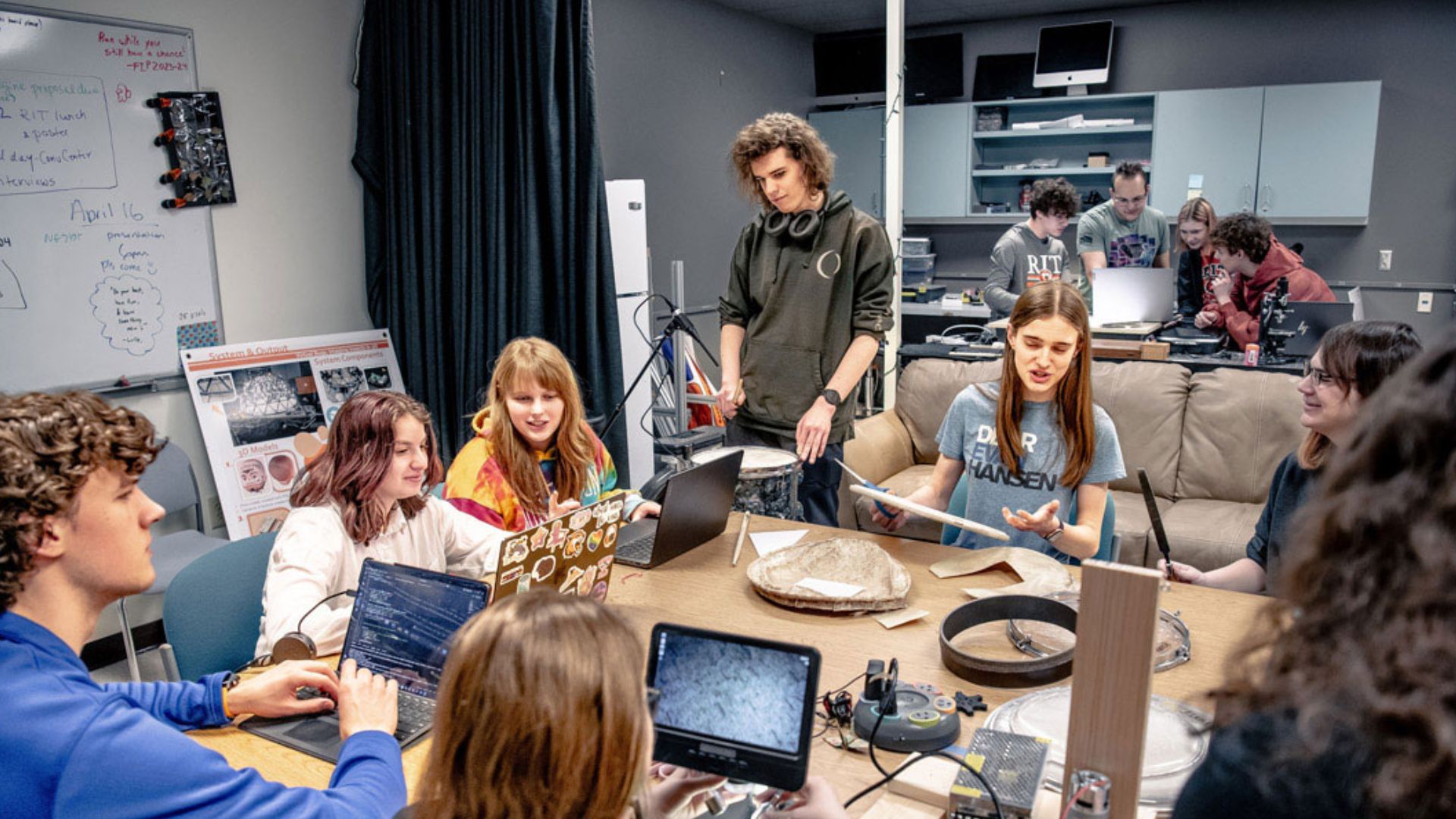
Rochester, New York – At Rochester Institute of Technology, students do not have to wait until the later years of college to begin working on challenging technical projects. For first-year students in imaging science and motion picture science, the learning experience starts almost immediately through the university’s Freshman Imaging Project.
The course, offered through RIT’s Chester F. Carlson Center for Imaging Science, gives new students the chance to move beyond traditional classroom lessons and work directly on an advanced imaging system. They research a problem, develop an idea, design a solution and build a working system.
The projects can be very different from one year to the next. Previous students have worked on technology designed to uncover hidden writing in historical documents and systems capable of examining the characteristics of strawberries. Although the subjects vary, the goal remains much the same — introduce students to imaging by giving them a real problem to solve.
Imaging science itself brings together several areas of technology and science. The field combines computer science, engineering and physics to study how images are created, how people perceive them and how images can be analyzed.
For RIT, that combination of disciplines has made hands-on learning an important part of the student experience for decades. The freshman project is designed to encourage students to think creatively, work with others and learn how to approach problems that do not necessarily have an obvious answer.
That early experience has also had a lasting effect on some graduates.
One example is Ricardo Motta ’91 BS/MS in imaging science. His career has taken him through some of the most important developments in digital imaging, but he traces part of that journey back to his first year at RIT.
Motta grew up in Brazil and had been working in the film industry after leaving engineering school. He was already building a career in filmmaking when he became increasingly interested in the science behind the images he was creating.
“I was pursuing filmmaking, I had a great job, I was up-and-coming,” said Motta, “but I became really interested in understanding all about light, the numbers, the optics, lenses, image quality, and sensitometry. I decided I had to learn that and, at age 22, to be a student again. I was very lucky that RIT accepted me.”
Starting college was not necessarily simple. Motta was adapting to life in a new academic environment while also improving his English, which was his third language. He soon became involved in a freshman project focused on photochemistry.
His work involved designing a single-step film development process known as a monobath. The project required research and experimentation, and Motta quickly discovered how much more there was to learn.
Rather than discouraging him, the challenge became part of what made the experience valuable.
A few years later, Motta continued his studies and took part in Franc Grum’s first color science class at RIT. Grum had helped establish the Munsell Color Laboratory and RIT’s color science program in 1983. RIT continues to offer graduate degrees in color science, a field closely connected to imaging.
Motta eventually presented his master’s research on CRT colorimetry, a project that brought together imaging and color science. Presenting the work at conferences also gave him an opportunity to meet professionals from the industry.
Those contacts helped open the door to his next major step.
In 1987, Motta joined Hewlett Packard Laboratories in California. He became part of a team working on technology that contributed to the development of ink-jet printing. His work included digital halftoning and image processing for some of the company’s early consumer color printers.
His career continued to expand over the following years. After more than a decade with Hewlett Packard, Motta became the company’s chief imaging architect as HP developed into a major force in imaging technology.
His earlier research also had a broader impact. His thesis work eventually evolved into sRGB, a color image standard that became widely used by computers and across the internet.
Motta later founded Pixim, a startup focused on CMOS image sensors. He subsequently worked as a distinguished engineer at Apple, NVIDIA and Google. Over the course of his career, he has received more than 60 patents and has worked on technologies including the LED flash used in phones and camera technology positioned behind displays.
Today, he is working independently on machine perception for robots.
Despite the scale of his career, Motta points back to something much earlier in his education when discussing what helped shape him as a student.
“The freshman project was what made me a better student,” said Motta. “The ability to do a project, guided by deeply knowledgeable people, having the right equipment, even as a freshman, was great. People see images, but they don’t know how they are created. Going hands-on is a great opportunity to learn that.”
The current class is continuing that tradition with a project inspired by soccer and the World Cup. This year’s students are studying sideline imaging systems used during soccer matches.
The project gives students an opportunity to investigate imaging technology in a setting that connects directly with sports. They are also working with RIT’s soccer programs as part of the effort.
Karen Braun ’96 Ph.D. in imaging science, associate director of the Chester F. Carlson Center for Imaging Science, has taught the Freshman Imaging Project since 2019. This year, she is joined by co-instructor Ricardo Figueroa, director of RIT’s School of Film and Animation.
The students are also collaborating with members of RIT’s soccer programs, including men’s soccer head coach Bill Garno ’88 and women’s soccer assistant coach Monica Cook ’10 BS, ’14 Ph.D. in imaging science.
The collaboration adds another practical dimension to a course already centered on solving a real-world problem. Students can consider the technical requirements of imaging systems while also learning how those systems are used in an actual sporting environment.
Braun’s own history at RIT also reflects the university’s long connection with imaging education. She was the first woman to earn a Ph.D. in RIT’s history.
RIT says its imaging science program was the first of its kind in the United States and remains the only formal imaging science program in the nation. The Chester F. Carlson Center for Imaging Science continues to bring together research and education in an area where technology, science and visual information overlap.
For students entering the program, the Freshman Imaging Project provides an early introduction to that world. Instead of simply studying concepts and waiting to apply them later, they are asked to investigate, build and test ideas while they are still learning the fundamentals.
That approach can make the first year of college feel less like preparation for future work and more like the beginning of it. For graduates such as Motta, the experience can become an important first step toward a much longer career in imaging and innovation.


-
 Local News1 year ago
Monroe County announces legal proceedings against properties listed in official public notice of foreclosure
-

 Local News2 years ago
New ALDI store close to Rochester to begin construction in late 2025 or early 2026
-

 Local News1 year ago
County Executive Adam Bello and members of the county legislature celebrate exceptional young leaders and advocates at the 2025 Monroe County Youth Awards
-

 Local News1 year ago
The 2025 Public Market Food Truck Rodeo series will begin this Wednesday with live music by the Royal Bromleys