Local News
RIT startup program teaches founders that listening to customers is the first step toward building successful businesses

Rochester, New York – Many first-time entrepreneurs believe the hardest part of launching a business is designing a product or finding investors. At Rochester Institute of Technology, however, students in a unique summer startup program are learning that success often begins much earlier—with asking questions, listening carefully, and understanding the real problems people face before trying to solve them.
That philosophy sits at the center of the Bernard Kozel StartUp Program @ Saunders, a 12-week summer experience that challenges students to step away from sales pitches and instead focus on customer discovery. Rather than rushing to showcase their ideas, participants spend weeks talking with potential users, gathering feedback, and uncovering the challenges that exist before shaping their products.
The approach may sound simple, but it requires discipline. Students are encouraged to avoid leading conversations toward their own inventions. Instead, they spend time exploring the daily frustrations and unmet needs of the people they hope to serve. Program leaders believe that those conversations often reveal insights that no amount of brainstorming in a classroom can provide.
“Every viable business starts with relentless customer discovery,” said program director Anthony Testa. “If you don’t fully understand the problem, you cannot build the solution.”
Now in its 24th cohort, the Bernard Kozel StartUp Program @ Saunders welcomes students from across the university, regardless of their academic discipline. Organized through Saunders College of Business, the immersive program allows participants to work full time on their ventures throughout the summer while receiving an honorarium. Teams also attend coaching sessions twice each week, hear from guest speakers with entrepreneurial experience, and conclude the program by presenting their ventures during a demonstration event at the Student Hall for Exploration and Development (SHED).
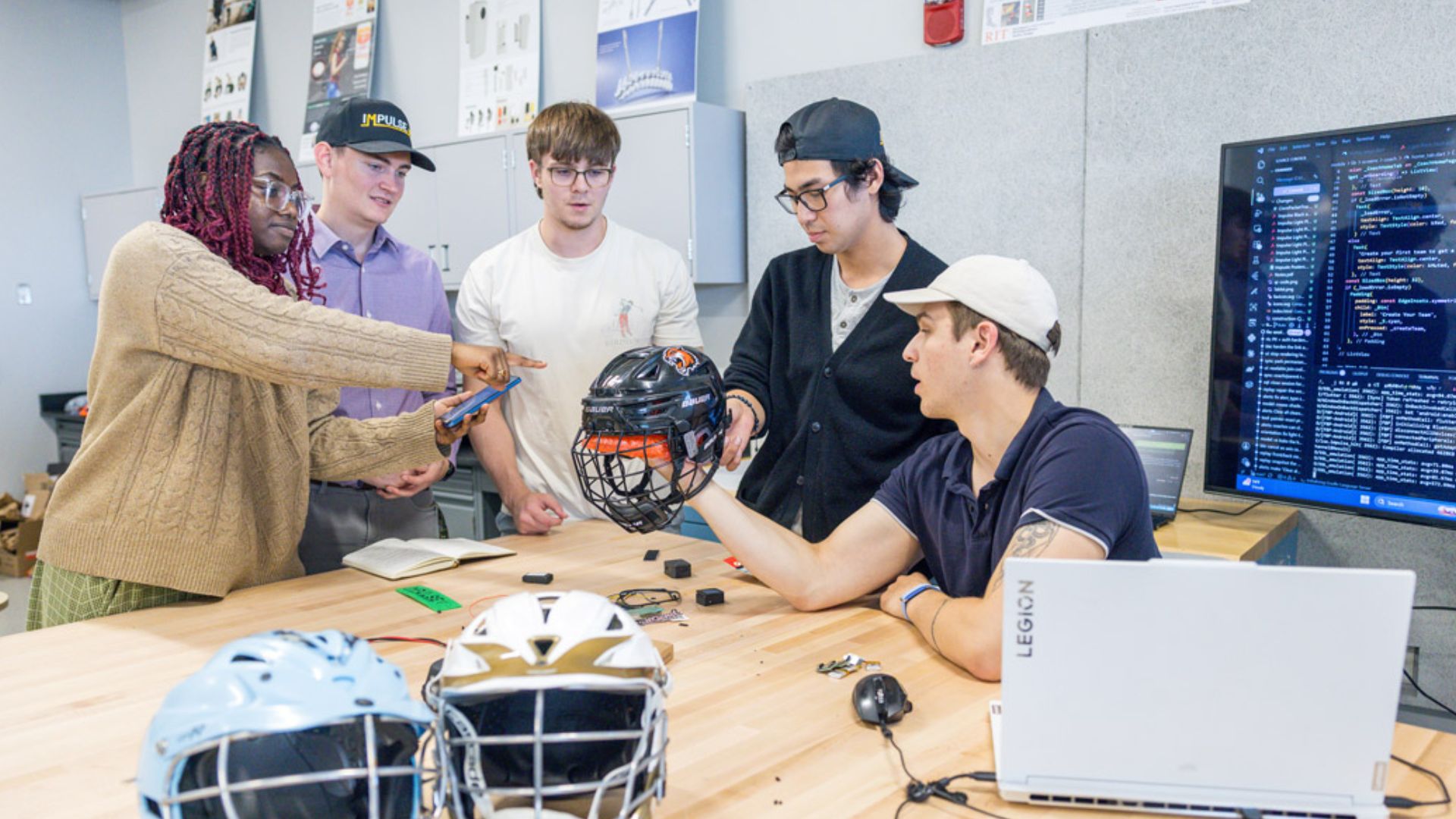
One team that embraced the customer-first mindset is Impulse, a startup developing a compact wearable sensor that monitors head impacts in sports. The device, which is smaller than an AirPods case, attaches to virtually any athletic helmet, tracks impacts in real time, and can notify coaches and athletic trainers on the sidelines when a collision reaches a potentially dangerous level.
Before refining the technology, however, the team spent much of the summer speaking with coaches, athletic trainers, and parents of young athletes. Surprisingly, many of those conversations barely mentioned the product itself. Instead, team members concentrated on learning how people currently deal with head injuries, the difficulties they encounter, and what they wish existing solutions could do better.
Impulse founder Luca Chiossone ’26, a mechanical engineering student in an individualized program, admitted that resisting the urge to showcase the technology was one of the most valuable lessons of the experience.
“When you’re working on something cool and technical, of course you want to talk about it,” said Chiossone. “But learning to just listen is something I take away a lot from this experience.”
That shift in thinking helped the team make several adjustments as they gathered more information from prospective users.
“We’ve done a few mini-pivots and really refined our scope,” added Dillon Gallo, a fifth-year finance co-op student. “We’re wasting less time because of how much they made us prioritize interviews.”
Impulse also includes Eric Choi ’26, a computer science student, along with fourth-year students Nick Velasquez, who is enrolled in an individualized program, and Vivienne Quarshie, who studies management information systems.
Another startup participating in this year’s cohort is Guardivo, a company focused on helping artists protect their work from unauthorized use across the internet. The team consists of third-year computer science students Ekam Ghai and Colin Rills, fourth-year human-centered computing student Dan Weil, and Austin Schmidt, a 2026 graduate in global business management.
Guardivo’s platform scans the web for stolen or duplicated artwork and allows artists to issue takedown notices with a single click. Yet, just like the Impulse team, the founders discovered through extensive conversations that their original concept needed significant refinement.
Early versions of the platform presented users with an overwhelming collection of search results. Feedback from hundreds of discussions with artists revealed that professionals wanted a clearer way to separate harmless fan reposts from businesses selling counterfeit merchandise. In response, the team redesigned the experience, creating a filterable dashboard that made the information far easier to navigate.
“Instead of throwing every piece of information at someone, they’re able to filter it—we implemented that pretty quickly once we heard it,” Rills said. “We were like, obviously that makes sense. We just didn’t think of it beforehand.”
For Ghai, repeatedly digging deeper during conversations proved equally valuable.
“Sometimes asking ‘why’ 15 different times sounds annoying,” added Ghai. “But in reality, that’s where you get the majority of answers you never realized.”
The learning environment inside the Kozel program extends well beyond customer interviews. Students regularly critique one another’s presentations, exchange ideas, and even connect fellow participants with interview contacts who might better fit another team’s business. Alumni from Rochester Institute of Technology and graduates from previous Kozel cohorts also return to mentor participants, offering guidance based on their own startup journeys.
That collaborative atmosphere has become one of the defining characteristics of the program, encouraging founders to celebrate each other’s progress instead of viewing every venture as competition.
“We’re not out for only ourselves,” said Choi. “We see the potential and the growth of the other companies as well, and that inspires all of us to keep giving feedback to each other.”
The startup program also fits into a broader entrepreneurial network across the university. Guardivo first came together during a hackathon hosted by RIT’s MAGIC Spell Studios before joining the summer accelerator, while Impulse originated as a capstone project and is set to continue development through the university’s Gap Year Fellowship. Student companies that progress further can also receive support through Venture Creations, RIT’s incubator for early- and mid-seed startups.
With applications already being accepted on a rolling basis for the program’s 25th cohort in the summer of 2027, university leaders hope more aspiring entrepreneurs will embrace the same lesson that this year’s participants discovered: innovative technology may capture attention, but lasting businesses are built by first understanding the people they are meant to serve.


-

 Local News1 year ago
Monroe County announces legal proceedings against properties listed in official public notice of foreclosure
-

 Local News2 years ago
New ALDI store close to Rochester to begin construction in late 2025 or early 2026
-

 Local News1 year ago
County Executive Adam Bello and members of the county legislature celebrate exceptional young leaders and advocates at the 2025 Monroe County Youth Awards
-

 Local News1 year ago
The 2025 Public Market Food Truck Rodeo series will begin this Wednesday with live music by the Royal Bromleys