Local News
RIT students help transform Floating Garden into a one-of-a-kind public space on the Erie Canal

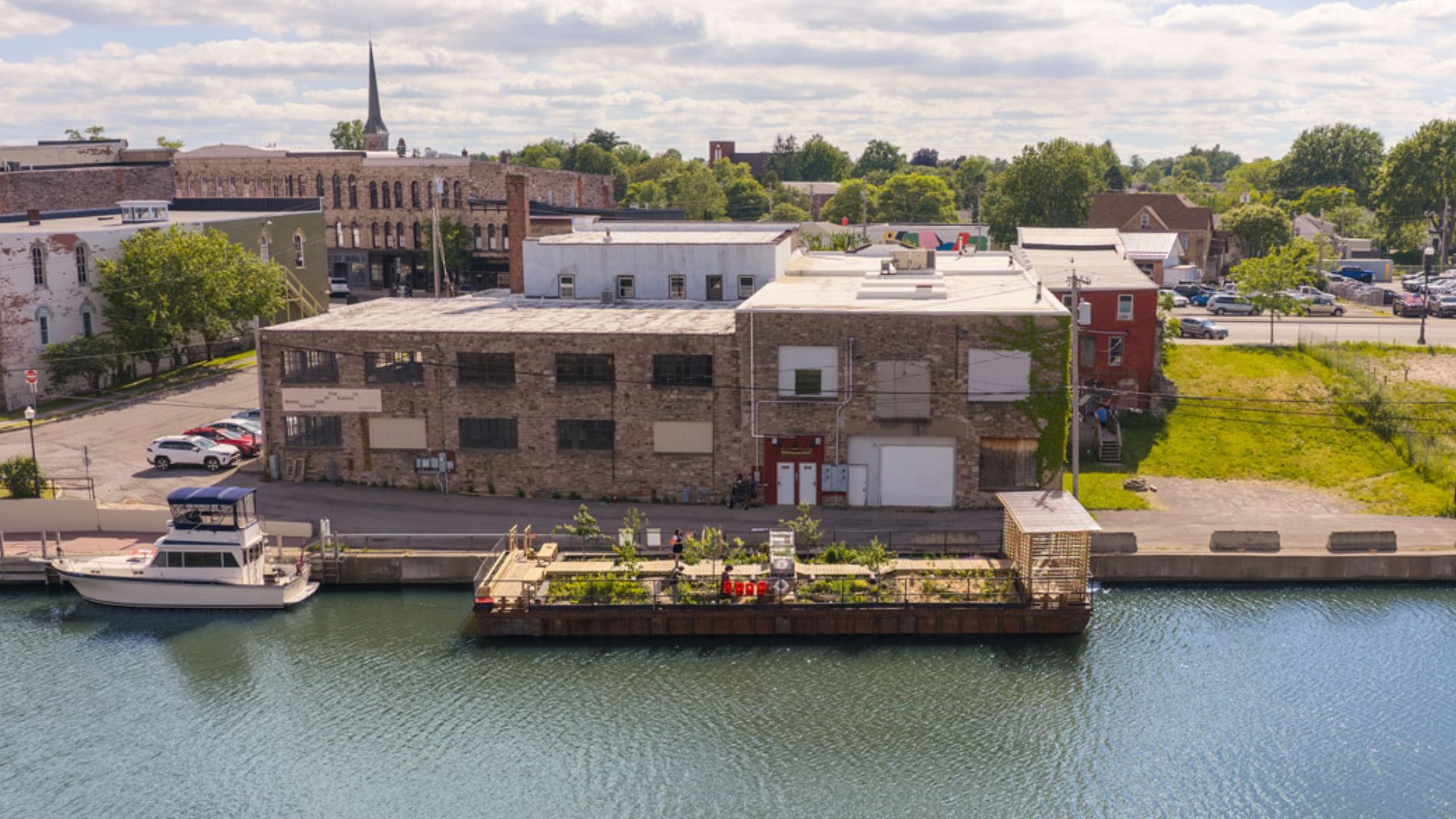
Rochester, New York – A floating food forest now traveling New York’s historic waterways is doing more than drawing attention for its striking appearance. It is also showcasing how art, architecture and sustainability can come together through collaboration, with students from Rochester Institute of Technology helping transform an ambitious idea into a functioning public space.
The project, known as Floating Garden, officially debuted on June 6 as part of the inaugural Medina Triennial – All That Sustains Us. Conceived by New York interdisciplinary artist Mary Mattingly, the floating installation serves as a living symbol of food sovereignty while inviting visitors to rethink how waterways can become places for gathering, learning and growing food.
The installation will remain in Medina through the fall before beginning a journey along the Erie Canal and the Hudson River, eventually making its way to New York City. Alongside the thriving food forest is a specially designed gathering area called the Floating Pavilion, a structure that became the focus of an extensive student-led effort at RIT.
Students from multiple academic disciplines worked together to design and build the pavilion, bringing expertise from architecture, engineering and sustainability into a single project. Rather than limiting participation to one department, the initiative encouraged students with different backgrounds and technical skills to solve problems together.
The effort was led by Amanda Reis, former professor at RIT’s Golisano Institute for Sustainability, who organized the project as an open workshop intended to mirror the collaborative nature of real-world design and construction.
“Having more opportunities for student overlap is really essential in any discipline that is by nature very collaborative,” Reis said. “No project happens individually.”
That philosophy shaped nearly every stage of the work. Students first met in February to fabricate many of the pavilion’s components inside RIT’s SHED, where sections of the structure were carefully prepared before being transported to Medina several months later.
Once on site in May, however, the project entered a completely different phase. What had looked straightforward inside a controlled workshop quickly became far more complicated when construction shifted onto the surface of an aging barge floating on the Erie Canal.
Unlike a traditional building site, the work platform was constantly shifting. The metal deck beneath the crew was uneven after years of service, and every movement of the water introduced another challenge. Pieces that fit perfectly in the workshop often required adjustments before they could be installed.
Students also incorporated leftover materials from an earlier project known as the Peace Pavilion, demonstrating how recycled resources could become part of a new public installation instead of being discarded.
Mattingly praised both the design and the teamwork that made the pavilion possible, noting that Reis played a central role throughout the process.
“Amanda not only designed the pavilion but worked with her student team to realize it on site, amidst all of the complications of working on the water,” she said. “She brings rigor, pragmatic intellect, and fun into the process—it would not have been the same without her.”
Those complications were impossible to ignore once construction began.
“That barge was constantly moving,” said architecture alumnus Youngjin Yi ’26. “We went through a lot of troubleshooting as to how we could level the build.”
Every stage required creative thinking. Workers had to adapt construction techniques normally used on solid ground while dealing with changing weather conditions and a structure that refused to stay perfectly still.
Additional expertise arrived from another corner of campus when members of RIT’s American Welding Society student chapter joined the effort. Their involvement began almost by chance after Reis visited the group’s booth during a university fundraiser.
The welding students quickly discovered that working outdoors on an old floating vessel bore little resemblance to the controlled conditions inside their campus workshop.
Even powering their equipment required an unconventional solution. Since no standard electrical supply was available on the barge, the team assembled a custom adapter connected to a generator to operate their welding equipment safely throughout the build.
“You hear that prep work is about 95% of your time and welding is only 5%,” said Sammy Surcel-Debes, a third-year mechanical engineering student. “In our shop, it was more like 50/50.”
Graduate students Youngjin Yi, Gil Merod and Mackendra “Macky” Nobes also served as project assistants, helping guide design decisions while supporting construction from start to finish.
For many participants, the project became far more than another assignment. It offered an opportunity to contribute to something that would remain accessible to communities long after construction ended.
“Projects like the Floating Garden and Pavilion excite me about the future of art and architecture; projects that demonstrate how creative sparks can foster social connections and new traditions,” said Nobes. “Having the opportunity as a student to work with a multidisciplinary team to help provide communities with a unique, interactive public experience has been invaluable.”
Merod said the experience broadened his understanding of what architecture can accomplish when paired with a larger social purpose.
“Working on the Floating Pavilion has shown me how architecture can extend beyond design and become a platform for social impact,” added Merod. “Mary Mattingly’s Floating Garden highlights the importance of access to fresh food in urban environments, and this project translates that mission into a shared spatial experience.”
The project also reflects RIT’s long-standing emphasis on hands-on learning. Students were able to move beyond classroom theory by tackling real engineering, fabrication and construction challenges under professional guidance. Experiences like these have helped shape the university’s reputation for innovation and practical education, where students regularly apply academic knowledge to projects with lasting community impact.
At its core, the Floating Garden builds upon nearly ten years of work connected to Swale, a mobile, community-driven initiative focused on expanding food access while reimagining New York’s waterways as public spaces that support environmental stewardship and economic justice.
Rather than functioning solely as an art installation, the Floating Garden serves as a conversation about sustainability, food security and shared public space. Visitors are invited not only to observe the floating landscape but also to consider how urban waterways might support healthier, more connected communities.
As the barge prepares to continue its journey from Medina through the Erie Canal and eventually down the Hudson River to New York City, it carries with it more than plants and architectural structures. It also represents months of collaborative work by students, educators and artists who transformed an ambitious vision into a traveling public space that blends creativity, education and environmental awareness into a single floating destination.


-
 Local News2 years ago
Monroe County announces legal proceedings against properties listed in official public notice of foreclosure
-

 Local News2 years ago
New ALDI store close to Rochester to begin construction in late 2025 or early 2026
-

 Local News1 year ago
County Executive Adam Bello and members of the county legislature celebrate exceptional young leaders and advocates at the 2025 Monroe County Youth Awards
-
 Local News1 year ago
The 2025 Public Market Food Truck Rodeo series will begin this Wednesday with live music by the Royal Bromleys