Local News
Mohammed Al Zarooni discusses how integrated economic zones are shaping global trade, investment, and long term economic development strategies across regions

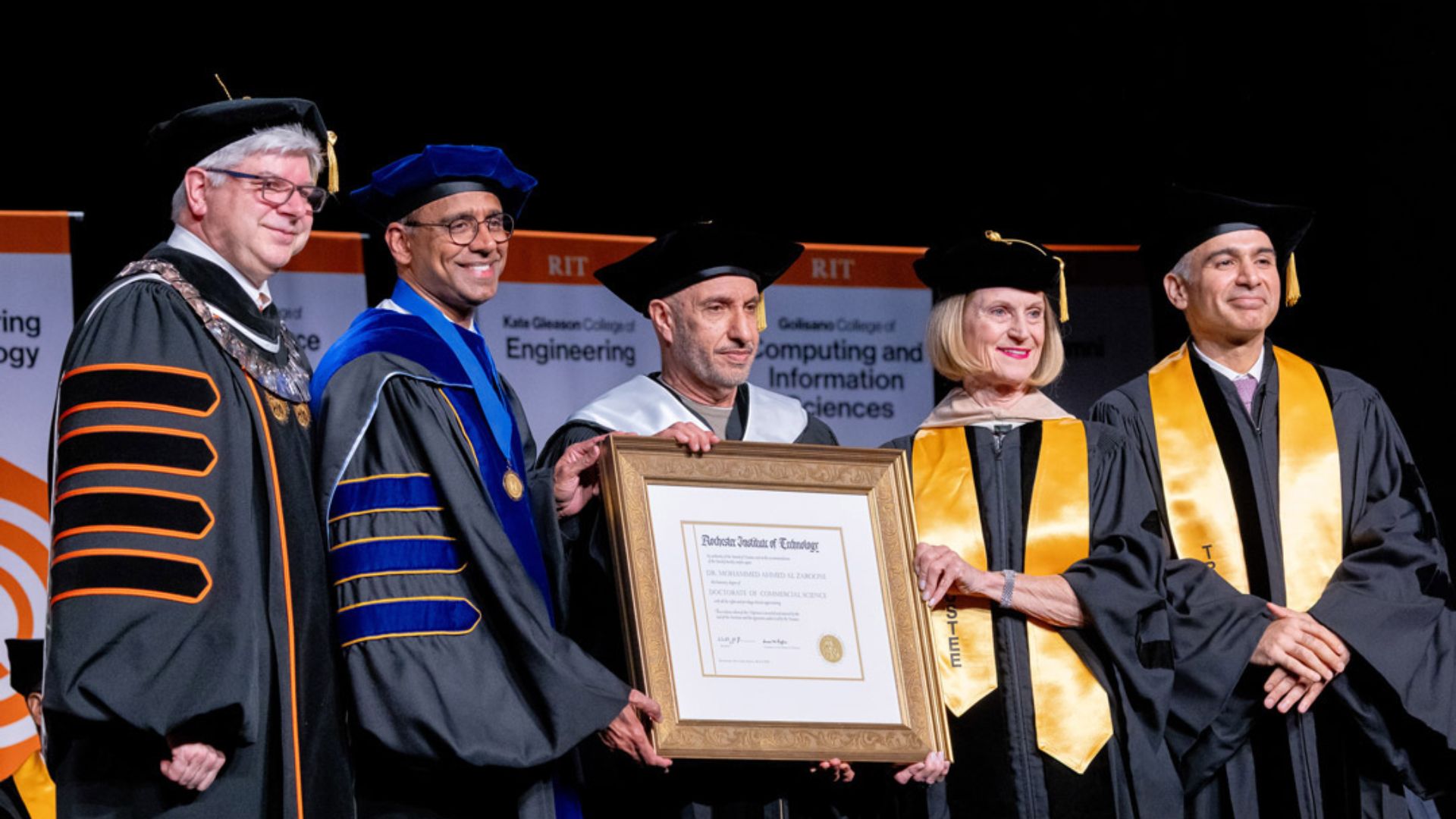
Rochester, New York – In a rapidly changing global economy, where innovation, trade, and education are increasingly interconnected, some leaders stand out for shaping how these forces come together. One of them is Mohammed Al Zarooni, who was recently awarded an Honorary Doctorate of Commercial Science during the 2026 Academic Convocation at Rochester Institute of Technology on May 8.
Al Zarooni is widely recognized as one of the leading figures in the development of free zones and integrated economic zones, particularly in the Gulf region. He also holds senior positions across several organizations and boards, including his role as executive chairman of the Dubai Integrated Economic Zones Authority and as a member of the board of RIT Dubai. His work sits at the intersection of policy, business development, and long-term economic strategy.
During his conversation following the honorary degree recognition, Al Zarooni reflected on how free trade and economic zones have evolved into powerful engines of growth across multiple regions of the world. His perspective is not limited to the Gulf alone. He described these zones as global tools that help reshape how economies attract investment and develop industries.
“In fact, the concept of free trade zones and economic zones have proven to be powerful enablers of economic growth across the world, not only in the Gulf region, but in advanced emerging economies alike, including the United States. They serve as strategic platforms to facilitate trade, attract foreign investments and foster innovation.”
That idea forms the foundation of his broader economic vision. In Dubai, he explained, the free zone model has already played a central role in strengthening the emirate’s position as a global hub for trade, investment, and innovation. It is not a static system. It is an evolving framework that continues to adapt as global markets shift.
He emphasized that the Dubai Integrated Economic Zones Authority operates through a unified structure that connects three major zones: Dubai Airport Freezone, Dubai Silicon Oasis, and Dubai CommerCity. Each of these zones serves a different purpose, but together they form a coordinated ecosystem designed to support growth across industries.
Dubai Airport Freezone acts as a global gateway for trade and logistics. Dubai Silicon Oasis focuses on innovation, knowledge, and advanced technologies. Dubai CommerCity is designed as a dedicated platform for digital commerce. While each zone has its own identity, their integration allows them to function as one connected system.
“Together these zones form an integrated ecosystem that enhances value chain connectivity, supports high-growth sectors, and offers investors a seamless, business-friendly environment driven by smart services and progressive regulatory frameworks.”
This interconnected structure also extends into education, particularly through Dubai Silicon Oasis, which is home to RIT Dubai. Al Zarooni noted that this connection between academia and industry is a key element of the region’s long-term development strategy. It helps ensure that education is aligned with real-world needs, especially in fast-growing digital sectors.
“Dubai Silicon Oasis is also home to RIT Dubai, where I serve on the Board of Directors. This creates a strong link between academia and industry, enabling us to align academic outcomes with real market needs and develop a future ready talent pipeline that supports the digital economy.”
From his perspective, the strength of Dubai’s economic model lies not only in infrastructure or regulation, but in integration itself. By bringing together investment systems, governance structures, industry platforms, and education, the emirate builds a more flexible and competitive economic environment.
“Ultimately, this model of integration, which brings together infrastructure, investments, regulation, and education is what helps make Dubai’s economic competitiveness, drives diversification, and positions the emirate as a leading benchmark for sustainable growth across the UAE and the wider region.”
A key part of that ecosystem is Dubai Silicon Oasis, which has developed into a fully integrated technology district. Unlike traditional technology hubs that focus primarily on business activity, this model blends innovation with daily life, creating an environment where work, research, and living coexist.
Al Zarooni explained that this design is intentional. The goal is not only to attract companies, but to create conditions where collaboration happens naturally across different sectors and institutions. Strategic partnerships play a central role in that process.
“Dubai Silicon Oasis, a member of Dubai Integrated Economic Zones Authority, is distinctive because it operates as a fully integrated district, where innovation is not confined to business activity alone, but embedded across the entire environment—from research and development to everyday living.”
He highlighted the importance of partnerships with global technology companies, startups, and innovation centers, all of which contribute to a system where ideas can move from concept to market more efficiently. Academic institutions are also a core part of this structure, helping bridge the gap between education and industry.
“Academic institutions such as RIT Dubai are a key part of this model, helping bridge the gap between education and industry while supporting the development of highly skilled talent in critical fields.”
Looking ahead, he said the focus is on expanding the impact of this ecosystem while maintaining its adaptability. That includes attracting more high-value investments and supporting emerging sectors that require flexible, future-ready environments. Growth, he noted, is not just about size, but about continuous evolution.
At the center of this educational and innovation network is RIT Dubai, which has seen significant transformation since its establishment in 2008. The opening of its new campus in 2021 marked an important milestone, but it is only part of a larger expansion strategy now underway.
The next phase of development is expected to be completed by 2027 and will significantly increase capacity. Once finished, the campus will be able to accommodate up to 4,500 students, more than doubling its current size.
The expansion includes modern classrooms, advanced laboratories, and collaborative learning spaces designed to support research and hands-on education. It also supports the growth of academic programs in fields that are becoming increasingly important to the UAE’s future, including artificial intelligence, computing, engineering, and other emerging technologies.
Al Zarooni emphasized that this is more than a physical expansion. It reflects a deeper commitment to talent development and to strengthening the connection between academia and industry.
He also expressed satisfaction with the progress of RIT Dubai and its role within Dubai Silicon Oasis. The institution has developed strong academic standards, industry engagement, and programs aligned with labor market needs. Its emphasis on experiential learning helps ensure students graduate with both theoretical knowledge and practical experience.
As the university continues to grow, he expects it to play an even larger role in supporting Dubai’s broader economic transformation and the UAE’s shift toward a knowledge-based economy.
RIT Dubai’s evolution also includes expanding academic disciplines. From its early offerings, it has grown to include computer science, artificial intelligence, data analytics, cybersecurity, and design. These programs reflect both global trends and regional priorities.
The teaching model has also changed. Greater emphasis is now placed on internships, co-op programs, and industry collaboration, giving students direct exposure to real-world challenges. The student body has become more international as well, reflecting the university’s growing global profile.
In addition, RIT Dubai provides opportunities for students and faculty from the United States to engage with a different regional environment while remaining connected to the wider RIT network. This creates a bridge between academic systems and global markets.
For students, this means access to internships, co-op placements, and projects with companies operating across the Middle East, Africa, and South Asia. For faculty, it offers opportunities for applied research and collaboration in areas such as advanced technologies, sustainability, and smart cities.
For both groups, the experience offers something broader: exposure to a region that is becoming increasingly influential in the global economy, along with the chance to build international networks and expand academic and professional horizons.
In the end, the conversation with Al Zarooni reflects a broader story about how education, industry, and policy can work together in a connected global system. It is a story still unfolding, shaped by long-term planning, strategic partnerships, and a vision of growth that extends far beyond any single institution or region.


-
 Local News2 years ago
Monroe County announces legal proceedings against properties listed in official public notice of foreclosure
-

 Local News2 years ago
New ALDI store close to Rochester to begin construction in late 2025 or early 2026
-

 Local News1 year ago
County Executive Adam Bello and members of the county legislature celebrate exceptional young leaders and advocates at the 2025 Monroe County Youth Awards
-

 Local News1 year ago
The 2025 Public Market Food Truck Rodeo series will begin this Wednesday with live music by the Royal Bromleys