Local News
After losing his longtime job at 40 Terrance Cooper found a new purpose in healthcare and radiologic technology

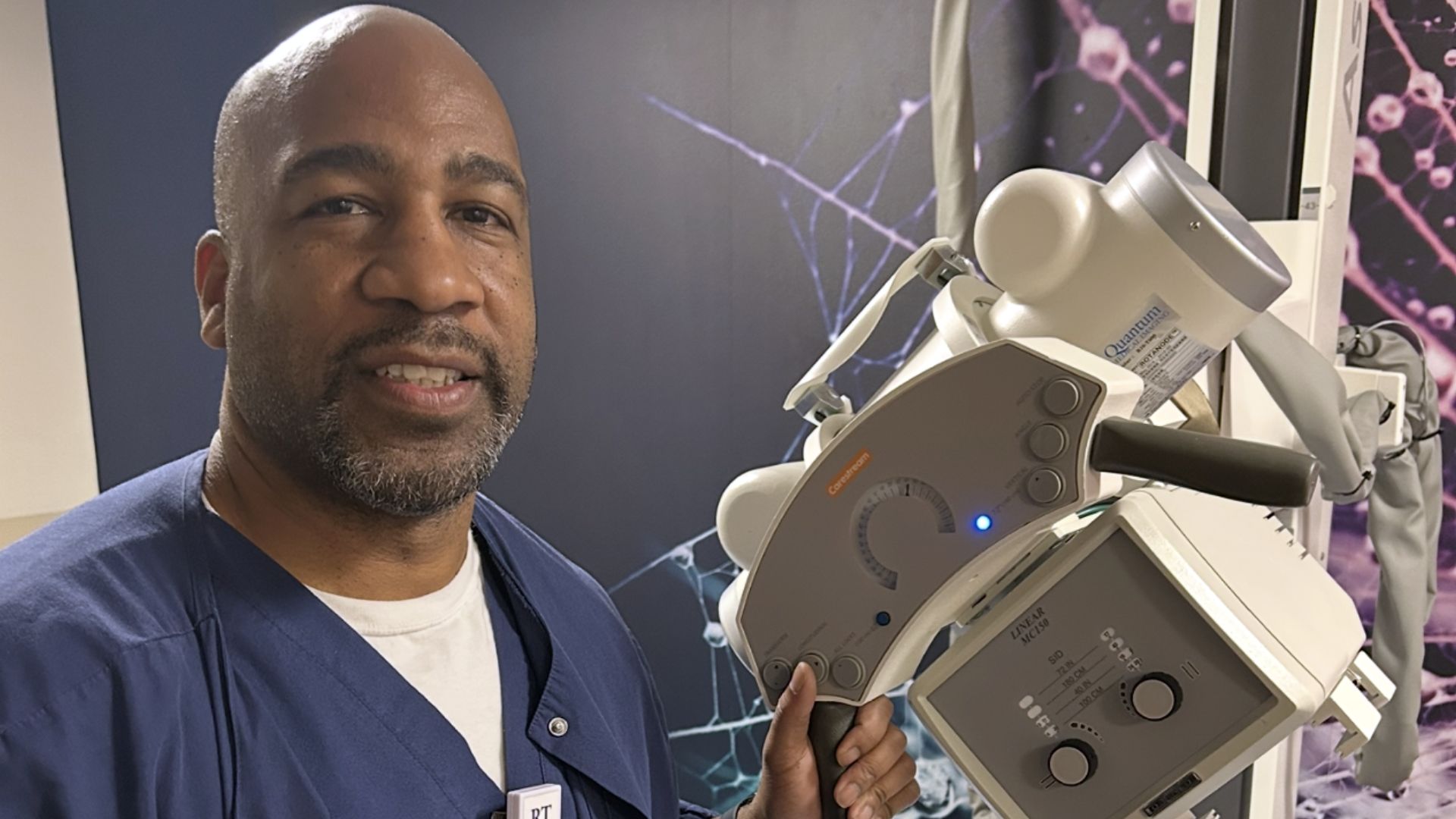
Rochester, New York – For many people, starting over at midlife sounds less like an opportunity and more like a risk too large to take. Careers become familiar. Routines settle in. Bills still need to be paid. Stability, even when uncertain, can feel safer than change.
But for Terrance Cooper, turning 40 became the beginning of a completely different future — one he never expected to find inside a hospital imaging department.
After spending more than a decade working in banking and insurance, Cooper had built what many would consider a successful professional life. He had experience, a steady paycheck, and years invested in his field. On paper, things looked secure. In reality, however, the warning signs had already started appearing.
“We actually knew we were losing our jobs for about five years,” he said. “Most companies don’t give you that kind of heads up.”
As operations shifted and positions were gradually centralized elsewhere, the sense of certainty began to fade. Cooper understood the industry was changing, even if the final outcome had not yet arrived. The waiting created its own kind of pressure — living in a career that no longer felt permanent while trying to imagine what could possibly come next.
Then came a conversation that would quietly redirect his life.
A longtime friend, Herb Gregory, believed Cooper had qualities suited for healthcare work. Gregory, who previously worked with him in banking before becoming a traveling radiologic technologist and former employee at Strong Memorial Hospital, encouraged him to think about X-ray technology.
“He said, ‘Hey, you should apply for X-ray. I think you’d be good at it,’” Cooper said.
The suggestion stayed with him.
Healthcare had never been part of his original career path. The idea of entering a completely new profession at 40 carried obvious complications. Returning to school meant prerequisites, licensing requirements, clinical training, and eventually a major certification exam. It also meant uncertainty — something many people try to avoid later in life rather than embrace.
Still, Gregory continued to encourage him.
“I know you, I know your personality—I think you’d be good at it,” he told Cooper.
That belief mattered.
While still employed as an insurance adjuster, Cooper slowly started laying the groundwork for change. One class at a time, he enrolled in prerequisite courses while receiving tuition reimbursement through State Farm, provided he passed each course successfully. It was careful, deliberate progress, made while balancing work responsibilities and the growing realization that his old career was nearing its end.
When his position officially disappeared in November 2018, he was already moving toward something new instead of standing still.
Only a few months later, in January 2019, Cooper submitted his application for a radiologic technology program. Yet even then, nothing felt guaranteed. Admission was competitive, and the pressure weighed heavily on him.
“I really wanted to do my best in those [prerequisite] classes to make sure I didn’t mess up that chance or set my calendar back,” he said.
When the acceptance finally came, excitement mixed with fear.
“It was kind of scary, honestly,” he said.
The reality of the transition hit hard. Cooper already held a bachelor’s degree, but now, two decades later, he would return to school for an associate degree in radiology at Monroe Community College. Many of his classmates were younger. The classroom environment was different from the one he remembered. The expectations were demanding.
Still, he pushed forward.
Then the world changed.
Like countless students across the country, Cooper’s education was suddenly disrupted by the COVID-19 pandemic. Clinical training — one of the most important parts of healthcare education — became uncertain almost overnight.
“We actually got kicked out of clinicals; we weren’t allowed in the hospital,” he said.
For students training in a medical field, losing access to hospitals created enormous challenges. Timelines shifted. Schedules changed repeatedly. Programs were forced to adapt quickly while students tried to maintain momentum in the middle of global uncertainty.
For Cooper, however, the disruption reinforced something he already believed about learning and growth.
“You’re only as old as your ability to stop processing new information,” he said.
That mindset became essential.
Returning to school later in life demanded discipline, humility, and patience. Cooper leaned heavily on support systems around him, especially classmates and family members who helped him stay focused during difficult stretches.
“We had a very diverse group, older and younger,” he said. “I naturally gravitated toward a few people, and we helped each other out.”
Despite the stress surrounding the pandemic and the intense pace of clinical education, Cooper immersed himself completely in the program.
“My sole focus was learning and understanding the nuances of X-ray,” he said. “A hundred percent of my time and attention was devoted to the program.”
That focus, he believes, came partly from age and experience.
“The older I got, the more focused I became,” he said. “I was paying for this—so I wasn’t screwing around.”
There was a maturity to his approach that he admits may not have existed when he was younger.
“I honestly don’t know if I could have been that disciplined and focused at 18 to 21,” he said.
Years spent working in banking and insurance also shaped the way he approached healthcare training. Professionalism, communication skills, accountability, and work ethic all carried over into his new environment. Those experiences helped him navigate stressful situations and build confidence inside hospital settings where precision and calmness mattered every day.
But beyond the technical aspects of radiology, Cooper discovered something even more meaningful — purpose.
Healthcare offered something his previous careers never fully provided: direct human impact.
Every patient interaction mattered.
Whether handling routine imaging appointments or helping in trauma situations where every second counted, Cooper found himself focusing not only on the images but also on the people behind them.
“I feel my job is to be the calming presence, put their minds at ease, and leave them with a positive experience,” he said.
Hospitals can feel overwhelming for patients, especially when fear, pain, or uncertainty are involved. Cooper quickly realized communication was often just as important as technical skill.
“No one wants to be in a hospital, so it’s already a very scary experience: You get more from patients when you explain what you’re doing.”
That philosophy now guides the way he approaches patient care every day.
“Treating people with respect and dignity, that’s what excellent patient care looks like to me,” he said.
The work itself also brought an energy and immediacy he had not experienced in previous office-based roles. In emergency and trauma situations, radiologic technologists play a critical role in helping medical teams make urgent decisions quickly.
“Time was of the essence,” he said. “My goal was to get the images right the first time, so I wasn’t slowing anyone down. It was really cool and scary at the same time.”
For Cooper, moments like those reinforced that he had made the right decision — even if the road toward it had been uncertain, stressful, and intimidating.
Now, looking back, the career shift represents more than simply changing jobs. It reflects the possibility of reinvention, even later in life, when many people believe major change is no longer realistic.
At 40, Cooper stepped away from familiarity and entered an entirely different world. He returned to classrooms, adapted during a pandemic, learned new technical skills, and built a career centered around helping others.
Most importantly, he found renewed meaning in the process.
“It gave me a chance to try something new, to step outside of my comfort zone,” he said. “The fresh start was needed.”


-
 Local News1 year ago
Monroe County announces legal proceedings against properties listed in official public notice of foreclosure
-

 Local News2 years ago
New ALDI store close to Rochester to begin construction in late 2025 or early 2026
-

 Local News1 year ago
County Executive Adam Bello and members of the county legislature celebrate exceptional young leaders and advocates at the 2025 Monroe County Youth Awards
-

 Local News1 year ago
The 2025 Public Market Food Truck Rodeo series will begin this Wednesday with live music by the Royal Bromleys