Local News
RIT presidents reflect on decades of leadership and explain how the university’s past continues to shape its future direction

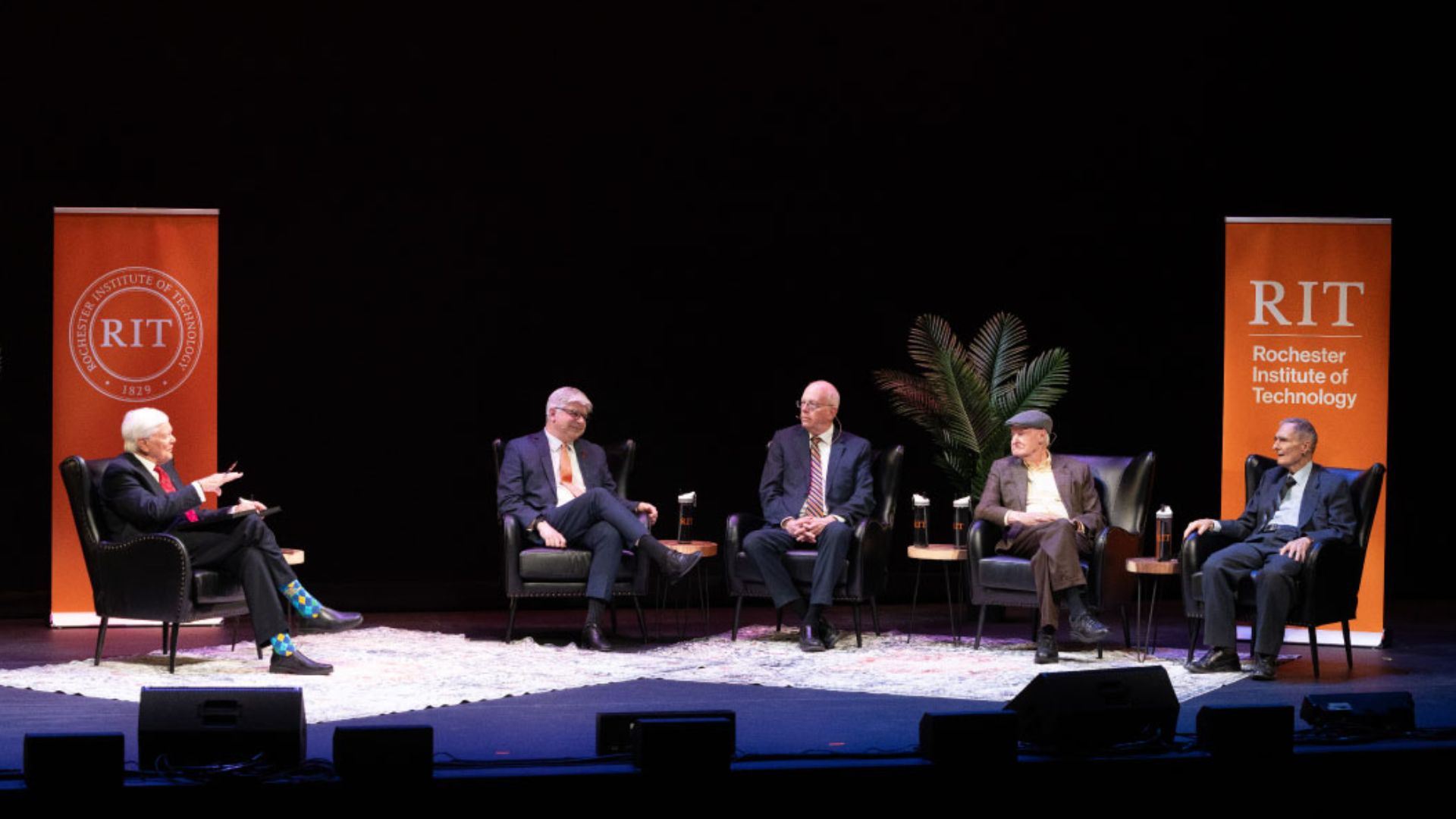
Rochester, New York – Inside the gleaming new performance hall at Rochester Institute of Technology, the past did not feel distant. It felt present—alive in memory, voice, and vision. On April 10, four leaders who shaped the university across decades gathered under one roof, offering not just reflection, but a layered narrative of how RIT became what it is today—and where it may be headed next.
The event, held at the recently opened Performing Arts Center, brought together former presidents Albert Simone, Bill Destler, and David Munson, alongside current president Bill Sanders. Guiding the conversation was veteran journalist Don Alhart, whose steady moderation allowed the discussion to unfold with both clarity and depth.
The theme—transformation—was not treated as a single moment in time. Instead, it emerged as a continuous process, shaped by decisions, risks, and, perhaps most importantly, people.
Sanders opened the discussion with a tone of humility and recognition, positioning himself not as a starting point, but as part of a longer journey. A self-described student of history, he acknowledged the groundwork laid before him.
“I want to thank our past presidents for the journey that they led RIT on for so many years. I’m so inspired by what they have done,” Sanders said. “This campus is second to none. Our students are kind, thoughtful, smart, and creative. Our staff and faculty are dedicated to the mission. This place is clearly defined by its people.”
His remarks hinted at a central thread running through the entire conversation—the idea that institutions are not built by strategy alone, but by communities willing to evolve together. Sanders emphasized RIT’s distinctive blend of disciplines, where technology intersects with the arts, design, and liberal studies. It is this fusion, he suggested, that continues to set the university apart in a crowded academic landscape.
That collaborative spirit, however, did not appear overnight. Simone, who served as the university’s eighth president, reflected on a time when listening became a leadership tool as much as decision-making.
“What I valued most was the ability to listen and learn from faculty, staff, and students,” Simone said. “That collective voice helped shape the university in meaningful ways.”
For Simone, progress was not only about expansion but inclusion—ensuring that more voices were heard and more opportunities created. He pointed to efforts aimed at diversifying the campus and strengthening its connection with the surrounding community, steps that quietly but significantly broadened RIT’s reach and relevance.
Destler, who followed Simone, described a different kind of expansion—one that pushed beyond geographical boundaries. Under his leadership, RIT extended its presence internationally, forming partnerships and establishing campuses that elevated its global standing.
“In the future, you won’t see many universities that are not internationally engaged in some way,” said Destler, the university’s ninth president. “That’s a good foundation for us to move forward.”
His vision of a globally connected institution was not merely aspirational; it was strategic. Destler also emphasized diversity as a driving force, underscoring the importance of bringing more people into higher education and ensuring that access continues to widen.
Yet, perhaps one of his most visible contributions came in the form of an idea—one that grew into a defining tradition. The Imagine RIT: Creativity and Innovation Festival, now approaching nearly two decades, stands as a testament to the university’s hands-on, experimental culture.
“It shows what happens when you give this community an idea,” he said. “Students, faculty, and staff can turn a half-baked idea into a good one.”
Destler’s reflections were not limited to academics. He recalled moments that united the campus in unexpected ways, including the university’s run to the NCAA Frozen Four in men’s hockey. Such experiences, he suggested, played a subtle but powerful role in shaping identity and belonging.
Munson, the university’s tenth president, turned the focus toward physical space—how buildings and infrastructure can reflect ambition. For him, the Performing Arts Center itself symbolized more than a new facility. It represented a promise fulfilled.
“We needed a venue that matched our students’ aspirations and capabilities,” said Munson, RIT’s 10th president. “Any kind of student on our campus can be involved here.”
Under Munson’s leadership, RIT saw significant developments, including the expansion of doctoral programs, the creation of the SHED makerspace, and improvements to athletic facilities. These were not isolated upgrades but part of a broader effort to position the university among top-tier institutions, while maintaining its distinctive identity.
He also highlighted the importance of integration—particularly through institutions like the National Technical Institute for the Deaf, which continues to play a vital role in shaping RIT’s inclusive environment.
As the conversation shifted back to Sanders, the focus turned forward. His vision, still in its early stages, is built on adaptability—a recognition that the world students are entering is changing faster than ever before.
“The future of work is evolving,” Sanders said. “We need to prepare students to become leaders and build careers that don’t even exist yet.”
That uncertainty, rather than being a challenge alone, was framed as an opportunity. Sanders outlined priorities that reflect emerging trends, including artificial intelligence, health technologies, and student success initiatives. At the same time, he reaffirmed longstanding pillars of the RIT experience, such as cooperative education and global engagement.
“We want our students to be world citizens with a global mindset,” he said. “Community well-being is also essential, creating an environment where everyone can thrive.”
The discussion did not shy away from broader concerns facing higher education. Rising costs, shifting expectations, and questions about long-term value continue to shape the national conversation. Destler acknowledged these pressures but maintained a sense of optimism.
“It’s crucial that we continue to rise and take our place among the nation’s top universities,” he said.
Sanders echoed that sentiment, though with a sharper edge—one that hinted at the competitive realities ahead.
“Many universities will fail in the years ahead. We’re going to define our own success and continue moving toward the top tier of higher education becoming sought after from around the nation and the globe.”
By the end of the evening, what emerged was not a single vision, but a layered one—built across time, shaped by different առաջնորդs, yet tied together by a shared belief in possibility.
At RIT, the past is not simply remembered. It is actively shaping what comes next.


-
 Local News2 years ago
Monroe County announces legal proceedings against properties listed in official public notice of foreclosure
-

 Local News2 years ago
New ALDI store close to Rochester to begin construction in late 2025 or early 2026
-

 Local News2 years ago
County Executive Adam Bello and members of the county legislature celebrate exceptional young leaders and advocates at the 2025 Monroe County Youth Awards
-

 Local News1 year ago
The 2025 Public Market Food Truck Rodeo series will begin this Wednesday with live music by the Royal Bromleys