Local News
RIT professor Deborah Blizzard honored with Eisenhart Award for teaching with compassion curiosity and dedication to students

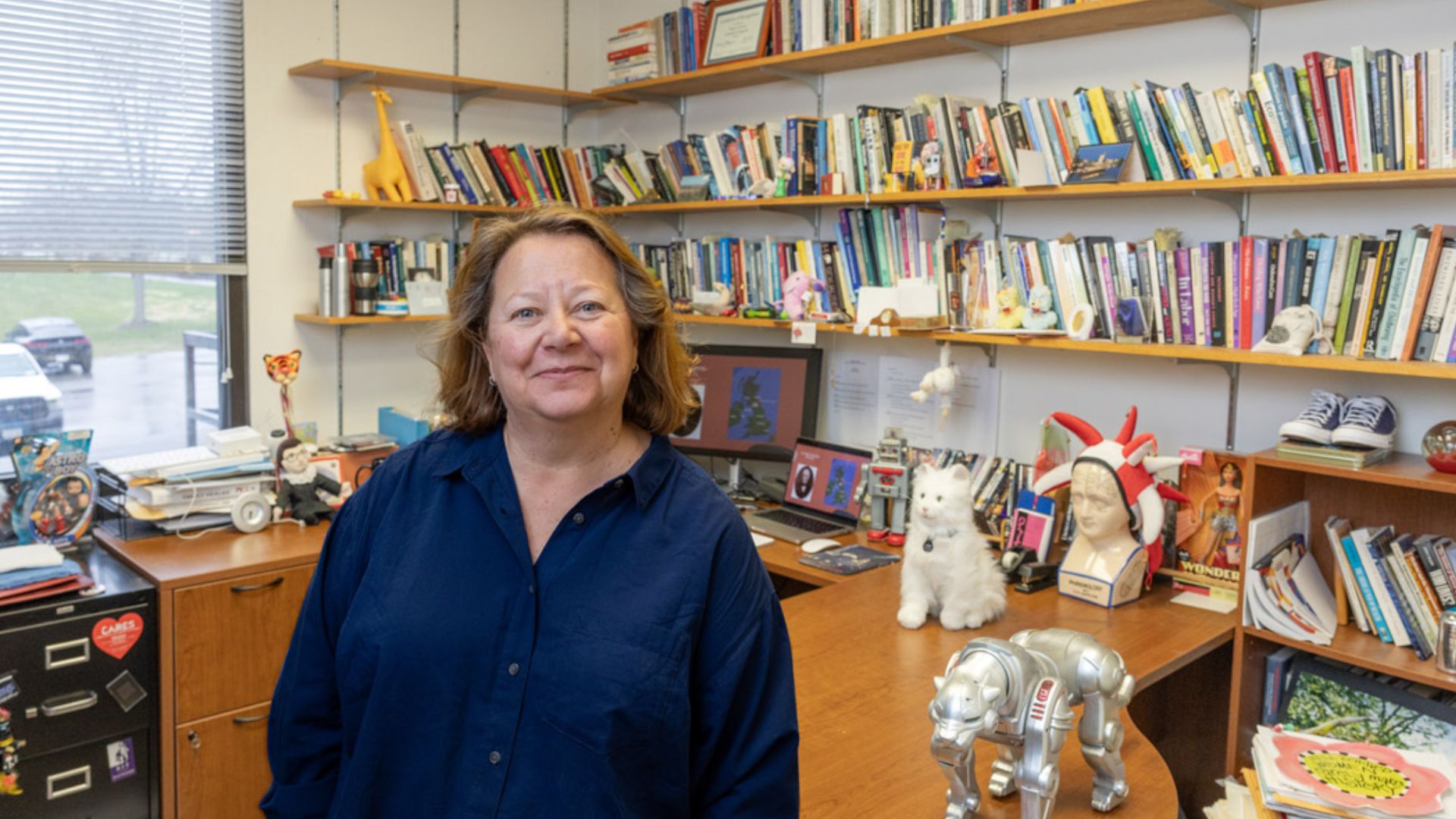
Rochester, New York – For students walking into one of Professor Deborah Blizzard’s classes, there is rarely a predictable script. One day might open with a playful debate about the eternal food controversy—whether pineapple truly belongs on pizza. The next could spiral into a philosophical exploration of what defines a human being in an age of technology and artificial intelligence.
The topics vary widely, but one thing remains consistent: students feel safe sharing their thoughts. That atmosphere of openness, curiosity, and genuine respect is at the heart of Blizzard’s teaching philosophy. It is also the reason she has been honored with the 2026 Eisenhart Award for Outstanding Teaching at the Rochester Institute of Technology.
Blizzard, a professor in RIT’s Department of Science, Technology, and Society, has spent nearly a quarter century shaping classrooms where ideas are welcomed and curiosity is encouraged. Over the years, she has developed a reputation for blending thoughtful discussion with a sense of warmth that helps students feel comfortable tackling complicated questions.
Her approach to teaching starts with a simple but powerful belief.
“It’s important to me that my students know that their value isn’t tied to how well they consume education. They’re valuable just as they are; as multi-layered, multi-faceted human beings trying to learn and share their ideas,” said Blizzard, professor in RIT’s Department of Science, Technology, and Society.
That mindset—placing humanity at the center of education—has shaped everything from the way she structures class discussions to how she interacts with students outside the classroom. Blizzard’s commitment to compassion and thoughtful engagement ultimately caught the attention of the university’s Eisenhart Award committee, which recognized her dedication to both teaching and mentorship.
Receiving the honor, Blizzard says, was an emotional moment.
“Receiving this award has been a very humbling, overwhelming moment. I’ve sat on this committee, so I know the history and the quality of past recipients. It’s really humbling to say that I can stand in the company of that group,” she said.
Her path to RIT, however, was not something she carefully planned years in advance. Instead, it unfolded through a simple suggestion from a trusted colleague.
Blizzard learned about an open faculty position through a friend from graduate school, the late Franz Foltz, who had served as an associate professor in the Department of Science, Technology, and Society. Foltz encouraged her to apply, believing she would fit well within the department.
That recommendation changed the course of her career.
More than two decades later, Blizzard reflects on that decision with gratitude. What began as a new opportunity soon became a professional home. She discovered a community where intellectual exploration could thrive and where students were eager to wrestle with difficult questions.
During her 24 years at RIT’s College of Liberal Arts, Blizzard has taken on a variety of roles. Beyond teaching, she has served as chair of the Department of Science, Technology, and Society, led the Women, Gender, and Sexuality Studies program, and participated in numerous university committees. Each position added another layer to her understanding of how education functions within a larger academic community.
Yet despite those responsibilities, the classroom has always remained central to her work.
Blizzard believes that learning should feel engaging rather than intimidating. To achieve that balance, she tries to create an environment where humor and curiosity coexist with serious intellectual debate.
Many of the courses she teaches ask students to confront philosophical questions that challenge deeply held beliefs about identity, technology, and society. These discussions can be complex, even uncomfortable at times. For Blizzard, introducing moments of lightness is essential.
“Asking them to confront these questions can feel risky, so I try to take the risk out of it,” she said. “I tell my students that learning is an adventure. We don’t necessarily always know the destination, but we’re going to closely examine whatever path we’re taking.”
That sense of exploration has guided her teaching since her earliest days at RIT. When she first joined the university, Blizzard focused primarily on the intersection of gender, science, and technology. Over time, her interests evolved, and so did her course offerings.
In fact, she has created eight new courses during her tenure, each designed to push students beyond traditional boundaries of thinking.
One course in particular has become a favorite among students: Cyborg Theory: (Re)thinking the Human Experience in the 21st Century. The class regularly fills to capacity, drawing students from various disciplines who are curious about how technology reshapes the meaning of humanity.
Read also: Comics scholar Daniel Worden earns prestigious Eisenhart Award for outstanding teaching at RIT
“With Cyborg Theory, I got to embrace so many different things from the technological, to the philosophical, to the anthropological, and beyond,” said Blizzard. “I tell students at the beginning that, by the end of the semester, I promise they will not have any answers, but they will have better questions. And that’s why it’s fun.”
That perspective captures Blizzard’s broader philosophy about education. Rather than delivering neat conclusions, she encourages students to sit with uncertainty and develop sharper ways of thinking about the world.
In her view, the goal of teaching is not simply to provide information but to help students become thoughtful, empathetic individuals.
Blizzard hopes that students who pass through her classroom carry more than academic knowledge into the future. She wants them to learn how to ask meaningful questions, work collaboratively with others, and approach challenges with kindness and humility.
Those lessons are not always delivered through lectures alone. Sometimes they emerge through quiet moments—a conversation with a stressed student, a word of encouragement after a tough week, or recognition of achievements that have nothing to do with grades.
Blizzard believes those moments matter just as much as formal instruction.
“People tend to look for these big moments when they reflect, but I think that’s a problematic view. It doesn’t have to be major victories. A lot of times, it’s just one little step that has an impact,” said Blizzard. “As a professor, you may never know the impact you have on a student. You just do your best and hope that it lands.”
For Blizzard, teaching is less about delivering answers and more about nurturing curiosity. The classroom becomes a shared journey—one where students and professor alike explore ideas, challenge assumptions, and discover new ways of understanding the world.
And while the path may not always have a clear destination, it is precisely that uncertainty that makes the adventure worthwhile.


-

 Local News2 years ago
Monroe County announces legal proceedings against properties listed in official public notice of foreclosure
-

 Local News2 years ago
New ALDI store close to Rochester to begin construction in late 2025 or early 2026
-

 Local News2 years ago
County Executive Adam Bello and members of the county legislature celebrate exceptional young leaders and advocates at the 2025 Monroe County Youth Awards
-

 Local News1 year ago
The 2025 Public Market Food Truck Rodeo series will begin this Wednesday with live music by the Royal Bromleys