Local News
Assistant professor at RIT documents the lasting artistic legacy of distinguished alumnus Charles Gaines

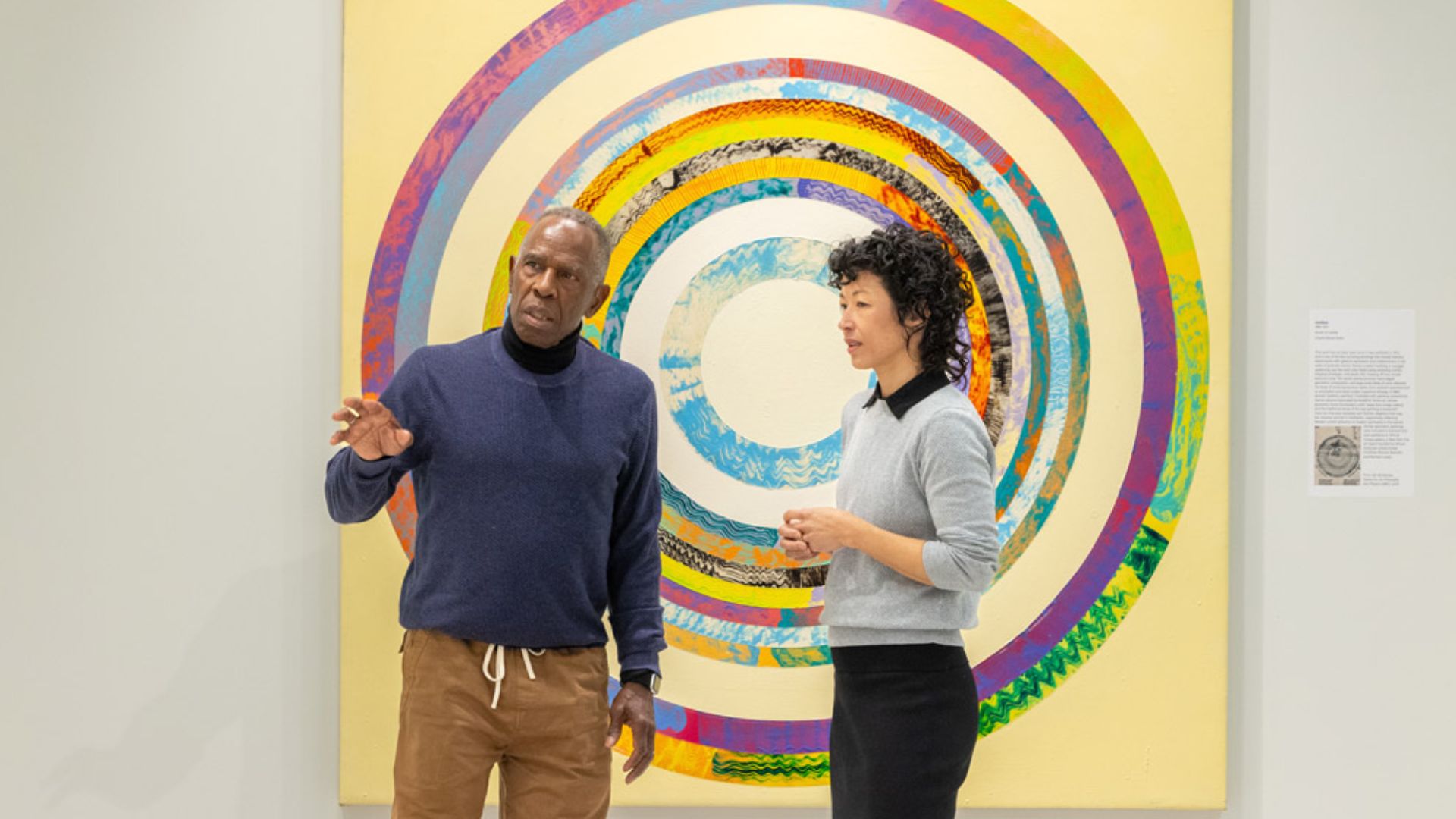
Rochester, New York – For many historians and art scholars, studying an influential figure often means working with fragments of the past—archival documents, old interviews, or the quiet testimony of artworks themselves. Direct dialogue with the subject of their research is rare. But for Ellen Tani, an assistant professor of art history at Rochester Institute of Technology, that unusual opportunity became the starting point for a long-running intellectual collaboration.
Her research focuses on the life and work of Charles Gaines, a celebrated conceptual artist and alumnus of the university who graduated in 1967 with a degree in art and design. Over the years, Gaines has built a reputation as a pioneering thinker whose work blends systematic processes with visual art. Through formulas, numerical structures, and carefully designed frameworks, he has created art that examines logic, representation, and language in new ways.
Today, Tani is working to document that legacy in a way that has not been done before. She is currently writing what will become the first full scholarly monograph dedicated to Gaines’ career. The book, titled Charles Gaines Black Conceptualism and the Poetics of Systems, is scheduled for publication in 2028.
The project represents years of research, conversation, and reflection. It also seeks to fill a gap in art history scholarship. Although Gaines is widely respected among artists and curators, relatively little academic writing has fully explored his influence.
According to Tani, many people in the art world recognize Gaines as a significant figure, particularly for the way his work connects early conceptual art movements of the 1960s and 1970s with later generations of artists experimenting with conceptual ideas. Yet, despite decades of exhibitions and recognition, the scholarly record remains surprisingly thin.
Tani hopes her work will help correct that imbalance.
Her interest in Gaines dates back to her doctoral studies. While researching African American conceptual art for her Ph.D. dissertation, she came across a catalog from a 2005 exhibition titled Double Consciousness Black Conceptual Art since 1970. Gaines’ work appeared in the show, and the catalog included an excerpt from his 1993 essay The Theater of Refusal Black Art and Mainstream Criticism.
The passage caught her attention immediately.
“The aesthetic of his artwork—its fairness, austerity, abstractness, and the conceptual nature of it—seemed so distant from the very strong critical voice that I saw in his writing,” said Tani. “I realized that is the space in which the art historian does their work, spanning that distance and fleshing out what that distance means. There is no disconnect between one form in which an artist thinks and another.”
Her curiosity eventually led to a meeting. In 2012, Tani attended a conference organized by the College Art Association. Gaines was speaking on a panel there. After introducing herself and sharing her interest in his work, the two arranged to continue the discussion through a Skype call.
What began as a brief academic exchange grew into a collaboration that has lasted more than a decade.
Unlike many scholarly projects, where the researcher studies their subject from a distance, Tani’s work has evolved through ongoing conversations with Gaines himself. The two regularly discuss ideas about art, theory, and interpretation. Their relationship has developed into something closer to a creative partnership than a traditional researcher–subject dynamic.
Tani says these conversations have shaped her understanding of Gaines’ work while allowing her to test and refine her arguments.
“From our very earliest conversations, our relationship has been about discussions around ideas, not about what information I can extract from this artist about their career. There is a mutual trust and respect we have for one another as intellectuals and creative practitioners,” said Tani.
Gaines has also expressed appreciation for the collaboration.
“I respect Ellen because she’s very smart, such a good writer, and a clear articulator of complex ideas. Being part of this writing project with her is like working with a friend. I have this feeling that she understands me on several levels, not just as a subject of a book.”
While the forthcoming book represents the long-term result of Tani’s research, her efforts to highlight Gaines’ work have already taken shape in another form.
Earlier this year, she curated the first exhibition of Gaines’ art ever presented on the RIT campus. The show is currently displayed at the RIT University Gallery and will remain open to visitors through April 10.
The exhibition traces the arc of Gaines’ career, bringing together examples of printmaking, drawing, and other works that demonstrate his enduring fascination with systems and structures. His art often explores the tension between strict logic and expressive possibility, turning mathematical processes into visual compositions that challenge viewers’ expectations.
Among the works included is a rare early painting that has not been publicly displayed for more than half a century. For visitors, the show offers a rare chance to see how Gaines’ artistic language evolved over time.
The exhibition was made possible through support from several organizations, including the Anna Ballarian Visiting Artist Series and the RIT College of Art and Design, along with assistance from Gaines’ studio.
Bringing the exhibition together also gave students an opportunity to gain hands-on experience in curatorial work. Tani invited Rebecca Soriano, a 2024 graduate of RIT’s individualized program, to serve as a curatorial assistant.
Soriano had previously helped Tani with research related to the Gaines book project. The exhibition allowed her to take on a more active role in organizing and presenting the artist’s work.
Today, Soriano works in Philadelphia as an interpreter, rental coordinator, and collections assistant at Historic Germantown. She believes the experience she gained during the exhibition will play an important role in her future career in museums and galleries.
“The project felt intimidating in some ways at first, but it’s been such a good experience that has slowly made me feel more confident in my own knowledge and skill,” she said. “Throughout the whole process, I’ve felt that my voice and contributions matter in these conversations.”
For Tani, the exhibition and the book represent two parts of a larger mission: bringing deeper scholarly attention to Gaines’ contributions to contemporary art.
Born in 1944 and based in Los Angeles, Gaines has spent more than 50 years producing artwork that challenges conventional boundaries between mathematics, philosophy, and visual expression. His work has appeared in major institutions including the National Gallery of Art, the Art Institute of Chicago, and the Institute of Contemporary Art Miami. He has also exhibited work at Governors Island.
Over the years, he has received numerous honors recognizing his impact. In 2019 he was awarded the Edward MacDowell Medal. He was inducted into the National Academy of Design in 2020 and later welcomed into the American Academy of Arts and Letters in 2022. In 2023, RIT awarded him an honorary doctorate.
“It’s very special that this opportunity has come up at my alma mater,” said Gaines. “As an alum, you have a built-in value for your school, the place where you feel you got much of your art training, and to have that value reflected back to me in the way that it is now is noteworthy.”
As Tani continues to develop her book, she plans to examine how Gaines’ use of systems relates to deeper cultural and political questions. Her research will explore how his work intersects with ideas about representation, language, ideology, and the broader history of conceptual art.
The project recently received additional support when Tani was awarded an Andy Warhol Foundation for the Visual Arts Arts Writers Grant in 2025. The grant supports critical writing about contemporary visual art and will help her complete the manuscript.
In the meantime, visitors still have a chance to see Gaines’ work firsthand at the RIT gallery exhibition.
For Tani, the chance to research an artist while also engaging in conversation with him has been both rare and rewarding. What began as a moment of curiosity during her doctoral research has evolved into a collaborative journey—one that continues to unfold as she works to document and interpret the legacy of a pioneering conceptual artist.


-
 Local News2 years ago
Monroe County announces legal proceedings against properties listed in official public notice of foreclosure
-

 Local News2 years ago
New ALDI store close to Rochester to begin construction in late 2025 or early 2026
-

 Local News2 years ago
County Executive Adam Bello and members of the county legislature celebrate exceptional young leaders and advocates at the 2025 Monroe County Youth Awards
-

 Local News1 year ago
The 2025 Public Market Food Truck Rodeo series will begin this Wednesday with live music by the Royal Bromleys