Local News
RIT turns public participation into global impact by opening scientific research data to people around the world

Rochester, New York – In a scientific world often seen as distant and complex, a quiet but powerful shift is taking place. At the Rochester Institute of Technology, researchers are showing that science does not have to remain behind closed doors or hidden inside specialized laboratories. Instead, it can be opened to the world—inviting anyone with curiosity and determination to take part.
From remote sensing projects to astrophysics research and biodiversity studies, the university has increasingly embraced a model that blends academic expertise with public participation. The approach has already begun to stretch across continents, connecting professional scientists, students, and everyday enthusiasts in ways that would have seemed unlikely just a decade ago.
What emerges from this growing movement is something larger than any single study. It is a global network of people examining data, asking questions, and contributing insights—sometimes from professional labs and sometimes from living rooms halfway around the world.
Research data traveling across the globe
Thousands of miles from the RIT campus, in Israel, a scientist is analyzing imagery to detect extremely small objects hidden within complex visual data. At the same time, in the United States, a citizen scientist studies distant galaxies from his own home computer.
Both individuals are connected by the same thread: data originally collected at Rochester Institute of Technology.
At Ben-Gurion University of the Negev in Israel, Professor Stanley Rotman is using hyperspectral imagery to refine techniques that help identify subtle objects within images. Hyperspectral technology analyzes light across hundreds of wavelengths, allowing researchers to uncover details that ordinary images cannot reveal.
Meanwhile, in Denver, citizen scientist Baba Karthik Kalapatapu examines spectral signatures from galaxies billions of light-years away. His interest began as a personal fascination with astrophysics and cosmology, yet the work he performs contributes to real scientific analysis.
Their shared foundation lies in datasets made publicly available through RIT research initiatives.
Opening research data to the public is not simply a matter of transparency. It has become a powerful tool that accelerates scientific progress while expanding education and collaboration.
“Many of the questions we face today are so wide-ranging in scope that they demand diverse perspectives and meaningful public involvement,” said André Hudson, dean of RIT’s College of Science. “Because science directly affects people’s lives, citizens should be part of the process. When they are, discovery becomes more innovative, more equitable, and more responsive to the needs of society.”
A massive data experiment
One of the largest examples of this philosophy unfolded last fall in western New York.
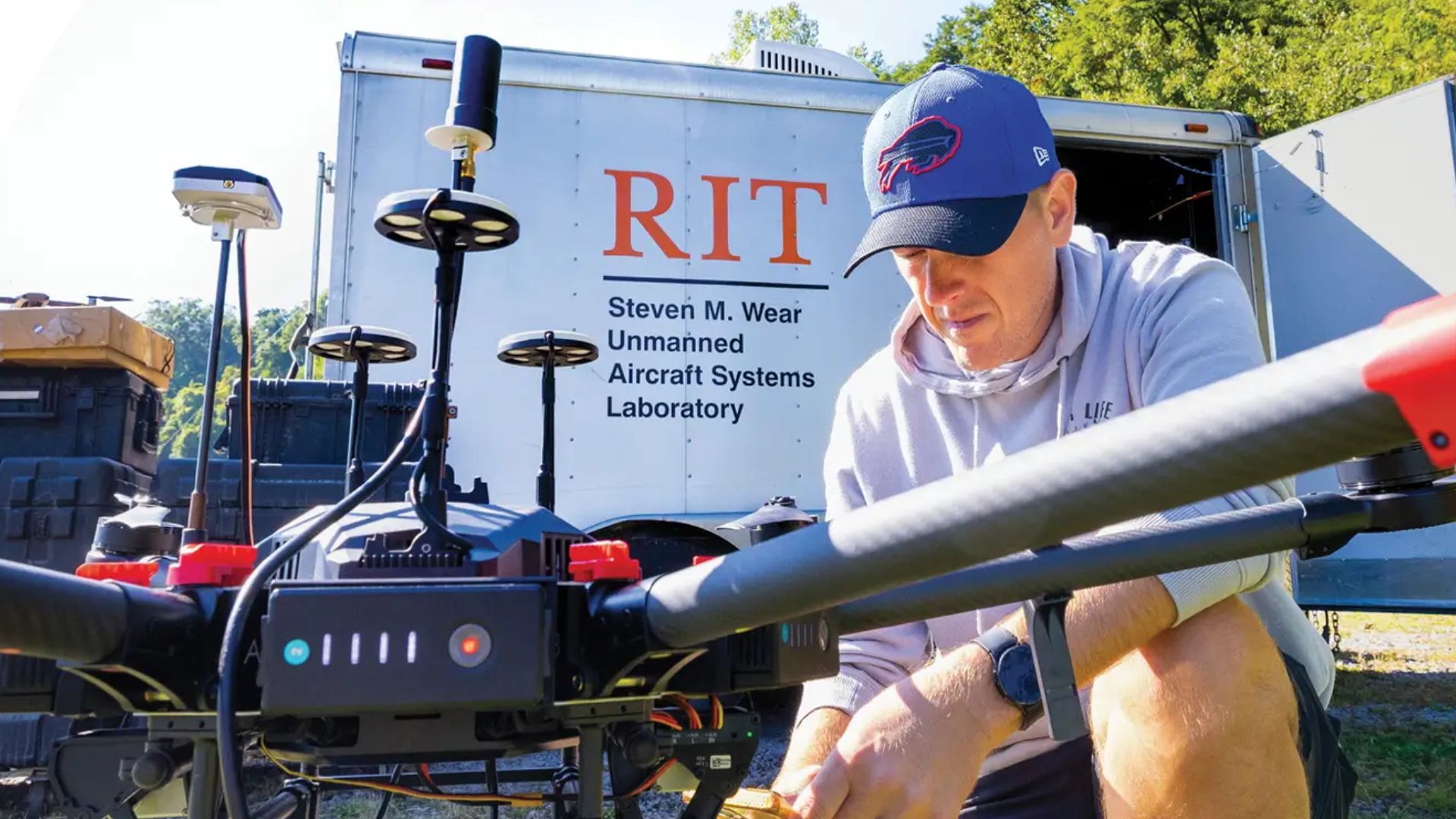
At the Tait Preserve, researchers from around the world gathered for a large-scale remote sensing experiment organized by RIT’s Digital Imaging and Remote Sensing Laboratory.
The project, known as ROCX 2025, was designed with a clear purpose: collect an extensive, highly accurate dataset and then make it accessible to the global scientific community.
The event lasted two weeks but required years of preparation. Scientists carefully coordinated aircraft flights, satellite imaging passes, drone surveys, and ground-based instruments so that every piece of collected data aligned with what was actually present on the ground.
More than sixty researchers participated in the operation, using a combination of advanced sensing platforms. Commercial satellites captured images from space while aircraft and drones gathered additional perspectives closer to the Earth’s surface.
Ground sensors and observation teams ensured the information was calibrated and verified—an essential step in remote sensing research where accuracy is critical.
Once fully organized and processed, the data from ROCX 2025 will be released to researchers worldwide.
The information could help scientists working across numerous fields, including environmental monitoring, agricultural analysis, surveillance technologies, and even mine detection.
According to John Kerekes, a research professor at RIT’s Chester F. Carlson Center for Imaging Science, the careful coordination behind the experiment sets it apart from many existing data collections.
“There is much earth-observing data out there, but it’s not always coordinated with knowing what’s on the ground,” he said.
By combining ground verification with aerial and satellite observations, the resulting dataset becomes significantly more valuable to researchers attempting to develop new algorithms or analytical methods.
From student researcher to national laboratory scientist
For some scientists, involvement in these collaborative efforts begins early in their careers.
Amanda Ziemann, who earned multiple degrees from RIT, first worked with a similar remote sensing data project while still a student. Today she is a scientist in the Space Remote Sensing and Data Science Group at Los Alamos National Laboratory in New Mexico.
Returning to participate in ROCX 2025 felt like a full-circle moment.
Her experience as a student working with public datasets helped prepare her for the demands of professional research. Now she plans to use the newly collected information to study patterns of human activity and environmental change over time.
By comparing those patterns with hyperspectral imagery collected at different intervals, Ziemann and her colleagues can build algorithms designed to interpret complex visual data more accurately.
“Having a data set that’s open, that’s well vetted, calibrated, and labeled makes it so that it’s easier for us to communicate our technical advancements to the community,” Ziemann said. “There aren’t very many ground truth public remote sensing hyperspectral data sets. We can make good use of the data for our research needs, and that’s what we’re excited about.”
Her perspective highlights one of the central goals behind RIT’s open-data philosophy: enabling scientists everywhere—whether at major laboratories or smaller institutions—to conduct meaningful research.
The universe as a shared research project
While some RIT projects focus on Earth observation, others reach far beyond the planet itself.
In the university’s astrophysical sciences program, researchers are exploring ways to involve the public in studying the evolution of galaxies across the universe.
Ph.D. student Sadie Coffin is continuing work on a participatory science project called Redshift Wrangler, originally developed by her adviser, Jeyhan Kartaltepe.
Supported by funding through NASA’s Future Investigators in Earth and Space Science and Technology program, the project trains volunteers to analyze astronomical data.
Participants learn how to interpret spectral signatures—patterns of light emitted by galaxies at different wavelengths. By studying these signatures, they help determine how galaxies form, grow, interact with neighboring galaxies, and evolve over billions of years.
Human eyes remain surprisingly valuable in this type of research.
Computers can process enormous amounts of data, but subtle patterns or unusual structures sometimes stand out more clearly to a trained observer.
“There’s certainly not just one route to science,” said Coffin. “There are a lot of advantages to having human eyes on our data. Volunteers can take our data, ask their own questions, and do their own science that we can’t do as one person or a small team of people.”
For volunteers like Kalapatapu, the project offers something deeper than casual interest.
“Having data available to the public is extremely important,” said Karthik Kalapatapu, who is an associate project manager for a renewable energy company.
“You either learn how to read research papers or trust researchers who are giving talks about it, but for me, I need to understand the data. The fact that I can sit in my apartment, open a laptop, and study wavelengths of light from billions of years ago to understand the evolution of the cosmos is pretty neat.”
Coffin believes projects like Redshift Wrangler also play a broader role in strengthening public confidence in scientific research.
“I think it makes people a lot more likely to have trust and understanding of why science is so important,” she said.
Studying life one cubic foot at a time
Public participation is not limited to astronomy or satellite imaging.
Back on Earth, researchers at RIT are working with communities to explore biodiversity in local ecosystems.
Elle Barnes, an assistant professor in the Thomas H. Gosnell School of Life Sciences, contributes to a project known as One Cubic Foot.
The initiative was launched by photographer and environmental advocate David Littschwager and is supported by the Smithsonian Institution.
The concept is simple but powerful. Researchers place a one-cubic-foot frame—called a biocube—into a natural environment. Within that small space, scientists document every organism they can find.
The method reveals a surprising truth: even the smallest section of a habitat can contain an extraordinary diversity of life.
The project first arrived in Rochester in 2015 through collaboration with the Seneca Park Zoo to examine life in and around the Genesee River.
A decade later, researchers returned to observe how conservation efforts had influenced the river’s ecosystem.
Barnes brought expertise in genomics and environmental DNA analysis to the effort. By collecting water samples, her team can extract traces of DNA left behind by organisms in the environment—allowing them to identify species that might otherwise remain invisible.
The long-term goal is to involve local citizens in collecting samples that can then be analyzed in Barnes’s laboratory.
The more data gathered, the clearer the picture of biodiversity becomes.
“If you continue to sample over time, and you employ citizens who are excited to go out and study the health of the river, you’ll have a much better understanding about the fruits of your conservation labor,” said Barnes. “I also think that it’s critical to the scientific field that you take the time to talk to the people that directly benefit from your work.”
Education through access
For scientists like Rotman, the availability of open data also plays an essential role in education.
At smaller universities with limited resources, collecting hyperspectral imagery independently can be extremely expensive. Public datasets allow instructors to bring real-world research material directly into classrooms.
Rotman has relied on RIT data collections for nearly two decades.
He says the quality and accessibility of the datasets make them especially valuable for teaching students about remote sensing technologies.
“I can’t have undergraduate classes and undergraduate projects unless I know I have the data available,” said Rotman. “This is reliable data, and RIT does it beautifully.”
A model for the future of science
The projects emerging from RIT represent a growing shift within the scientific community.
Rather than restricting knowledge to specialized laboratories, researchers are increasingly recognizing the benefits of openness and collaboration.
From hyperspectral imagery to galaxy spectra and environmental DNA samples, the data generated by these projects travels far beyond campus boundaries.
Students, professional scientists, and curious volunteers all become part of the same global effort.
And in that shared effort, science becomes not just a profession—but a collective exploration.


-
 Local News1 year ago
Monroe County announces legal proceedings against properties listed in official public notice of foreclosure
-

 Local News2 years ago
New ALDI store close to Rochester to begin construction in late 2025 or early 2026
-

 Local News1 year ago
County Executive Adam Bello and members of the county legislature celebrate exceptional young leaders and advocates at the 2025 Monroe County Youth Awards
-
 Local News1 year ago
The 2025 Public Market Food Truck Rodeo series will begin this Wednesday with live music by the Royal Bromleys