Local News
Researchers discover luminous signature that could finally help identify elusive supermassive black hole mergers in deep space

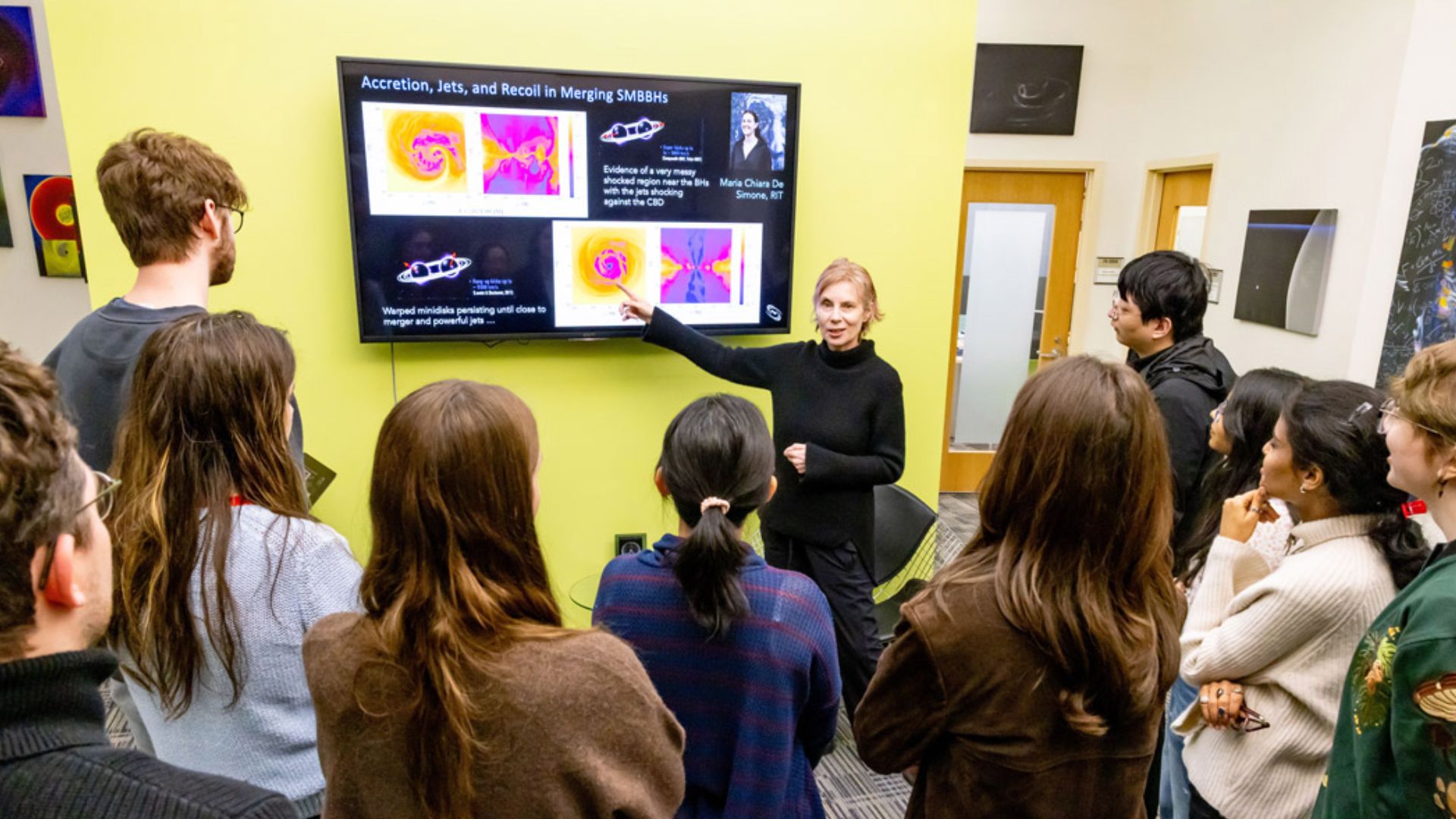
Rochester, New York – For decades, astronomers have known that the universe’s largest black holes eventually collide. These titanic events occur when galaxies merge, drawing their central supermassive black holes into a gravitational dance that ends in a violent union. Yet despite the certainty that these mergers happen, scientists have never actually seen one unfold through a telescope.
Now, a team of researchers has uncovered a promising clue that could finally make such observations possible. Scientists from Rochester Institute of Technology (RIT) believe they have identified a specific flash of light—a sudden spike in brightness—that occurs at the exact moment two supermassive black holes merge. If confirmed through observations, this luminous signal could provide astronomers with a reliable way to detect these otherwise hidden cosmic collisions.
The discovery emerged from years of theoretical work and complex computer simulations conducted by researchers at RIT’s Center for Computational Relativity and Gravitation (CCRG). The effort was led by Lorenzo Ennoggi, who recently completed his Ph.D. in astrophysical sciences and technology, working closely with astrophysicist Manuela Campanelli, a Distinguished Professor at RIT.
Their work has been detailed in two separate scientific papers published in journals of the American Physical Society. Together, the studies describe how the final moments before and during a black hole merger produce unique patterns in light and radiation—signals that could guide astronomers searching for these elusive events.
Supermassive black holes, which sit at the centers of most galaxies, can contain millions or even billions of times the mass of the sun. When galaxies collide, their central black holes are pulled together by gravity. As they spiral closer, they interact with surrounding gas and magnetic fields, producing jets of high-energy particles and electromagnetic radiation.
The challenge has always been detecting the exact moment of the merger.
Until now, simulations suggested that the brightness of these systems tends to drop as the black holes move toward each other. However, Ennoggi’s detailed modeling revealed something surprising: a brief but dramatic surge in luminosity at the instant the two black holes merge.
“People were not able to do this simulation with the full physics that Lorenzo has been able to include, so they were not getting this rise in luminosity at the merger,” Campanelli explained. “What Lorenzo has discovered is that there is a bump at the merger, and the bump is correlated between both the jet and the light from the disk. That bump is important because it will allow mergers to be identified for the first time.”
In simpler terms, the system grows dimmer as the black holes approach each other—but right at the moment of impact, there is a sudden burst of light. That burst may act like a beacon for astronomers scanning the sky.
Campanelli emphasized that scientists already understand the broader cosmic story behind these events. Galaxies frequently collide throughout the universe, and when they do, their central black holes eventually merge as well. But while gravitational wave detectors have observed collisions between smaller black holes, direct observation of supermassive black hole mergers has remained out of reach.
Finding the correct electromagnetic signal could change that.
“If astronomers know exactly what signature to look for, they can point their telescopes at the right place and time,” researchers say. The spike identified in the simulations could serve as that long-missing indicator.
The discovery did not come easily. Running the simulations required immense computational power and careful adjustments to include all relevant physical processes. Ennoggi explained that the path to the breakthrough involved repeated attempts.
“I had to repeat the simulations quite a few times,” said Ennoggi. “When I finally had something that worked and we managed to find something of relevance from the physics point-of-view, I was very happy.”
Another member of the research team, Ph.D. student Maria Chiara de Simone, said the results could help astronomers combine two different kinds of cosmic signals—gravitational waves and light.
Gravitational waves are ripples in spacetime created by massive objects accelerating through space. Observatories such as LIGO have successfully detected these waves from collisions involving smaller black holes and neutron stars. But for supermassive black holes, the signals are more difficult to pinpoint without additional information.
“We are in the process of getting ready to help in observations because the gravitational wave emission and the electromagnetic emission together help with localization so we can get more information about galaxy evolution in a broader aspect,” de Simone said.
By combining gravitational wave data with light signals from telescopes, astronomers could determine not only where the merger happened but also learn more about how galaxies grow and evolve.
The research involved a large international collaboration. Other co-authors include Yosef Zlochower from RIT’s School of Physics and Astronomy; Scott Noble from NASA’s Goddard Space Flight Center; Julian Krolik from Johns Hopkins University; Federico Cattorini from the University of Milano-Bicocca; Jay Kalinani, an RIT postdoctoral researcher; Vassilios Mewes from Oak Ridge National Laboratory; Michail Chabanov, an RIT postdoctoral researcher; and Liwei Ji, an RIT postdoctoral associate.
In the second study published by the team, researchers explored another possible way to identify these powerful mergers. Their simulations examined the behavior of photons—particles of light—produced during the collision process.
Black hole mergers are primarily known through gravitational waves, but they also emit photons through two main mechanisms: radiation from hot gas surrounding the black holes and radiation from highly energetic electrons traveling in powerful jets.
The simulations showed that as two black holes spiral toward each other, photon radiation gradually decreases. But at the moment of merger, that radiation rises sharply, producing a distinct signal that scientists believe could be detectable.
Such a pattern—first dimming, then suddenly brightening—could act as a recognizable fingerprint for these events.
The publications mark the culmination of nearly four years of doctoral research for Ennoggi. After completing his Ph.D., he returned to Italy, where he now works in high-performance computing applied to the oil and gas industry.
Meanwhile, de Simone continues to build on the work as part of her own doctoral research.
“I’m continuing Lorenzo’s work and extending the parameter space of our simulations,” said de Simone. “The idea is to produce simulations that help us with observations. We can work together with the observation side of the astrophysics world and get more exciting results. It’s nice to collaborate with other universities and professors.”
The work also highlights the collaborative spirit of the CCRG research center at RIT. The center brings together scientists, graduate students, and international partners to tackle some of the most complex problems in astrophysics.
Campanelli said that fostering this kind of environment was part of the center’s original vision.
“When the center was created, I wanted to have this environment where you would have scientists and researchers and students together so there would be a lot of interaction,” said Campanelli, director and co-founder of the center. “The NASA-funded project for these simulations in particular involved numerous institutions and gave students exposure to work with other scientists. We are reaping the benefits and seeing that it’s working.”
If astronomers eventually observe the luminous spike predicted by these simulations, it could open a new window into the universe. For the first time, humanity might witness the moment when two supermassive black holes—cosmic giants millions of times heavier than the sun—finally collide and become one.


-

 Local News1 year ago
Monroe County announces legal proceedings against properties listed in official public notice of foreclosure
-

 Local News2 years ago
New ALDI store close to Rochester to begin construction in late 2025 or early 2026
-

 Local News1 year ago
County Executive Adam Bello and members of the county legislature celebrate exceptional young leaders and advocates at the 2025 Monroe County Youth Awards
-

 Local News1 year ago
The 2025 Public Market Food Truck Rodeo series will begin this Wednesday with live music by the Royal Bromleys