Local News
RIT star hunters use advanced AI tools to reveal rare and hidden clues about how celestial bodies live evolve and eventually die

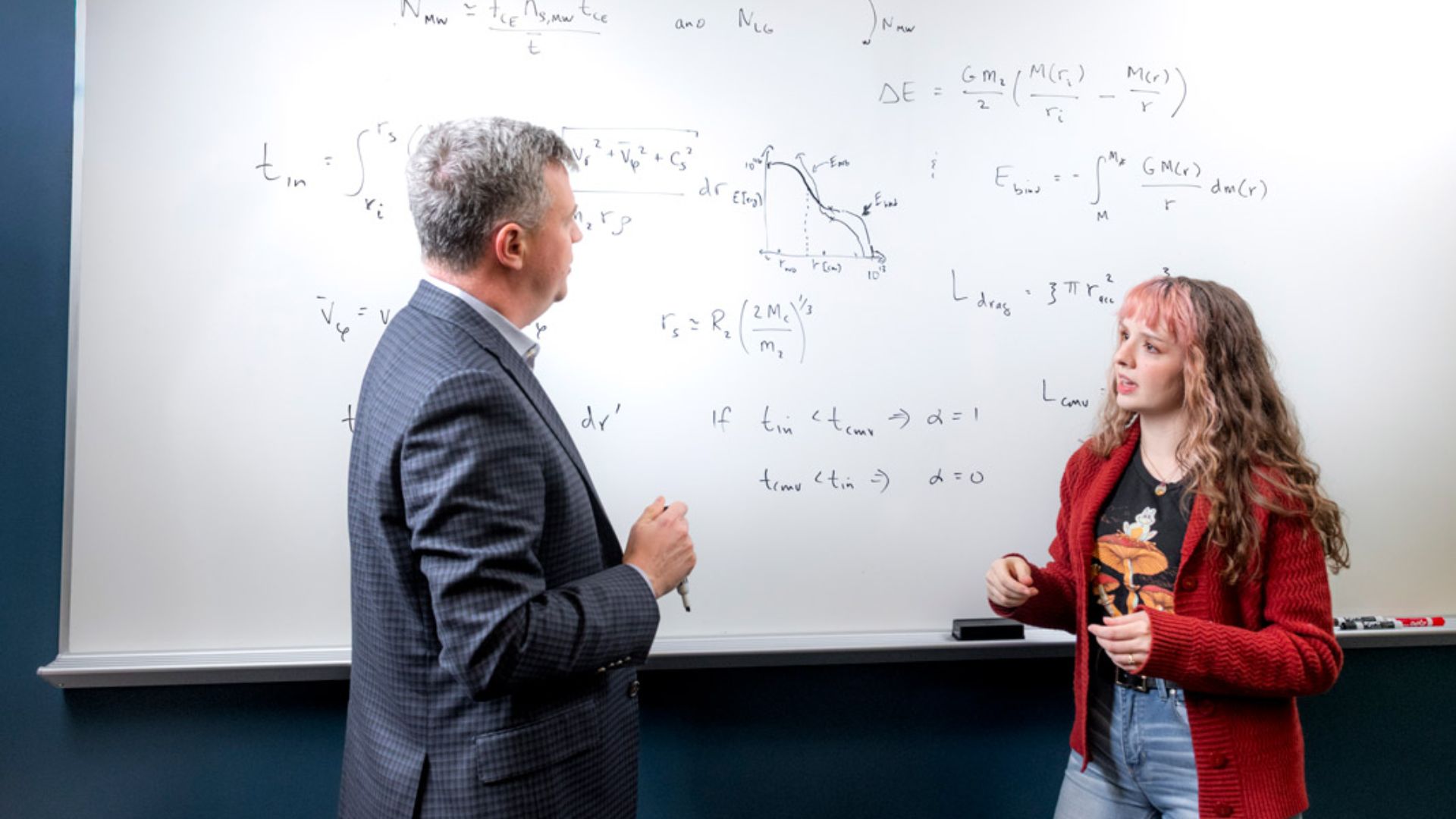
Rochester, New York – Rochester Institute of Technology researchers are venturing deep into one of astronomy’s most elusive mysteries, using artificial intelligence to detect rare stellar events that normally slip past even the most powerful telescopes. Their work is uncovering hidden stories about how stars live, collide, and eventually die—stories that unfold only briefly and are easy to miss.
At the center of this effort is Jason Nordhaus, an associate professor of physics at the National Technical Institute for the Deaf and a faculty member in RIT’s Center for Computational Relativity and Gravitation. With support from the National Science Foundation, Nordhaus and his team are working to identify unusual star systems that can reveal how stars interact when one consumes the other. These dramatic stellar encounters, which occur when a star engulfs a companion star, are among the rarest events in the galaxy. Even though one may happen once a year in the Milky Way, astronomers often miss the signs because the evidence fades almost immediately.
“The systems we are looking for are composed of a star in a one-day orbit around the dead core of the star it tore apart. Identifying these binaries in clusters holds the key to answering one of the biggest unknowns in stellar astrophysics,” explained Nordhaus. “Star clusters provide extra information that can be leveraged, such as their ages, compositions, and the evolutionary state when the star was consumed.”
These fleeting clues are critical because they help scientists understand the “common envelope phase,” a period when two stars become trapped inside a shared outer layer. This phase can dramatically reshape the future of both stars and is central to how close binary systems—and eventually gravitational waves—are formed. But because the signs vanish so quickly, researchers have struggled for decades to gather enough examples to build a complete picture.
To overcome that challenge, Nordhaus turned to a new approach: artificial intelligence. Working alongside RIT astrophysical sciences and technology Ph.D. student Bailey Filer and collaborators from the University of Toronto, Boston University, and the University of California San Diego, the team developed mathematical tools that allow AI to sift through vast amounts of astronomical data. Instead of waiting for a rare event to be caught in real time, the system hunts for the subtle fingerprints these interactions leave behind.
The results have been striking. Using their new method, the researchers uncovered 52 potential star systems that may have undergone these extraordinary interactions—an unprecedented number. Several of these candidates were found in star clusters that astronomers have studied for decades, meaning the systems were hiding in plain sight. Among them, Nordhaus said, one appears to be “pristine,” offering an unusually clear view of what happens when a star begins to swallow another during the common envelope phase.
For Filer, who is working on the theoretical and simulation side of the project, joining a team probing such rare cosmic behavior has been energizing both scientifically and personally. “The work that I’m doing takes just a little chip off of the problem we’re studying, and many other people are going to continue to chip away at it,” she said. “That kind of collaboration is really cool in and of itself.”
Nordhaus has made mentorship a key part of his research, continuously bringing both undergraduate and graduate students into complex scientific projects. For him, teaching and discovery go hand in hand. “There can be a perception that students in labs aren’t performing critical tasks but, at RIT, our students, from undergraduates to doctoral candidates, are an integral part of our research. As a team, we look forward to experiencing that never-ending enthusiasm for science and discovery together.”
As AI becomes more deeply woven into astronomy, projects like this one show how powerful the technology can be when paired with human curiosity and collaboration. The work of these RIT “star hunters” is creating new opportunities to explore how stars transform, collide, and sometimes destroy one another—phenomena that shape the evolution of galaxies and the origins of gravitational waves.
With dozens of new candidate systems now identified, Nordhaus and his team are preparing for the next stage: analyzing these stellar clues one by one, building a clearer portrait of what happens when stars meet their end in the most dramatic way imaginable.


-
 Local News2 years ago
Monroe County announces legal proceedings against properties listed in official public notice of foreclosure
-

 Local News2 years ago
New ALDI store close to Rochester to begin construction in late 2025 or early 2026
-

 Local News2 years ago
County Executive Adam Bello and members of the county legislature celebrate exceptional young leaders and advocates at the 2025 Monroe County Youth Awards
-
 Local News1 year ago
The 2025 Public Market Food Truck Rodeo series will begin this Wednesday with live music by the Royal Bromleys