Local News
Venture Creations startup company is charting a new path in the future of breast cancer detection technology

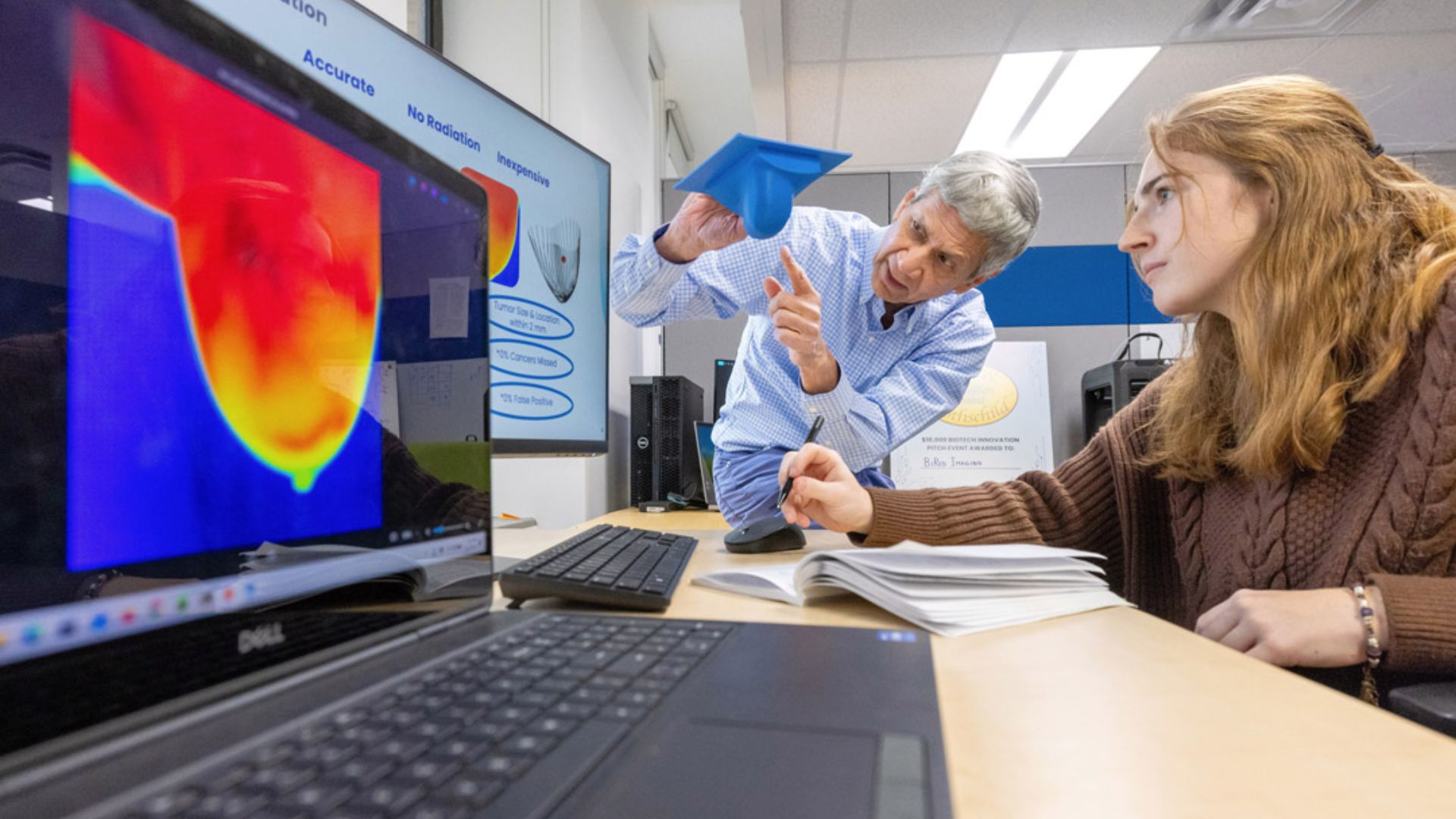
Rochester, New York – A small startup inside RIT’s Venture Creations incubator is quietly pushing forward a new chapter in breast cancer detection—one that may spare patients from some of the most uncomfortable and stressful parts of traditional screening. BiRed Imaging, founded in 2020 by RIT mechanical engineering professor Satish Kandlikar, is demonstrating how a thoughtfully designed combination of infrared imaging, physics-based modeling, and artificial intelligence can change what early detection looks and feels like.
BiRed Imaging’s early results are drawing attention because the company’s method sets itself apart from mammography, which has served as the standard for decades. Traditional mammograms rely on breast compression and, in many cases, expose patients to radiation. They remain effective as a general screening tool, but they also have well-known limitations—particularly for patients with dense breast tissue. False alarms are common, leading to painful biopsies, follow-up scans, and anxiety-filled waiting periods for patients who are eventually told there was no cancer at all. Supplemental screening tools like ultrasound and MRI can provide additional detail, yet they bring their own drawbacks such as higher cost, operator dependence, and in some cases, additional radiation.
Kandlikar and his team are working to create a system that can reduce many of these burdens. Their technology captures thermal signatures using infrared imaging. Because tumors often generate more metabolic heat than surrounding tissue, those heat patterns become a new kind of diagnostic marker once they are processed by BiRed’s physics-informed AI algorithm. And importantly, the process is simple for the patient: she lies comfortably on an open imaging table, with no compression, no radiation, and no need for a specialized operator to run the system.
“It is safe to assume that just about everyone has been touched in some way by cancer, whether personally or with a loved one or friend,” said Kandlikar. “The research that our team is doing has meaning—for us, for patients, for breast cancer clinics and hospitals. Our technology, which is non-radiative and contactless, promises an improved patient experience, fewer unnecessary invasive procedures, and cost-savings for an overburdened healthcare system.”
Early clinical studies suggest the approach has real potential. In its initial work with 41 patients, BiRed’s technology successfully predicted when a tumor was present—and when it was not. According to Kandlikar, that accuracy translates directly into practical benefits: fewer false positives, fewer biopsies, fewer follow-up scans, and reduced overall costs for screening centers and hospitals. These outcomes address a major issue for health systems nationwide. A widely cited study from Health Affairs estimated that false-positive mammograms and overdiagnoses cost the U.S. roughly $4 billion each year.
As promising as the technology is, BiRed Imaging’s model also emphasizes education and hands-on learning for RIT students. One of the young researchers helping advance the work is Sarah Fink, a second-year biomedical engineering student from Syracuse, N.Y. She joined the company as a biomedical research assistant through a co-op assignment and quickly became an essential member of the team.
“I’m working with AI, software, and mechanical engineers on a biological topic, so by having some expertise as a biomedical engineering undergrad, I’m able to help bridge the biomedical aspects with the technical process as a whole,” said Fink.
Her responsibilities include assisting with patient imaging and learning the technical and clinical workflows that make BiRed’s process possible. For a student, it’s an uncommon opportunity—one that intertwines academic training with a tangible, real-world impact on women’s health.
The company has also drawn in several recent graduates who now work full time on the project. Carlos Gutierrez ’24 Ph.D. (engineering) serves as chief technical officer, while Atharva Sundge ’25 MS (artificial intelligence) and Abhinav Kalsi ’25 MS (artificial intelligence) contribute as AI and software engineers. Their roles highlight how the venture has grown from a concept into a functioning research and development team pursuing clinical validation and commercialization.
BiRed Imaging’s momentum has been supported by multiple rounds of external funding. The National Science Foundation has awarded the company nearly $556,000 to support prototype development, refine its algorithm, and expand its clinical studies. Additional funding arrived through New York state’s innovation grant program, including a recent $100,000 award to accelerate its next stages, and the RIT Venture Fund has also invested in the company’s growth. With a series of partners behind it, BiRed has begun screening patients in collaboration with Rochester Regional Health—another key step toward determining its effectiveness as an adjunctive clinical tool.
For Fink, being part of this rapid progress is both energizing and humbling. “I’m so incredibly lucky and grateful to be a part of this team and to see how my work is directly impacting our next steps as a small company,” she said. “I get chills thinking and talking about BiRed’s future knowing that I’m working toward making a difference in the field of breast cancer detection. It’s truly a unique experience.”
As BiRed Imaging continues its research, the company stands at a meaningful intersection of engineering, medicine, and patient care. With the potential to reduce unnecessary procedures, improve the screening experience, and lower costs for an already strained healthcare system, the startup is showing how innovation from a small team can ripple outward in significant ways. If its early promise holds, BiRed may soon reshape a process that millions of women experience every year—and redefine what compassionate, accurate breast cancer detection can look like.


-
 Local News2 years ago
Monroe County announces legal proceedings against properties listed in official public notice of foreclosure
-

 Local News2 years ago
New ALDI store close to Rochester to begin construction in late 2025 or early 2026
-

 Local News2 years ago
County Executive Adam Bello and members of the county legislature celebrate exceptional young leaders and advocates at the 2025 Monroe County Youth Awards
-

 Local News1 year ago
The 2025 Public Market Food Truck Rodeo series will begin this Wednesday with live music by the Royal Bromleys