Local News
McCarthy advances women’s healthcare education by creating a groundbreaking new mammography training tool

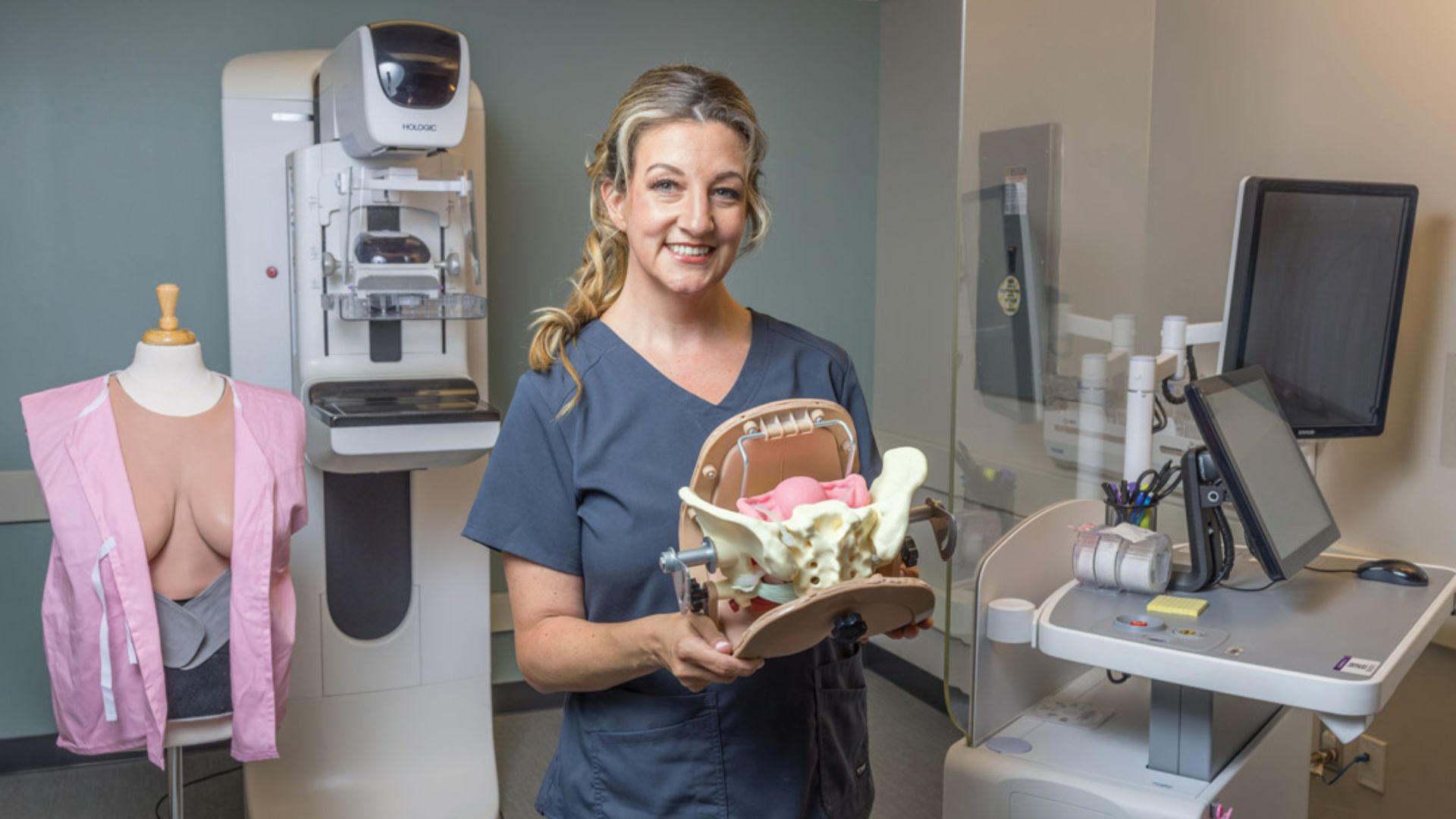
Rochester, New York – For decades, mammography has stood as one of the most essential tools for detecting breast cancer early, yet many practitioners learning the craft face the same stubborn obstacle: there simply are not enough realistic training options to prepare them for the precision needed in real clinical settings. Despite the fact that mammography is recommended for every woman in the United States over the age of 40—a group that makes up roughly one-quarter of the population—the educational pathway for mastering proper positioning has been missing a crucial piece.
That gap is now being filled through the vision and determination of Erica (Neadom) McCarthy ’03, a medical illustration graduate whose career unexpectedly evolved into one of the most meaningful fronts in medical simulation. As president of Bloom Medical Simulation, McCarthy is leading the charge behind a tool that many in the field have long hoped would exist. Her creation, MammoVest, is the first anatomically accurate training device designed specifically for learning breast positioning in mammography. Its purpose is straightforward but long overdue: to give learners a hands-on opportunity to practice the physical steps of the procedure without needing a live patient.
McCarthy’s mission is rooted deeply in research, which continues to show how vital proper technique is in catching abnormalities. “Research shows that 10 to 30 percent of breast cancers can be missed by mammography due to positioning errors,” said McCarthy. “A tool like MammoVest can help save the lives of women around the world.”
For Bloom, the innovation is not a standalone product but a reflection of its broader goal. As a division of One World Design and Manufacturing Group (OW DMG), the company blends advanced engineering, detailed anatomical modeling, and medical insight to create educational tools for complex procedures. McCarthy’s branch, founded in 2025, focuses heavily on women’s healthcare, carefully identifying where medical training tools fall short and building high-fidelity simulations to close those gaps.
“The work we do gives practitioners a chance to physically walk through the steps, gain muscle memory, and ask questions along the way—a chance to learn and make mistakes,” said McCarthy.
Her journey into this specialized work began long before Bloom existed. After joining OW DMG as a medical illustrator, McCarthy grew rapidly within the organization, drawing on an education that spanned both scientific rigor and artistic skill. Studying human anatomy, performing cadaver dissections, and documenting surgeries gave her a foundation that many designers never experience firsthand. At the same time, woodworking, sculpting, and 3D-modeling classes helped her develop the intuition needed to transform anatomical knowledge into functional physical models. “The education I received at RIT was so varied. It really built up my confidence to go out and innovate,” she said.
Before MammoVest took shape, McCarthy contributed to a number of widely used simulation tools, including the PELVIC Mentor for Surgical Science, the Bladder Catheterization Simulator for Erler-Zimmer, and the Miya Model Pelvic Surgery Training Model for Miyazaki Enterprises. Each project refined her ability to design devices that feel realistic, behave predictably, and meet strict medical training needs.
MammoVest began as a project for Hologic, one of the largest mammography equipment manufacturers in the world. The company needed a demonstration model to showcase a new compression paddle at an industry convention without relying on a live person. McCarthy accepted the challenge and created a prototype that immediately drew attention. “The attention the MammoVest prototype got in that booth was incredible. Mammography technologists told us that they were looking for a tool like this their entire lives,” said McCarthy.
The excitement around that prototype marked the beginning of a wider effort. In response to demand from educators and technicians, Bloom launched a pilot program and produced 29 prototype units, distributing them across seven countries. The global interest confirmed what McCarthy and her team predicted: the need for realistic mammography training tools is not isolated to one region—it is widespread. With additional support secured in 2020 through a Small Business Innovation Research grant from the National Institutes of Health, MammoVest entered full development and continues to be used around the world today.
But McCarthy’s ambitions extend beyond mammography. Her passion lies in tackling the overlooked corners of women’s healthcare where practitioners often receive minimal hands-on experience. One of Bloom’s next projects, EpisioPants, is being created to help learners practice performing and repairing episiotomies—procedures that occur only in high-pressure emergency childbirth situations but require practiced skill. “Practitioners learn these procedures in school, but they don’t get much of a chance to practice,” she said. “Our goal is to contribute to this sphere in a very focused way.”
As medical education grows increasingly reliant on realistic simulation, McCarthy’s work stands as an example of how thoughtful design can have measurable clinical impact. By creating tools that allow learners to rehearse intricate procedures repeatedly and safely, her team is helping shape a future in which fewer breast cancers are missed and more practitioners enter their fields with the confidence that only hands-on training can provide.


-
 Local News2 years ago
Monroe County announces legal proceedings against properties listed in official public notice of foreclosure
-

 Local News2 years ago
New ALDI store close to Rochester to begin construction in late 2025 or early 2026
-

 Local News2 years ago
County Executive Adam Bello and members of the county legislature celebrate exceptional young leaders and advocates at the 2025 Monroe County Youth Awards
-

 Local News1 year ago
The 2025 Public Market Food Truck Rodeo series will begin this Wednesday with live music by the Royal Bromleys