Local News
Researchers at the University of Rochester develop advanced metasurface technology that could greatly improve image clarity and brightness in next-generation augmented reality glasses

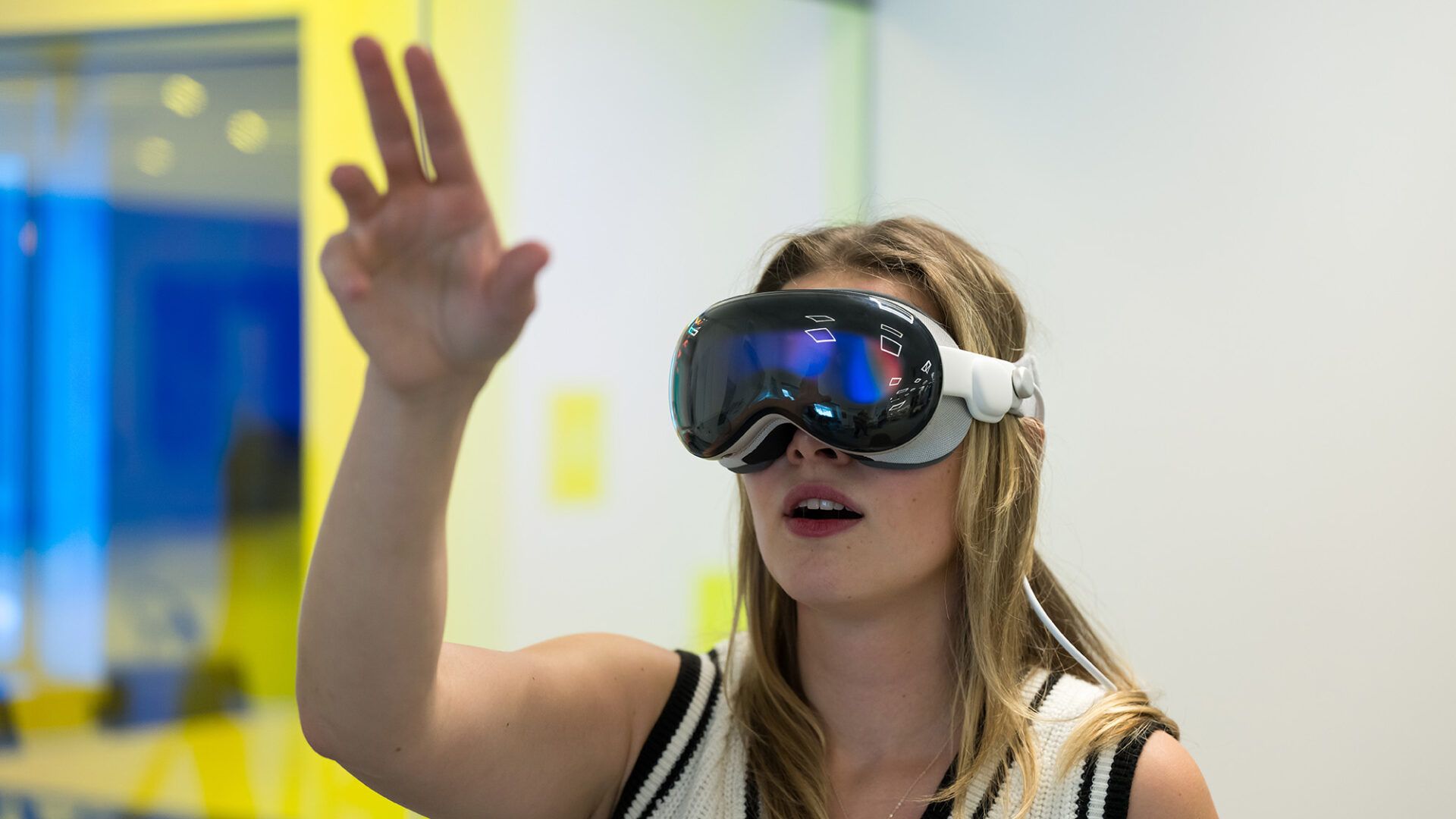
Rochester, New York – Scientists at the University of Rochester have taken a significant step toward solving one of augmented reality’s biggest hurdles: making AR glasses bright, clear, and energy-efficient enough for everyday use. Their new study, published in Optical Materials Express, describes how a carefully engineered optical component built from metasurfaces — materials structured at the nanoscale — could drastically improve image clarity and brightness in future AR headsets.
“Many of today’s AR headsets are bulky and have a short battery life with displays that are dim and hard to see, especially outdoors,” says research team leader Nickolas Vamivakas, the Marie C. Wilson and Joseph C. Wilson Professor of Optical Physics with URochester’s Institute of Optics. “By creating a much more efficient input port for the display, our work could help make AR glasses much brighter and more power-efficient, moving them from being a niche gadget to something as light and comfortable as a regular pair of eyeglasses.”
For years, engineers have faced the same problem: when you try to cram advanced optics, electronics, and displays into something as small as a pair of glasses, compromises pile up. The waveguides that channel light into the lenses tend to scatter and lose a lot of brightness along the way. That’s why most current AR glasses look washed out, especially under sunlight, and why the headsets drain batteries so quickly.
The Rochester team believes metasurfaces could be the key to overcoming these limitations. Unlike traditional optical elements, metasurfaces use tiny, precisely patterned nanostructures—each smaller than the wavelength of light—to control how light behaves. They can bend, focus, and filter light with incredible accuracy, all while remaining thinner than a strand of human hair.
“We report the first experimental proof that this complex, multi-zone design works in the real world,” says Vamivakas. “While our focus is on AR, this high-efficiency, angle-selective light coupling technology could also be used in other compact optical systems, such as head-up displays for automotive or aerospace applications or in advanced optical sensors.”
Reimagining the Heart of AR Displays
In most AR systems, a small display projects images into a transparent lens using what’s called an “in-coupler.” That component injects the virtual image into the waveguide so it can overlay the real-world view. However, these in-couplers are notoriously inefficient. A large portion of the light is either reflected, misdirected, or lost altogether before reaching the wearer’s eyes.
To address this, the University of Rochester researchers redesigned the in-coupler from the ground up. Instead of relying on a single uniform surface, they divided it into three specialized zones — each made from metasurface material, each tuned to handle light in slightly different ways. By working together, these zones guide more light into the waveguide while maintaining its intended shape and focus.
“Metasurfaces offer greater design and manufacturing flexibility than traditional optics,” Vamivakas explains. “This work to improve the in-coupler, a primary source of light loss, is part of a larger project aimed at using metasurfaces to design the entire waveguide system, including the input port, output port and all the optics that guide the light in between.”
This three-zone design proved to be much more than a theoretical concept. In earlier research, the team had predicted through computer modeling that dividing the in-coupler into separate functional areas would yield far greater efficiency. But until now, no one had managed to demonstrate that such a design could actually be built — and perform well — in real-world testing.
Testing the Design in the Lab
To verify the concept, the researchers fabricated the three metasurface zones individually and then assembled them into a single working prototype. Using a custom-built optical setup, they measured how efficiently each section captured and directed light into the waveguide across different viewing angles.
The results closely matched their predictions. Across most of the viewing range, the average measured efficiency reached 30 percent, compared to the simulated 31 percent. Only at the outer edge of the field of view — specifically at -10 degrees — did the efficiency drop to 17 percent, lower than the predicted 25.3 percent. The researchers attributed this to minor fabrication imperfections and the design’s high sensitivity to light entering at extreme angles.
Even with that slight drop, the numbers were impressive. The prototype successfully demonstrated that complex, multi-zone metasurface in-couplers can outperform traditional designs by capturing more light and directing it more precisely into the display.
“This paper is the first to bridge the gap from that idealized theory to a practical, real-world component,” says Vamivakas. “We also developed an optimization process that accounts for realistic factors like material loss and non-ideal efficiency sums, which the theory alone did not.”
Toward Full-Color and Commercial Designs
The current prototype operates using green light, which simplifies testing and measurement. However, the team’s long-term goal is to adapt the technology for full-color (RGB) operation — a necessary step before AR glasses can display lifelike, full-spectrum images.
The researchers are now refining their optimization process to improve fabrication tolerances and reduce performance drops at the edges of the viewing field. They’re also beginning to apply the same design framework to other components within the waveguide system, such as the output port that delivers the image to the eye.
Eventually, they hope to build an entirely metasurface-based waveguide that handles light more efficiently from start to finish. Once that’s achieved, the next challenge will be integration. To make this technology viable for real-world products, it will need to work seamlessly with actual micro-display engines — the tiny projectors that create the AR imagery — as well as with other optical elements that ensure clear, distortion-free visuals.
From Lab Prototype to Everyday Use
The leap from laboratory breakthrough to consumer-ready AR glasses remains significant. The researchers note that future development will depend heavily on advancing manufacturing methods capable of producing these intricate nanostructures at scale.
Because each metasurface must be patterned with nanometer precision, traditional manufacturing approaches are too slow and expensive for mass production. Developing a high-throughput, low-cost process will be key to commercial viability.
Still, the Rochester team’s results mark a major milestone. The ability to experimentally prove that a multi-zone metasurface in-coupler works — and works efficiently — represents a foundational advance in AR display design.
It also opens doors far beyond augmented reality. The same light control methods could enhance head-up displays in vehicles, compact optical sensors in aerospace systems, and even next-generation medical imaging devices.
“By creating a much more efficient input port for the display, our work could help make AR glasses much brighter and more power-efficient,” says Vamivakas. “It’s a step toward moving them from being a niche gadget to something as light and comfortable as a regular pair of eyeglasses.”
If future refinements continue at this pace, the dream of sleek, battery-friendly AR glasses that function like today’s smartphones might soon be within reach. Metasurfaces, with their ability to manipulate light on a scale invisible to the human eye, could be the technology that finally brings that vision into focus.


-

 Local News1 year ago
Monroe County announces legal proceedings against properties listed in official public notice of foreclosure
-

 Local News2 years ago
New ALDI store close to Rochester to begin construction in late 2025 or early 2026
-

 Local News1 year ago
County Executive Adam Bello and members of the county legislature celebrate exceptional young leaders and advocates at the 2025 Monroe County Youth Awards
-

 Local News1 year ago
The 2025 Public Market Food Truck Rodeo series will begin this Wednesday with live music by the Royal Bromleys