Local News
RIT student designs magnet storage stands for the world’s first Electron-Ion Collider

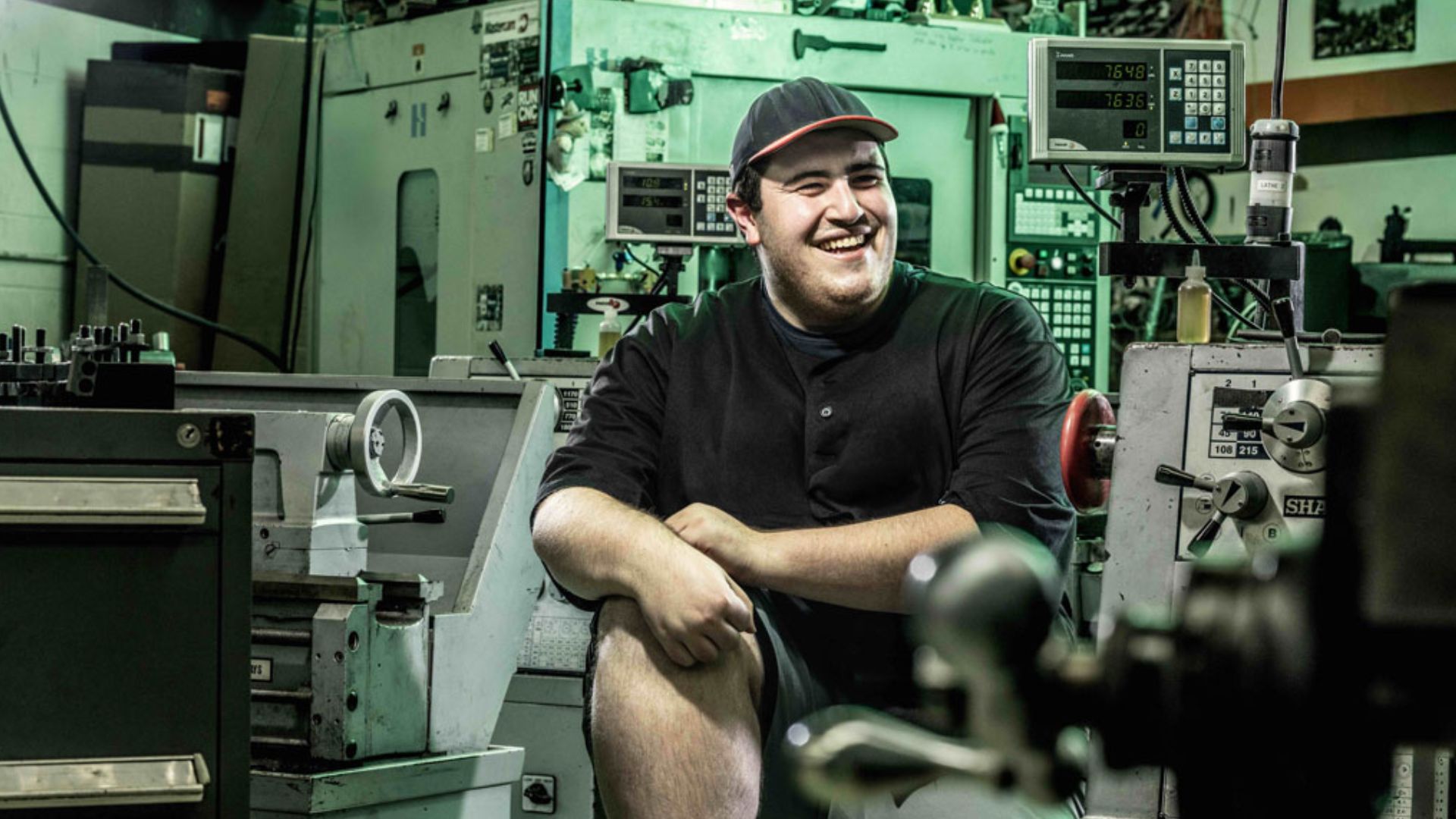
Rochester, New York – A summer engineering assignment gave Rochester Institute of Technology student Robert Desjardins a role in preparing for the world’s first Electron-Ion Collider. His task was practical but demanding. Brookhaven National Laboratory needed stronger, more efficient storage stands for enormous superconducting magnets, with little room to spare.
Desjardins, a fourth-year mechanical engineering technology student, spent 10 weeks developing a design that could hold four magnets instead of three. Each magnet stretches 20 feet and weighs more than 10,000 pounds. The stands needed to support loads of up to 45,000 pounds while fitting within the laboratory’s available space.
The work will help the U.S. Department of Energy laboratory preserve equipment for its next major particle accelerator. Magnets removed from Brookhaven’s Relativistic Heavy Ion Collider, known as RHIC, will be stored for reuse in the Electron-Ion Collider, or EIC. RHIC has been in service for more than 26 years. The new collider is expected to begin operating in the mid-2030s, helping scientists investigate the building blocks of matter.
For Desjardins, the assignment involved much more than making an existing structure taller. He reviewed older plans, revised digital models, spoke with manufacturers and tested how the proposed stands would handle heavy loads.
“The original stands were designed in the 1990s, and at the time they could hold only three of the magnets. They wanted to up the capacity to four,” said Desjardins. “I had to get my project fully designed, look at blueprints, revise computer-aided models, and start talking to the manufacturers and simulate some of the strength tests required.”
His mentor was Jonathon Greene, a Brookhaven mechanical engineer who graduated from RIT’s mechanical engineering program in 2015. Greene helped oversee the project and met regularly with Desjardins as the prototype developed.
The redesign also brought a substantial financial benefit. In an article published by Brookhaven, Greene credited the student with increasing storage capacity while lowering the cost of the original design.
“Rob costed down the original design while increasing the height. We saved about $420,000 by doing so.”
Greene expects roughly 80 magnets to be removed from RHIC and stored for the EIC using Desjardins’s design. That makes the stands an important part of keeping existing equipment available for the new facility.
Before reaching that stage, however, the design required extensive checking. Desjardins presented progress reports to a broader group of engineers and scientists, answering detailed questions about his material choices, safety reviews and simulation results. Those reviews covered load capacity as well as seismic analysis.
The testing took up a large share of the internship. Designing a structure capable of supporting such heavy equipment meant checking how it would perform under demanding conditions, then reviewing the results carefully.
“In engineering you have to simulate for the worst at all times. I did so many simulations; the design was half the project. The other half was performing the simulations and checking my work,” said Desjardins.
A native of West Sayville, N.Y., Desjardins is also pursuing a master’s degree in mechatronics and mechanical systems through RIT’s College of Engineering Technology. He said coursework in three-dimensional modeling, strength of materials and load tolerance helped prepare him for the Brookhaven assignment.
The internship put those classroom skills into use on a project with real requirements for cost, space and safety. It also gave him repeated opportunities to explain his decisions to experienced professionals and respond to their questions as the work progressed.
Both Desjardins and Greene credit internships and cooperative education experiences with helping students succeed in engineering. Such placements allow students to apply technical knowledge while gaining a clearer understanding of the work they may pursue after graduation.
RIT’s co-op and internship program is among the oldest and largest in the country. More than 4,000 of its students completed co-ops or internships last year, taking paid positions with national and international companies and organizations across nearly every industry.
At Brookhaven, Desjardins’s contribution addressed a specific challenge within a much larger scientific effort. The storage stands will help bridge the transition between two generations of collider equipment, allowing magnets from RHIC to be kept for future use.
For the student, working alongside the people responsible for that transition was a highlight of the summer.
“This was such a great experience, to learn and hear feedback on a project from experienced engineers, experts at their craft, and to be part of such a huge international project,” said Desjardins. “This was all real teamwork and it was great.”


-

 Local News1 year ago
Monroe County announces legal proceedings against properties listed in official public notice of foreclosure
-

 Local News2 years ago
New ALDI store close to Rochester to begin construction in late 2025 or early 2026
-

 Local News1 year ago
County Executive Adam Bello and members of the county legislature celebrate exceptional young leaders and advocates at the 2025 Monroe County Youth Awards
-

 Local News1 year ago
The 2025 Public Market Food Truck Rodeo series will begin this Wednesday with live music by the Royal Bromleys