Local News
RIT student wins HackMIT grand prize with low-cost device designed to help test medicine authenticity

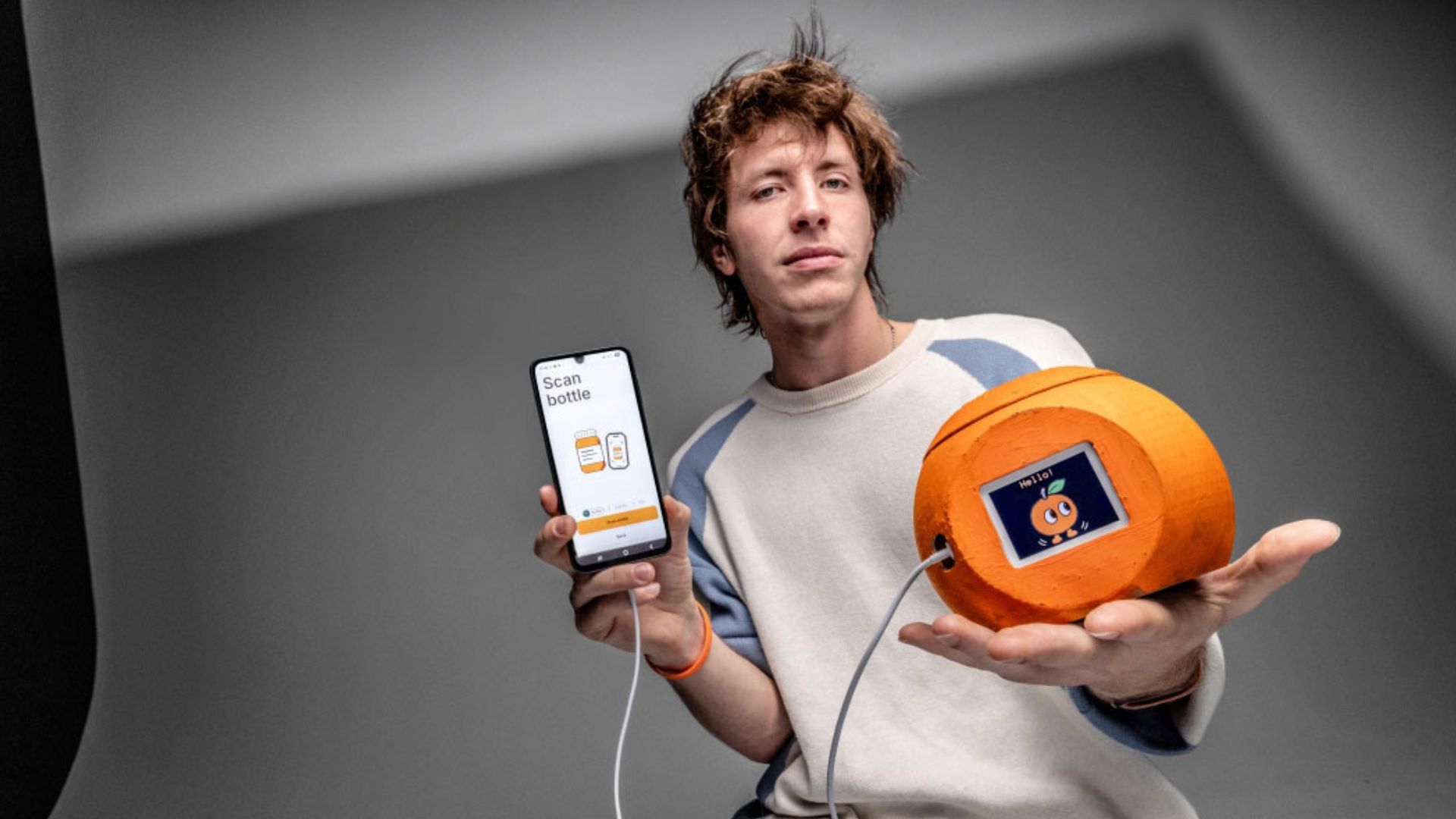
Rochester, New York – A Rochester Institute of Technology student and three teammates from universities across the United States won the top prize at HackMIT 2026 after creating a low-cost device designed to help people determine whether medicine may be authentic.
The device, called Peel, was developed during the Massachusetts Institute of Technology’s annual hackathon. The event brings together more than 1,000 students from around the world and gives them just 24 hours to create software and hardware projects.
Leo Pozhenko, an RIT student from Austin, Texas, worked on the project with Alan Tai of Northwestern University, Viktor Minchev of the University of California, Santa Barbara, and Nikhil Ramlukan of Johns Hopkins University.
Their work earned them the HackMIT grand prize and $8,000.
“Honestly, none of us expected to win the whole thing,” said Pozhenko, who is from Austin, Texas. “Our team built something we thought was useful and it meant a lot that the judges saw it that way too.”
Pozhenko is completing a combined accelerated bachelor’s and master’s degree at RIT in software engineering and computer science. His team entered HackMIT’s healthcare track with an idea aimed at addressing a serious problem in many parts of the world — medicines that are falsified or do not meet expected quality standards.
According to the World Health Organization, an estimated one in 10 medicines in low- and middle-income countries is substandard or falsified. Such medicines can create significant health risks and, in some cases, contribute to deaths.
Existing testing equipment can also be expensive. Some tools used to examine medicines cost tens of thousands of dollars, putting them out of reach for many individual consumers and communities.
Pozhenko and his teammates wanted to see whether they could build something much cheaper.
The result was Peel.
“The internal components come to just under $30,” said Pozhenko. “And it’s not in a lab—you can use it at home. This could put the power in the hands of the people.”
A different approach to testing medicine
Peel uses three independent observations when examining a medicine.
Part of the process relies on vision models, which extract information from photographs of prescription bottles and pills. Another part involves an optical dissolution tester that connects to a phone.
The device uses light to examine how a pill dissolves in water.
Information collected during that process is then combined with data from drug and regulatory databases using an AI evidence engine. The system produces a report that can help indicate whether the medicine behaves as expected or whether further laboratory testing may be necessary.
The device is not intended to directly analyze a pill’s chemical composition.
“It checks how a pill dissolves, not its chemical composition,” said Pozhenko. “And, as opposed to using specific acids, we can do this process using something accessible to anyone—water.”
The low-cost approach was central to the project. Rather than requiring specialized laboratory conditions and expensive materials, the students built the prototype around hardware that could potentially make testing more accessible.
For Pozhenko, however, getting to HackMIT in the first place was almost an afterthought.
He had not initially planned on attending the competition and submitted his application only two hours before the deadline.
At the time, Pozhenko was working late during a summer internship at Elsevier. With the swim season approaching, he decided he wanted to participate in a hackathon before his schedule became busier.
He had previously taken part in only one hackathon.
“I was just thrilled to be accepted,” said Pozhenko. “There are several tracks for the event. I wanted to do the healthcare track because that is a way to directly impact people.”
Shortly before the event, Pozhenko connected online with other students who shared an interest in the healthcare category.
The group began discussing the problem of falsified antimalarial medicines. Their conversation eventually turned to the possibility of collecting useful information by observing what happens when a pill dissolves in water.
Pozhenko then looked through the hardware available for competitors.
“I opened the pre-approved list of hardware for the hackathon and said, ‘Yeah, this is totally possible,’” said Pozhenko.
Building Peel in 24 hours
Pozhenko took responsibility for the hardware side of the project.
He designed the circuit and the enclosure using CAD, constructed the magnetic stirrer and wrote more than 1,500 lines of C++ firmware for the microcontroller.
Peel uses six LEDs covering wavelengths from infrared to violet. Different wavelengths of light are directed through the pill as it dissolves, allowing the device to collect measurements throughout the process.
The physical appearance of the prototype also became part of the team’s work.
A banana shape was considered but proved impractical for fitting the necessary components. The students instead settled on an orange-shaped design. Pozhenko painted the device orange and also created the small orange character used in the accompanying app.
Behind the playful design was a substantial amount of data.
Peel uses Elastic AI search to compare test results with information gathered from drug and regulatory databases.
The team created five indices containing large amounts of information. Those records included 22,000 recalls and safety alerts from five regulators, 138,000 National Drug Code products and 84,000 reference pills.
Once Peel gathers its observations, the AI evidence engine can produce a report within seconds.
The students also designed the system with future use in mind.
Each scan can contribute information to a shared library showing how genuine medicines behave. The idea is that the system could become more accurate as more people use it and additional information becomes available.
The team also developed a graph intended to help identify where substandard pills may have originated.
Getting all those pieces working within HackMIT’s 24-hour time limit was not easy.
The group encountered problems almost immediately.
Their first attempt at 3D printing the device failed after a power outage. When they needed painting supplies early in the morning, they used DoorDash to have paint and brushes delivered from a nearby store.
They also came close to exhausting their Deepgram credits during the demonstration.
Then there were hardware problems.
While installing the mini breadboard, Pozhenko accidentally loosened a ground connection, causing the device to stop working.
The limited time available also meant there was little opportunity for sleep.
“I went to take a 10-minute nap on the couch at 6 a.m., and we all woke up three hours later,” Pozhenko said. “We scrambled to finish and shoot the video demo before the deadline. We hit almost every problem you can hit in 24 hours and still shipped a working demo.”
Despite the setbacks, the team completed the project in time.
Their work ultimately earned more than just HackMIT’s overall grand prize. Peel also took first place in the Find the Signal track, which was sponsored by software company Elastic.
Plans for the next version
The HackMIT prototype is not expected to be the end of the project.
Pozhenko and his teammates plan to continue developing Peel and are already considering changes for a second version.
One priority is accuracy. The students want to improve the system’s ability to evaluate the information it collects while also reducing the physical size of the electronics.
Their goal is eventually to make the entire Peel device roughly the size of an orange.
The team also wants to address another limitation of the current approach. Because the prototype analyzes the way a pill dissolves in water, the testing process consumes the medicine being examined.
A future version could make the testing process non-destructive, allowing users to examine medicine without losing the dose.
For Pozhenko, the project brought together skills developed through his studies at RIT and the pressure of solving technical problems in a very short period of time.
In addition to studying software engineering and computer science, he is a member of RIT’s Division III men’s swim team and the Society of Software Engineers.
He credited several professors with helping prepare him for the challenges he encountered during HackMIT, including Kal Rabb, Richard Cliver, Daqing Hou and Gene Wolfe.
The knowledge gained through those courses, he said, helped him understand the hardware challenges and contribute ideas as the team rapidly moved from an initial concept to a functioning prototype.
“They gave me the foundation to understand what’s going on with hardware and to propose ideas to my team,” Pozhenko said.
What started with an application submitted only two hours before the deadline ended with a grand prize, a working prototype and plans to continue improving the technology.
For Pozhenko and his teammates, Peel now moves beyond the intense 24-hour HackMIT competition. Their next challenge will be refining the small, inexpensive device and exploring how far the idea of accessible medicine testing can go.
I can also create 10 longer, one-sentence news headlines for this article in the same capitalization style you usually use.


-
 Local News1 year ago
Monroe County announces legal proceedings against properties listed in official public notice of foreclosure
-

 Local News2 years ago
New ALDI store close to Rochester to begin construction in late 2025 or early 2026
-

 Local News1 year ago
County Executive Adam Bello and members of the county legislature celebrate exceptional young leaders and advocates at the 2025 Monroe County Youth Awards
-

 Local News1 year ago
The 2025 Public Market Food Truck Rodeo series will begin this Wednesday with live music by the Royal Bromleys