Local News
Mayor Evans dedicates 3,500-foot Turning Point Park boardwalk in honor of late Rochester Environmental Services Commissioner Edward J. Doherty

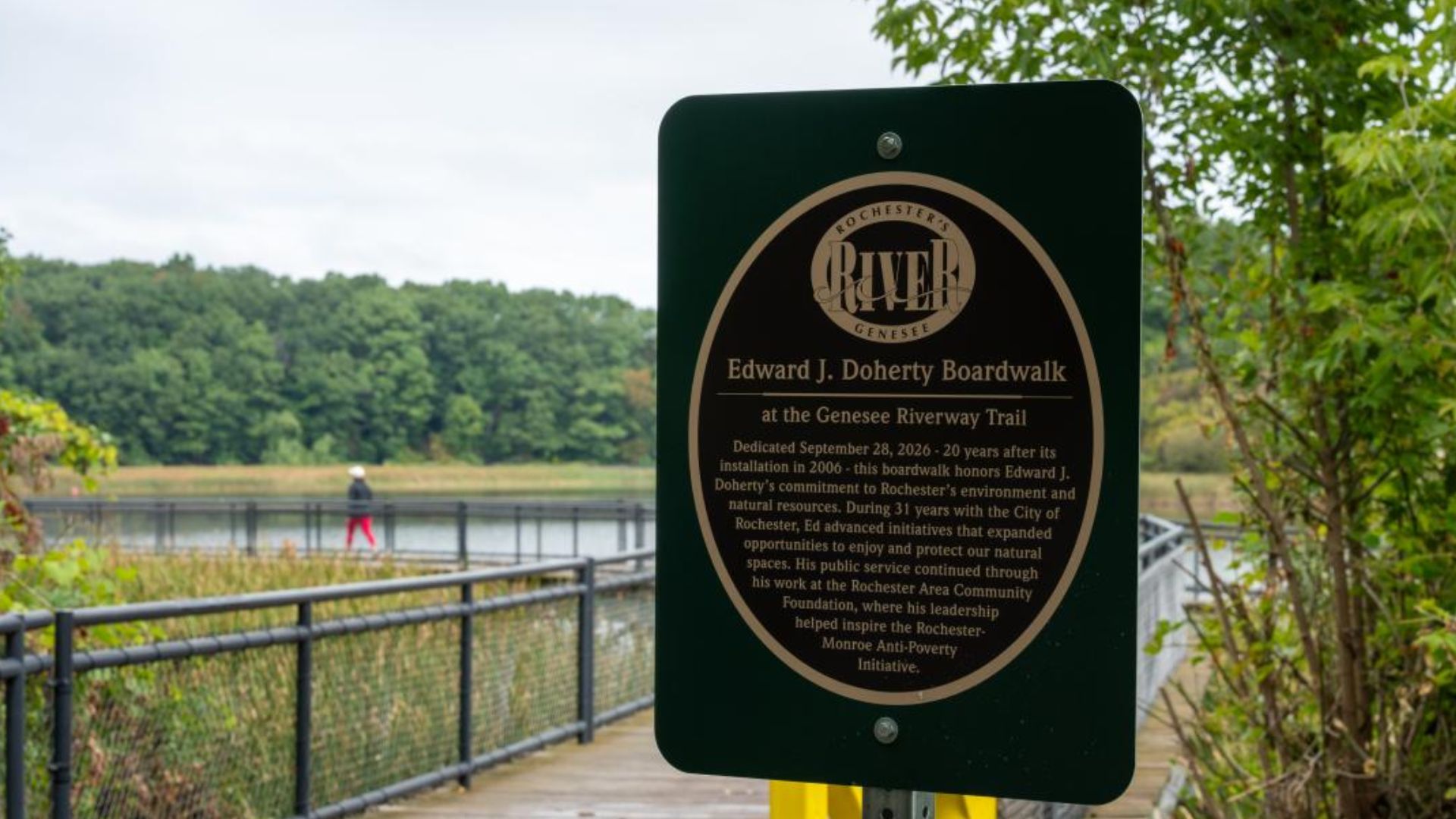
Rochester, New York – A major section of Rochester’s Genesee Riverway Trail now carries the name of a longtime city leader whose work helped shape the riverfront and expand public access to the city’s natural spaces.
Mayor Malik D. Evans held a dedication ceremony today at Turning Point Park, officially naming the 3,500-foot causeway bridge at the Turning Point Basin the Edward J. Doherty Boardwalk at the Genesee Riverway Trail. The ceremony also marked 20 years since the pedestrian bridge opened in 2006.
Doherty, who died in March 2026, spent more than three decades working for the City of Rochester. During that time, he held several important positions and played a major role in projects involving the environment, transportation, public access and the Genesee River corridor.
“Our City would look very different today if not for Ed’s vision, commitment, and sustained hard work,” said Mayor Evans. “It is fitting that we name this magnificent pedestrian bridge in his honor, in keeping with our tradition of recognizing the contributions of past visionaries who championed access to nature for city residents.”
The boardwalk at Turning Point Park is one of the most recognizable parts of the Genesee Riverway Trail. Its location through the river gorge presented unusual construction challenges, making the project far more complicated than a typical trail improvement.
Structural frames for the boardwalk had to be lowered into the gorge by helicopter. The project also faced a significant financial problem when construction bids came in about $1 million above the available budget.
Doherty, however, viewed the trail as too important to abandon.
The Turning Point Park section was intended to serve as a key connection between Downtown Rochester and the Port of Rochester in the Charlotte neighborhood. Doherty worked to find a way to close the funding gap, including negotiating for additional financial support from the New York State Department of Transportation and Rochester City Council.
His work on the riverfront went well beyond the Turning Point Park project.
As Commissioner of the City’s Department of Environmental Services from 1986 to 2005, Doherty was in a position to help develop a broader vision for the Genesee River corridor. He recognized that the river had significant value that was not being fully used and pushed for greater public access.
Read also: Governor Hochul directs 15 New York landmarks to shine gold for Gold Star Mothers and Families Day
Among the projects he helped guide was the development of the Genesee Riverway Trail as a citywide greenway following the river.
Doherty also led the development of the Thomas R. Frey Trail at El Camino. That effort began with the purchase of an abandoned railroad right-of-way that became the foundation for the trail.
Another important project involved Rochester Gas and Electric’s hydroelectric facilities at Middle Falls. Doherty helped lead the city’s involvement in the Federal Energy Regulatory Commission relicensing process for those facilities.
As part of that process, the city sought to have a pedestrian crossing of the Genesee River included as a condition of the license renewal.
The effort took years and required consideration of several different possibilities. Eventually, RG&E constructed a public walkway on top of the Middle Falls Dam. The walkway connected Lower Falls Park with St. Paul Street and became another important link in the Genesee Riverway Trail.
The project was completed at no cost to the city.
Doherty also directed the creation of a trail connection around the former Vacuum Oil site. The route connected Genesee Valley Park West with Ford Street and gave residents access to what city officials described as one of the best views of Rochester’s skyline.
Together, these projects reflected Doherty’s long-term focus on making the river and surrounding natural areas more accessible to Rochester residents.
His work with the city was not limited to parks and trails.
Before becoming Environmental Services Commissioner, Doherty served as Rochester’s City Budget Director from 1982 to 1986. In that position, he became one of the city’s lead negotiators during discussions that resulted in the 1985 Morin-Ryan Act.
The bipartisan City-County sales tax sharing agreement was created during a difficult period for Rochester, when the city faced severe financial pressure caused by a shrinking property tax base and rising municipal demands.
Doherty’s career also included a range of environmental and public service initiatives.
He led the city’s first comprehensive environmental management system and helped develop Monroe County’s first curbside recycling program. He also oversaw the introduction of mobile arm vehicles used to collect refuse bins.
In addition, Doherty worked with the city’s union to introduce single-operator refuse collection. He started the city’s anti-graffiti program and supervised the implementation of an automated water meter reading system.
After 31 years with the City of Rochester, Doherty retired from municipal government in 2005. Retirement, however, did not mark the end of his public service.
He began a second career with the Rochester Area Community Foundation, where he served as Vice President of Community Programs.
In 2013, he produced a major report examining poverty in Rochester. The report later helped lead to the creation of the Rochester-Monroe Anti-Poverty Initiative, and Doherty remained involved with the initiative.
The dedication ceremony brought together members of Doherty’s family, former city officials and many people who worked with him during his long career.
His wife, Patrice Mitchell, and their daughter, Laine, attended the event. Former Rochester Mayor William A. Johnson Jr. was also present, along with former Environmental Services Commissioner Norman Jones.
A number of former and retired Department of Environmental Services employees, friends and professional associates also attended the ceremony.
For those who worked with Doherty, the naming of the boardwalk provides a permanent connection between his legacy and one of the projects that required years of planning, negotiation and persistence.
The 3,500-foot structure is more than a pedestrian route through Turning Point Park. It represents a broader effort to open Rochester’s riverfront to the public and connect different parts of the city through trails and natural spaces.
The boardwalk’s unusual construction also reflects the challenges Doherty was willing to tackle. With the trail running through a difficult section of the Genesee River gorge, the project required specialized construction methods and additional funding after costs exceeded the original budget.
Despite those obstacles, the project was completed and opened in 2006.
Twenty years later, the bridge has been formally named after the city official who helped make the project possible.
The dedication also recognizes a career that extended far beyond a single trail or bridge. Doherty worked on city finances, environmental programs, recycling, waste collection, water services, public access and efforts to address poverty.
His approach to city government often involved finding practical solutions to difficult problems. That was particularly evident during the Turning Point Park project, when higher-than-expected construction costs threatened progress.
By securing additional support and continuing to push the project forward, Doherty helped establish another important section of the Genesee Riverway Trail.
The Edward J. Doherty Boardwalk now provides a lasting reminder of that work. It also gives Rochester residents and visitors a place where the impact of his efforts can be seen directly, along the Genesee River and within one of the city’s major park and trail systems.
The dedication comes only months after Doherty’s death, but the location and timing also connect his name to a project that has already served the community for two decades.
For city officials, family members, former colleagues and others who knew him, the newly named boardwalk offers a fitting way to recognize a career devoted to Rochester and its residents.


-
 Local News1 year ago
Monroe County announces legal proceedings against properties listed in official public notice of foreclosure
-

 Local News2 years ago
New ALDI store close to Rochester to begin construction in late 2025 or early 2026
-

 Local News1 year ago
County Executive Adam Bello and members of the county legislature celebrate exceptional young leaders and advocates at the 2025 Monroe County Youth Awards
-

 Local News1 year ago
The 2025 Public Market Food Truck Rodeo series will begin this Wednesday with live music by the Royal Bromleys