Local News
RIT chemical engineering students reshape tiny particles in research aimed at developing the materials of the future

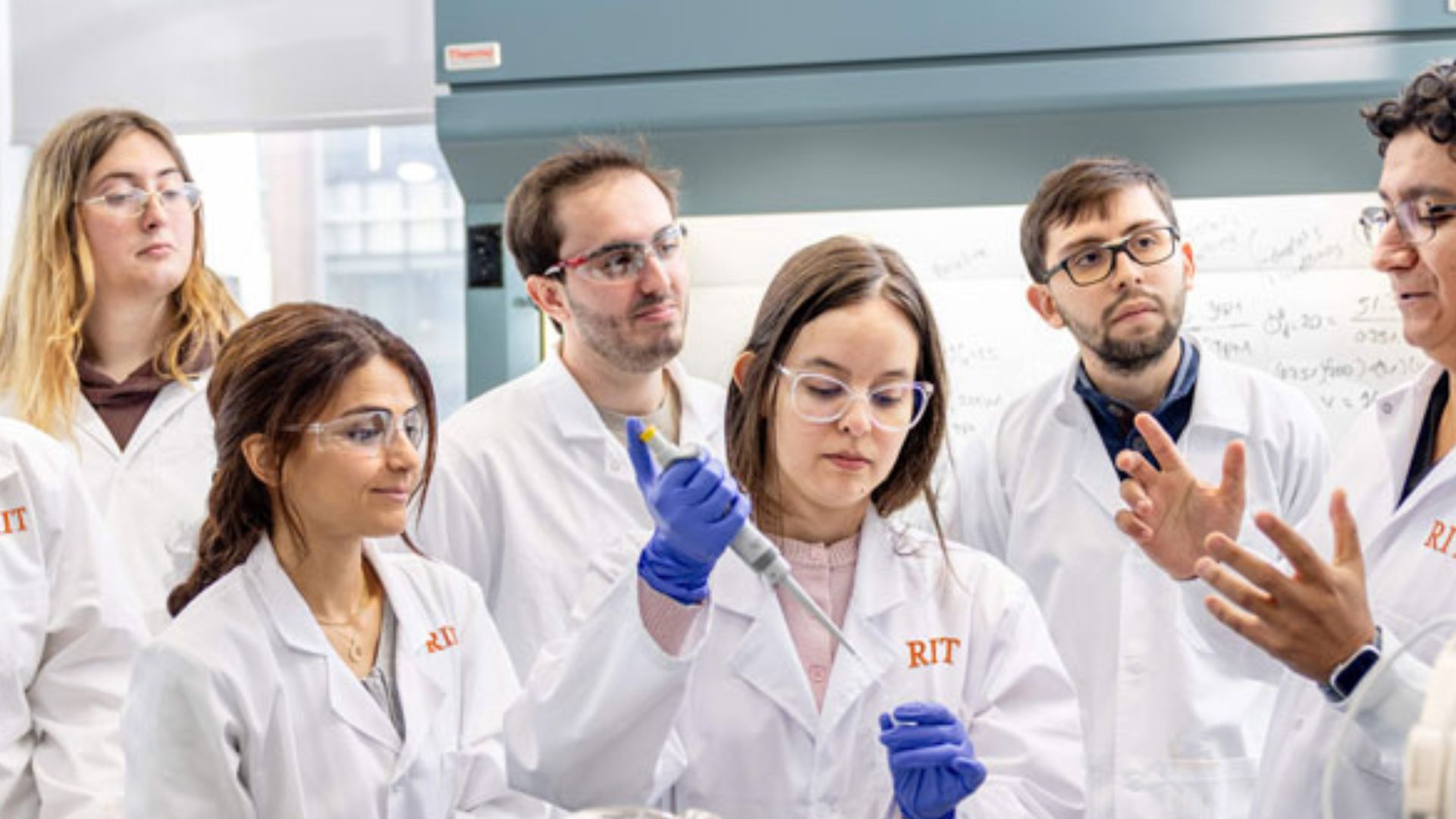
Rochester, New York – At Rochester Institute of Technology, a group of chemical engineering students is working with materials so small that their behavior can be difficult to see, yet the results could have applications in medicine, clothing, filtration and other technologies. Their research focuses on reshaping tiny particles and understanding how those particles can be used to create new materials with useful properties.
Among the students involved is Natalie Bedolla-Mortensen, a third-year chemical engineering student who began working in the lab during her first year at RIT. Her research is part of a broader effort to understand soft matter, an emerging area of science that looks at materials such as polymers, liquid crystal droplets and other substances that can respond to changes around them.
The work is led by Jairo Diaz Amaya, an assistant professor of chemical engineering in RIT’s Kate Gleason College of Engineering. Through his Soft Matter Signaling Lab, students are investigating how very small particles, known as colloids, can be changed and controlled.
“Our field of soft matter—polymers, droplets of liquid crystals, materials that react to stimuli—is getting us closer to mimicking responses or interfaces with biology,” said Diaz Amaya, an expert in soft matter related to biological systems. “This is extremely complicated because it happens at the nanoscale. But we still need to study the phenomenon because colloidal fabrication can be the start of ‘smart’ building blocks that interact with each other and emerge or create new materials with different properties.”
The research begins with understanding how individual particles behave. Students in the lab work on making colloids change their shape by using relatively simple factors, including temperature and chemical reactants. They are also studying how particles interact with light and how those interactions can be controlled to produce specific optical properties.
That work falls under colloidal fabrication, a process that involves manipulating small particles so they can form new materials. By changing the way the particles behave and interact, researchers can develop structures that may have properties that would not be possible with conventional materials.
Read also: City of Rochester adds free workshops to help seniors learn how to save money on property taxes
The potential uses are broad. Research into these materials could contribute to selective filtration, medical diagnostic devices and more sustainable materials. The work also gives students an opportunity to study ideas that are still being developed rather than simply following established formulas.
For Bedolla-Mortensen, that experimental side of the research has been especially appealing.
“I have come to love the versatility of the research we do, especially as a lot of what we do is heavily based on proof-of-concept because it has not been studied as in-depth before,” said Bedolla-Mortensen.
Her interest in the lab also connects with her plans for the future. Bedolla-Mortensen is interested in smart textiles, particularly materials that could make clothing more environmentally friendly or allow garments to respond to changes in the body and surrounding conditions.
“It was a large part of why I joined Jairo’s lab. I would like to work with textiles in order to make them more environmentally sustainable, either through biodegradability or other qualities, and to create a material for clothing that adapts to body temperature and changes thickness or size of stands as a result,” she explained.
The ideas being explored in the lab could also connect to biomedical applications. Bedolla-Mortensen is working on research involving particles that could eventually contribute to the development of materials used in biological settings. One possible long-term direction is the creation of cell tissues for 3D-printed organs, although the current research is focused on understanding and controlling the particles themselves.
The nanoscale nature of the work makes the research particularly challenging. Scientists are studying materials that cannot simply be handled and shaped like ordinary objects. Instead, they must understand how tiny particles respond to chemical and physical conditions and how those individual changes can produce larger material effects.
Diaz Amaya’s work has also received recognition from the Defense Advanced Research Projects Agency. He was recently honored with a DARPA Director’s Fellowship, following a 2024 DARPA Young Faculty Award. The fellowship supports early-career scientists working on projects connected to national security initiatives.
Students have been involved in the developmental research connected to the DARPA work, and the group has produced results involving chemical processes that transform polymers. For the students, that experience provides a chance to take part in research with applications that extend beyond the classroom.
RIT’s chemical engineering program supports this kind of hands-on work. The program focuses on designing and controlling chemical processes used to create new and alternative materials. Its areas of application include energy and battery systems, biomedical devices and materials, pharmaceuticals and other resources.
For Bedolla-Mortensen and her fellow students, the research offers a look at how small changes at the particle level can lead to entirely different material behavior. The work is still developing, but the basic idea is straightforward: by learning how to control tiny building blocks, researchers can explore materials designed for specific needs.
That combination of chemical engineering, materials research and real-world applications is giving RIT students a chance to work in a field that is still taking shape. Their experiments may eventually contribute to technologies ranging from smarter clothing and sustainable materials to medical devices and other advanced applications.


-

 Local News1 year ago
Monroe County announces legal proceedings against properties listed in official public notice of foreclosure
-

 Local News2 years ago
New ALDI store close to Rochester to begin construction in late 2025 or early 2026
-

 Local News1 year ago
County Executive Adam Bello and members of the county legislature celebrate exceptional young leaders and advocates at the 2025 Monroe County Youth Awards
-

 Local News1 year ago
The 2025 Public Market Food Truck Rodeo series will begin this Wednesday with live music by the Royal Bromleys