Local News
RIT president says the university’s next major build will focus on strengthening people and programs

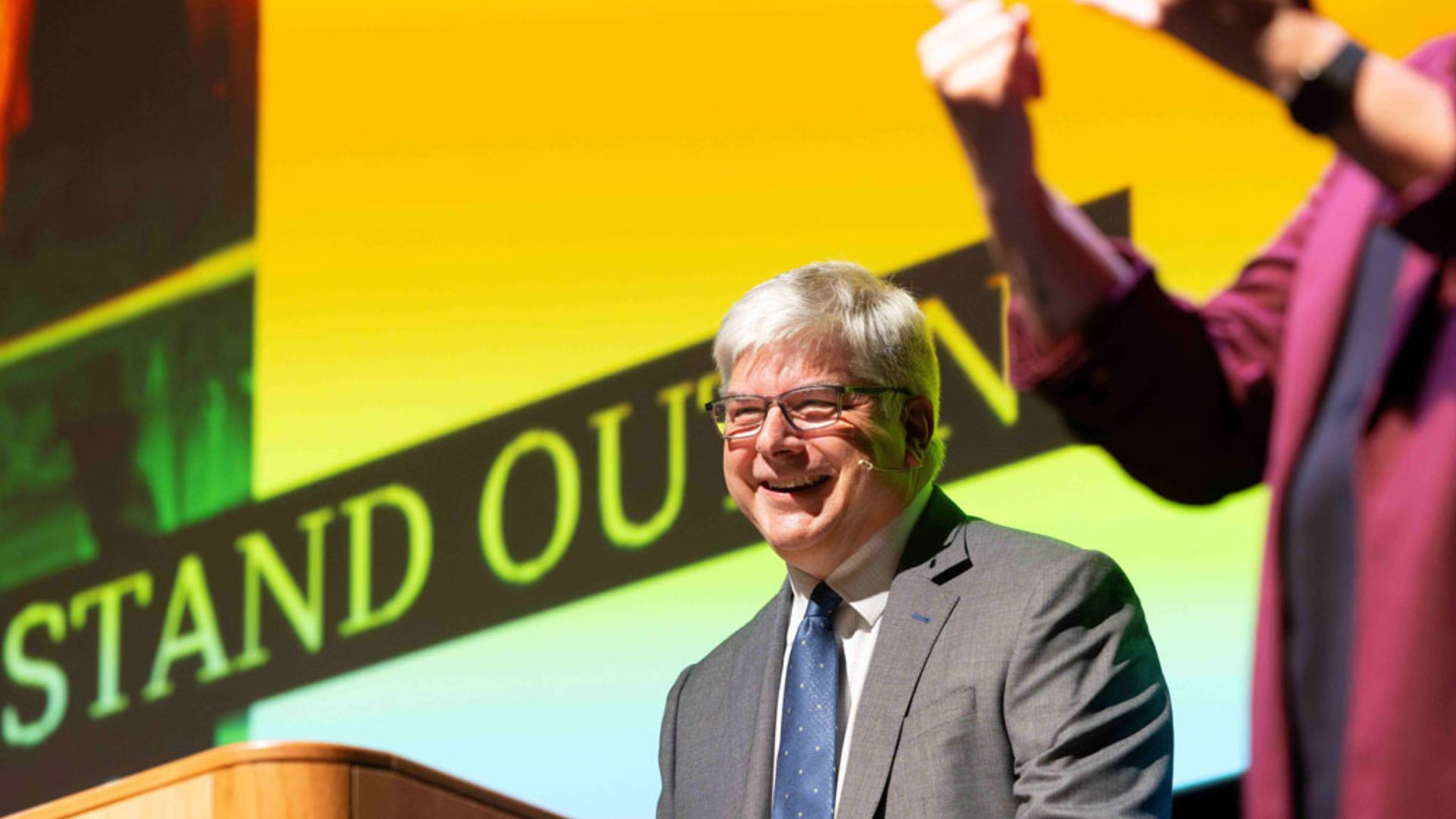
Rochester, New York – For years, construction cranes have been a familiar sight around Rochester Institute of Technology, marking the growth of the university through new buildings and expanded facilities. But RIT President Bill Sanders says the university’s next major effort will look different.
Instead of focusing primarily on new structures, Sanders said RIT now needs to strengthen the people, programs and systems that make the university work.
Speaking during his State of the University address Sept. 10 at the RIT Performing Arts Center, Sanders described the coming period as an important one for the university as colleges across the country respond to changing expectations about higher education and the value of a college degree.
“Now, another important building project is ahead of us. This time, we’re strengthening and supporting the people and programs of the university itself,” said RIT President Bill Sanders during his State of the University address Sept. 10 in the RIT Performing Arts Center.
Sanders said the higher education landscape is changing quickly. Colleges and universities are facing new questions from students, families and the public about what a degree provides and whether the cost of attending college leads to meaningful results after graduation.
For RIT, however, Sanders believes many of those changing expectations are closely connected to strengths the university has developed over many years.
He said some universities may need to reinvent themselves as the environment around higher education changes. RIT, he suggested, has a different opportunity: to look closely at what it already does well and build those strengths further.
One of the clearest examples is the success of RIT graduates in the workforce.
RIT undergraduates have an average starting salary of $78,600, according to the figures presented by Sanders. That is about $10,000 higher than the national average. RIT graduate students have an average starting salary of $91,900.
“That’s an important part of the value students and families expect from a college education,” he said.
Those numbers are part of a broader picture Sanders presented during the address. RIT awarded a record 5,420 degrees last spring, while nearly 4,000 first-year, transfer and graduate students arrived for the current semester.
The university is also continuing to emphasize the connection between classroom learning and practical experience. During the last fiscal year, 4,149 RIT students received a co-op opportunity, giving them a chance to gain experience in workplaces while continuing their education.
Nearly 93% of graduates also moved into employment, graduate school, military service or volunteer work. The figures include 85.8% who became employed, 5.9% who began graduate studies and 1.1% who joined the military or volunteered.
Sanders said employers are looking for the knowledge, talent and ability to innovate that RIT students bring with them.
The challenge now is making sure those strengths continue to produce results as the university and the world around it change.
To help guide that work, Sanders pointed to RIT’s Strategic Framework, which was announced earlier this year. The framework sets out four broad goals for the university.
The first is transformative student experiences and success. That goal focuses on providing students with the environment, resources and support they need to succeed.
The second is world-changing research. RIT wants to continue advancing discovery while also applying research and knowledge in ways that can have a practical impact.
The third goal centers on well-being and belonging. The university says it wants to create a culture in which students, faculty and staff feel supported, connected and able to thrive.
The fourth is global reach and mindset, reflecting RIT’s efforts to extend its education, partnerships and impact beyond its Rochester campus.
That international focus includes RIT’s campuses in Croatia, Kosovo and Dubai. The Dubai campus is preparing for a major expansion that is expected to double its student population to approximately 4,500 by 2028. The expansion will include additional academic, laboratory, research and innovation space.
Read also: Monroe County dedicates new 9/11 First Responders’ Memorial to honor heroes and remember those lost
Together, the four goals provide a framework for the work Sanders says is ahead.
He said the next year will be focused on action rather than simply planning. Some areas that are already working will need additional support, while other parts of the university will have to change.
That approach reflects the broader message of Sanders’ address. RIT does not need to abandon the qualities that have helped it grow. Instead, the university needs to make sure those qualities remain effective in a changing higher education environment.
“We know who we are, we know the strengths that distinguish RIT, and we know those strengths are increasingly relevant to the world around us,” he said. “That’s our next build: strengthening how RIT works so we can deliver the outcomes that matter most. And that’s work that belongs to all of us.”
The emphasis on people and programs also means the effort will involve much more than the university’s administration.
RIT Provost Prabu David, Vice President for Access, Engagement, and Success Keith Jenkins, Student Government President Yasmine Ibrahim, and leaders of the Faculty Senate and Staff Council also spoke during the State of the University event.
Their participation underscored the broad group of people involved in shaping the university’s future.
For RIT, the coming phase will therefore be less about how many new buildings appear on the campus skyline and more about what happens inside them. The university already has facilities, programs and partnerships that have helped produce strong graduate outcomes. Sanders’ message was that those foundations now need to be reinforced.
The university enters that period with several indicators of continued demand and success, including record degree production, thousands of new students, extensive co-op participation and strong post-graduation outcomes.
At the same time, the changing conversation around higher education means RIT cannot simply rely on past achievements.
Sanders’ plan calls for the university to strengthen what works, adjust where change is needed and make sure its people and programs remain connected to what students, employers and society need.
In that sense, the “next build” Sanders described is not a construction project in the traditional sense. It is an effort to improve how the university operates and how it supports the people who make up the RIT community.
The goal is to ensure that the university’s long-standing strengths continue to matter in the years ahead, while giving students new opportunities to succeed, researchers the support to make an impact, and the wider RIT community an environment where people can contribute and grow.


-
 Local News1 year ago
Monroe County announces legal proceedings against properties listed in official public notice of foreclosure
-

 Local News2 years ago
New ALDI store close to Rochester to begin construction in late 2025 or early 2026
-

 Local News1 year ago
County Executive Adam Bello and members of the county legislature celebrate exceptional young leaders and advocates at the 2025 Monroe County Youth Awards
-

 Local News1 year ago
The 2025 Public Market Food Truck Rodeo series will begin this Wednesday with live music by the Royal Bromleys