Local News
RIT researcher develops plant-based biopolymers that could reduce the need for plastic packaging materials

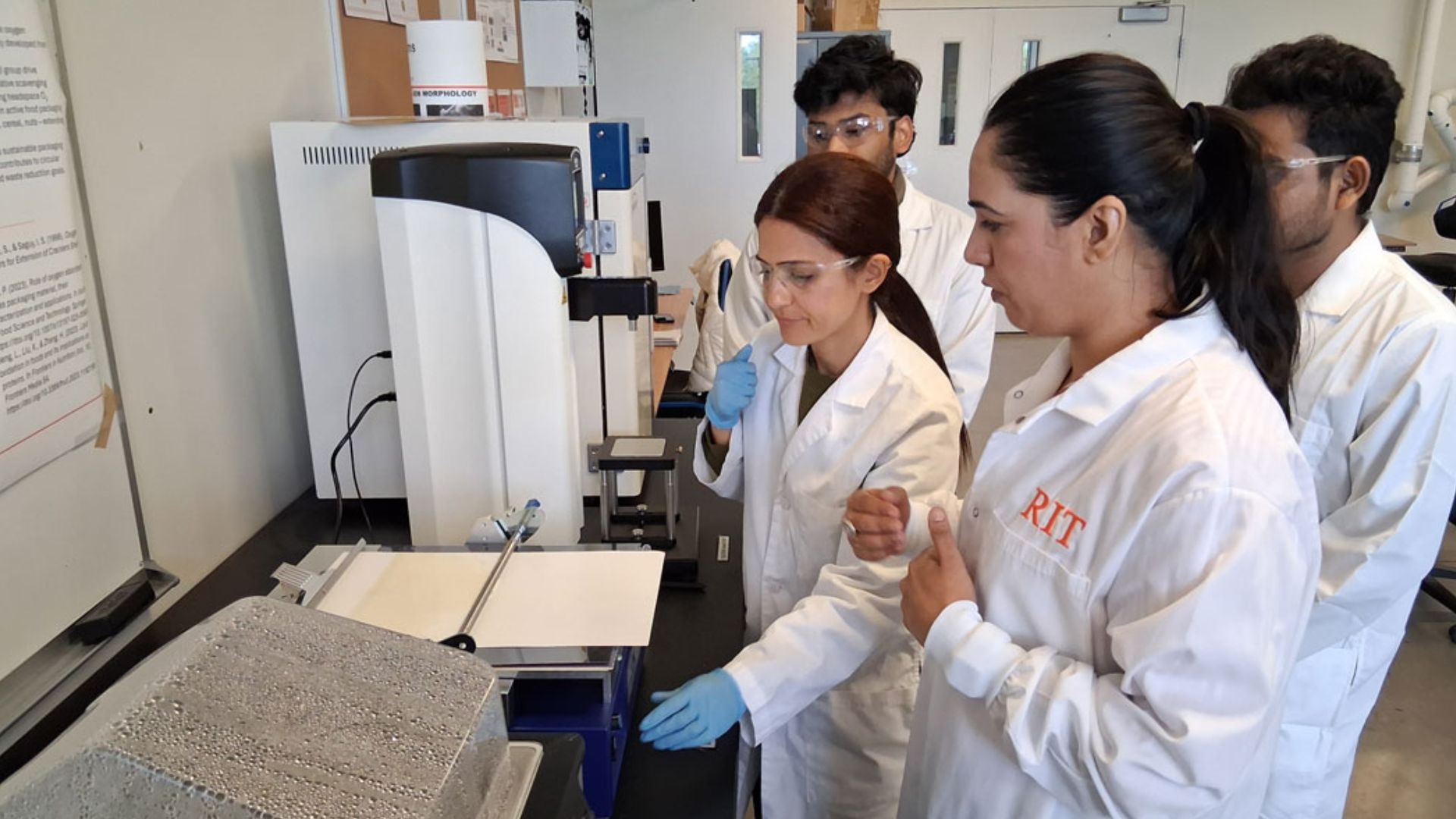
Rochester, New York – Researchers at Rochester Institute of Technology are exploring a new way to reduce the amount of plastic used in food packaging by turning a common plant-based material into a stronger protective coating for paper products.
The work is being led by Sneh Bangar, an assistant professor of packaging science in RIT’s College of Engineering Technology. Her research focuses on a biopolymer made from modified starch that could serve as a barrier on paper-based packaging, helping protect products while making the packaging more suitable for sustainable disposal options.
Paper is already widely used in packaging, including for products such as milk. But paper alone often does not provide all of the strength and protection needed to keep food safe and maintain product quality. To solve that problem, manufacturers commonly add plastic laminates or coatings to the paper.
Those layers can improve the performance of the package, but they also create another problem. When paper is combined with synthetic materials, the finished package can become much harder to recycle or compost.
Bangar and her research team are looking at whether a starch-based material can provide some of the same protection without relying as heavily on conventional plastic.
“We were able to achieve the same barriers that the plastic lamination or plastic coatings give,” said Bangar, who leads the Food Packaging and Shelf-Life Testing Laboratory in CET. “The goal is not to eliminate plastics but reduce the use of the plastics.”
The researchers focused on pearl millet starch, a material that is renewable, widely available and relatively inexpensive. However, starch in its natural form does not have all the properties needed for demanding packaging applications. It needs to be modified so it can become more stable, stronger and better able to resist water.
Read also: RCSD students complete paid URMC summer internship designed to open doors to future medical careers
To improve those characteristics, the team used a process known as crosslinking. At the molecular level, crosslinking creates bonds within polymer materials, changing their structure and helping strengthen them.
For the RIT project, the process was used to modify pearl millet starch and improve its stability and viscosity. The researchers are examining the resulting material as a potential alternative for protective packaging applications, particularly where paper-based products currently depend on plastic coatings or laminates.
The research comes at a time when food companies and consumers are looking for packaging materials that can reduce reliance on petroleum-based plastics. Food packaging is one of the largest areas where alternative materials could have an impact because so many products require protection from moisture, air and other factors during storage and transportation.
“When it comes to packaging, the food category contributes the most in the need for packaging options. We can add value to alternative packaging options with this new work,” said Bangar, who was recently recognized with the 2026 American Polymers Association Young Scientist Award, given to researchers working in alternative materials for packaging.
Bangar’s project is being conducted in collaboration with Clemson University and received funding through a U.S. Department of Agriculture program known as Assisting Specialty Crop Exports—Sustainable Packaging Innovation Lab.
The findings from the recent testing were detailed in the Aug. 14, 2026, edition of the International Journal of Food Properties. The research adds to ongoing efforts to find practical uses for bio-based materials while keeping packaging performance at a level required by the food industry.
Kyle Dunno, a professor and department chair of RIT’s Department of Packaging and Graphic Media Science, worked closely with Bangar and her research group on the biopolymers project. He said the growing demand for sustainable packaging is creating opportunities for research that combines renewable materials with established packaging technologies.
“As brands and consumers continue to seek more sustainable packaging solutions, there is growing interest in renewable materials that can reduce reliance on traditional plastics and synthetic coatings without sacrificing performance,” Dunno said.
He also pointed to RIT’s broader approach to packaging research, which brings together materials development, packaging science, manufacturing and product testing.
“RIT is uniquely positioned to address these challenges through the integration of packaging science, materials research, manufacturing technologies, and product testing,” Dunno said. “Research like Dr. Bangar’s exemplifies how our interdisciplinary approach can transform promising bio-based materials into practical packaging solutions that support a more sustainable future.”
The project also reflects changes within RIT’s College of Engineering Technology. In 2022, the college integrated its packaging science and print media programs as the packaging and print industries continued to evolve. The programs place an emphasis on sustainable practices, alternatives to plastics and improvements in manufacturing and distribution.
That structure gives students, faculty members and industry partners access to laboratories where new materials can be developed and packaging products can be tested. For researchers such as Bangar, that combination is important because creating a new material is only one part of the challenge.
The material must also work in a real packaging environment. It needs to provide the protection expected by manufacturers while offering potential environmental advantages over traditional synthetic coatings.
The RIT research does not present starch-based materials as an immediate replacement for every plastic used in packaging. Instead, the work is aimed at reducing the amount of synthetic material needed in applications where a renewable alternative can perform the required job.
By modifying pearl millet starch and testing its ability to act as a protective barrier, Bangar and her collaborators are working toward another option for paper-based packaging. The research highlights how a familiar agricultural material can be given new properties and considered for a role in an industry that continues to search for more sustainable solutions.


-
 Local News2 years ago
Monroe County announces legal proceedings against properties listed in official public notice of foreclosure
-

 Local News2 years ago
New ALDI store close to Rochester to begin construction in late 2025 or early 2026
-

 Local News1 year ago
County Executive Adam Bello and members of the county legislature celebrate exceptional young leaders and advocates at the 2025 Monroe County Youth Awards
-

 Local News1 year ago
The 2025 Public Market Food Truck Rodeo series will begin this Wednesday with live music by the Royal Bromleys