Local News
RIT researchers explore the role of teamwork in engineering education

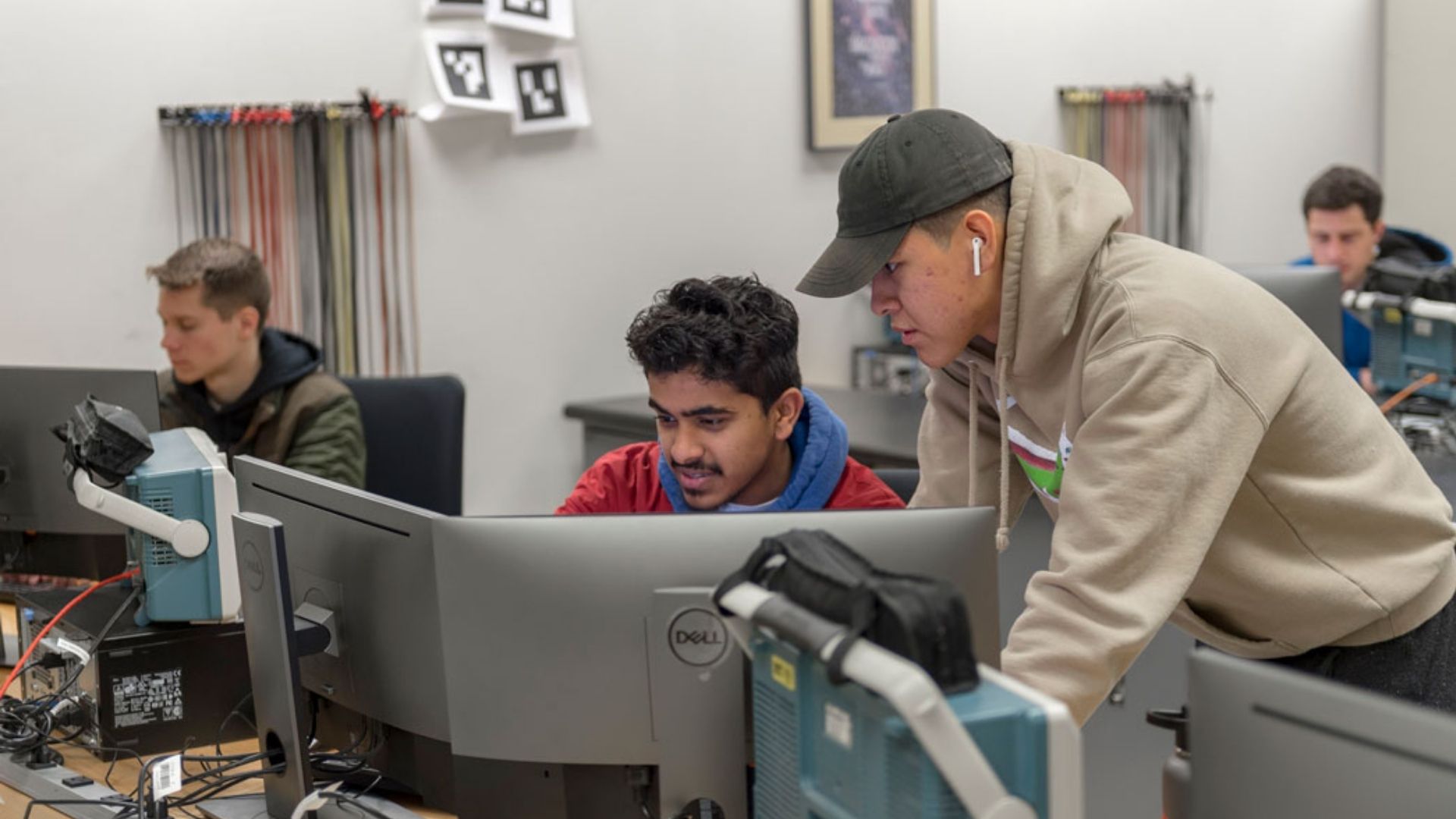
Rochester, New York – Engineering education has long placed a strong emphasis on technical ability. Students learn how machines work, how to solve complex problems and how to turn ideas into practical designs. But researchers at Rochester Institute of Technology are examining another part of an engineer’s education that can be harder to measure: the ability to work effectively with other people.
Kriz George, a doctoral student in physics at RIT, is part of a research team studying how engineering and engineering technology programs can better prepare students for teamwork and other interpersonal demands. His own path into the research reflects a broader shift in the profession. Early in his academic career in mechanical engineering, George was trained around the traditional idea of the engineer as a technical problem-solver. Today, he says, that role has become much broader.
“Typically, we are teaching students to have the mindset of an engineer, to build that identity of an engineer as a problem-solver. But there is a demand on engineers that is so much higher than technical skills,” said George ’22 (mechanical engineering at RIT Dubai) ’25 MS (manufacturing and mechanical systems integration). “It is going toward a more social, economic and sustainable responsibility for the work. Engineering education is moving toward these things, and they are more important than ever.”
George is working with Ashish Agrawal, an assistant professor in the First-Year Program Division within RIT’s College of Engineering Technology, on a collaborative study focused specifically on teamwork. The researchers are looking at how faculty members who teach engineering technology subjects introduce interpersonal skills into their courses while still meeting the technical demands of engineering education.
The issue has become increasingly important as the engineering profession changes. Artificial intelligence is reshaping workplaces, while engineers are also being asked to consider ethical questions, sustainability and the wider social and economic effects of the products and systems they develop. According to Agrawal, those changes create a need for engineering programs to reconsider how students learn to work with one another.
“The goal is that faculty are better equipped to help students learn teamwork and other interpersonal skills toward addressing these needs. Students can get a project done but our study also focuses on the process of making a more functional team,” he said. “We are helping students practice is a skill that is very important for the workplace.”
Agrawal’s research is supported by a National Science Foundation award. He is collaborating with Mark Huerta, an assistant professor of engineering education at Virginia Tech. The researchers plan to use the results of their work to create teaching modules that can be incorporated into courses, giving faculty additional tools for helping students develop teamwork skills.
The project also reflects a wider interest in engineering education research within RIT’s College of Engineering Technology. The college has developed academic, professional and social support programs throughout its degree offerings, with a particular focus on helping students during their first and second years. Those efforts are intended to improve retention and graduation rates while preparing students to become stronger engineering professionals.
For years, teamwork in engineering courses has often been approached in a relatively straightforward way. Students are assigned a group project, complete the work together and receive an evaluation based largely on the final project or report. Researchers involved in the RIT study argue that this method may not show the full picture.
“But a project report does not tell you how well you worked on a team,” Agrawal said. “We are trying to train students for the larger workplace. In industry, the process is as important as the product. More often than not, projects are not individual successes, but a collaborative team effort.”
That distinction is central to the current research. Producing a successful project does not necessarily mean that students have learned how to communicate, divide responsibilities, manage disagreements or contribute effectively within a group. A team can reach the right technical result while still struggling with the way its members work together.
The researchers examined foundational, first-year project-based learning courses at universities to better understand how teamwork skills are currently taught and assessed. Early findings point to gaps in both areas. The study suggests that students enter first-year courses with different levels of previous experience working in teams, meaning that simply placing them into groups may not provide enough preparation.
Instead, students may need more deliberate instruction and guidance throughout a project. That guidance can cover the technical side of the assignment, but it can also address problem-solving, communication and conflict resolution.
For engineering educators, the challenge is therefore becoming less about adding another group assignment and more about teaching students how to function within a team. The RIT research aims to help faculty make that process more structured and useful.
As engineering itself continues to evolve, the researchers believe education must evolve alongside it. Technical knowledge remains essential, but the ability to collaborate may determine how effectively that knowledge can be applied in real workplaces. By studying how teamwork is taught during the early stages of engineering education, the RIT team hopes to give faculty better ways to prepare students for a profession where success increasingly depends not only on what engineers can build, but also on how well they can build it together.
If you want, I can also make this more like a newspaper report, more like a university press release, or more natural and journalistic with a stronger opening and headline.


-
 Local News2 years ago
Monroe County announces legal proceedings against properties listed in official public notice of foreclosure
-

 Local News2 years ago
New ALDI store close to Rochester to begin construction in late 2025 or early 2026
-

 Local News1 year ago
County Executive Adam Bello and members of the county legislature celebrate exceptional young leaders and advocates at the 2025 Monroe County Youth Awards
-

 Local News1 year ago
The 2025 Public Market Food Truck Rodeo series will begin this Wednesday with live music by the Royal Bromleys