Local News
RIT students develop practical health care solutions through hands-on community projects

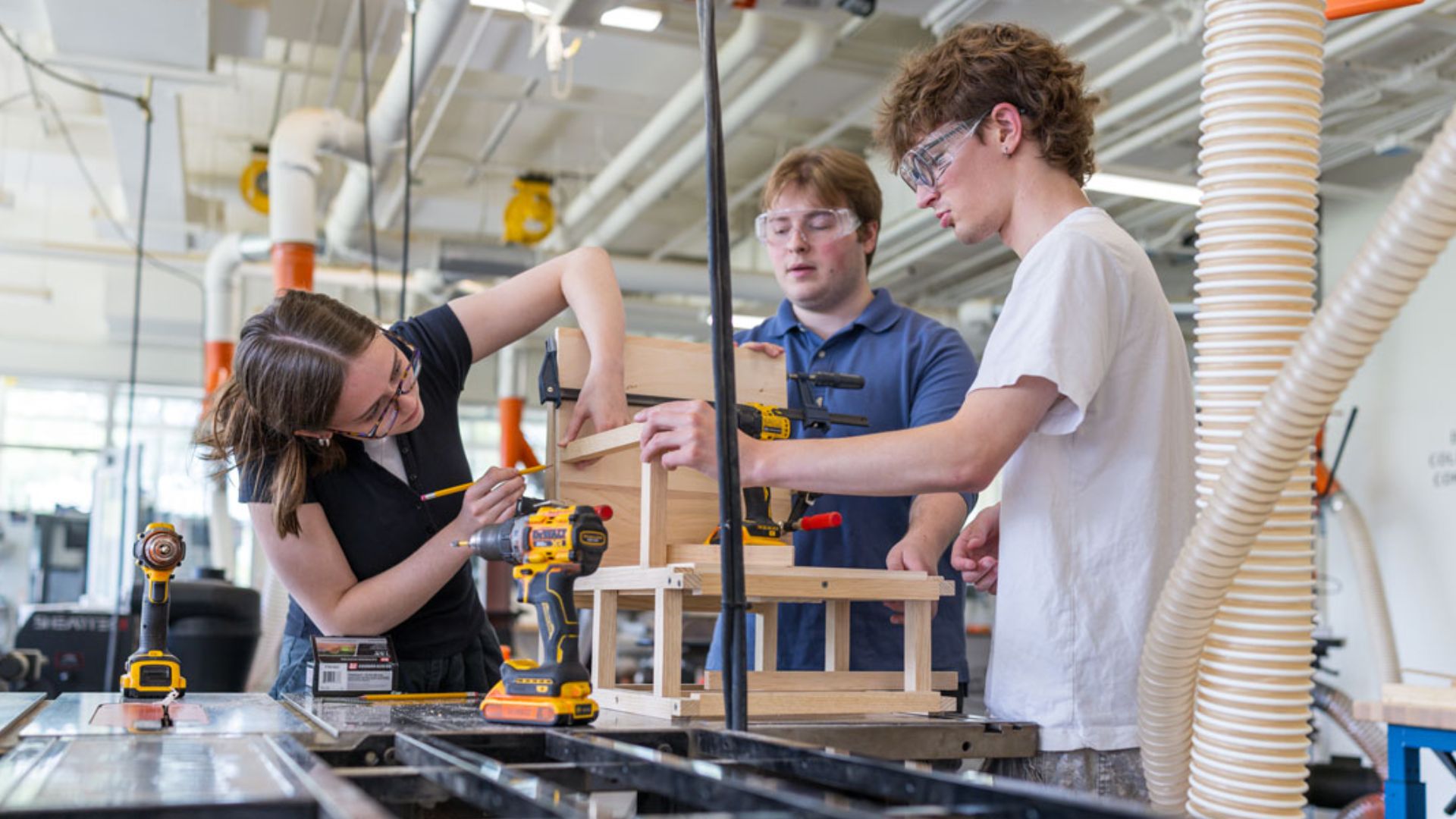
Rochester, New York – Rochester Institute of Technology students spent 10 weeks working on problems that extend well beyond the classroom, developing practical health care solutions for children and adults with disabilities while collaborating with local nonprofit organizations and health care professionals.
The work was part of Studio 930, an interdisciplinary program that gives students an opportunity to apply their academic training to real-world challenges. Eight projects brought together students from computer engineering technology, computer science, individualized programs, industrial design, mechanical engineering and mechatronics engineering technology.
Rather than starting with a textbook problem and working toward a theoretical answer, the students had actual clients, users and environments to consider. Their projects addressed challenges connected to conditions including dementia, autism and cerebral palsy, along with everyday problems faced by patients, caregivers and health care workers.
The experience is part of RIT’s broader emphasis on experiential learning. Students work across disciplines, meet with clients, build prototypes and test their ideas. The approach is intended to help them understand not only how a product works, but also whether it works for the person who is expected to use it.
RIT is ranked fifth among co-op and internship programs by U.S. News & World Report, highlighting the role that hands-on professional experience plays in the university’s educational model.
One Studio 930 team focused on a sensory installation for older adults living with middle-stage dementia at the Jewish Home of Rochester.
The students created a wooden “memory map” of Greater Rochester, using familiar local landmarks and details to encourage residents to remember places, begin conversations and interact with their surroundings.
Gabrielle “Gigi” Bakos, a third-year student in the individualized program and sustainable architecture M.Arch programs, was part of the team. To understand how sensory design could be used effectively, the students visited the Strong National Museum of Play, where they looked at installations originally designed for children.
The team then adapted those ideas for an older population.
Their research did not stop with a museum visit. The students took part in a virtual-reality orientation at the Jewish Home that helped them understand some of the effects of dementia. That experience influenced several decisions in their final design, including the colors they selected.
Read also: Governor Hochul designates Justice Erin S. Skinner to the Appellate Division Fourth Department
Because dementia can affect how people perceive color, the team chose contrasting colors for landmark pieces that could be attached to the map.
The goal was not simply to create something attractive. The students wanted the installation to be useful, respectful and familiar to the people interacting with it.
“It’s important that we designed with dignity,” said Bakos, an Ithaca, N.Y., resident and incoming student senator for the School of Individualized Study.
That idea became an important part of the project. Designing for people with disabilities required the students to consider the users’ abilities, needs and experiences at every stage.
Other Studio 930 projects took students into the world of health care technology, where relatively small design problems can have a major effect on workers and patients.
Some teams worked with Rochester Regional Health, a strategic partner in the RIT RRH Alliance. Students developed concepts for a precision liquid dispenser intended for nurses caring for patients with dysphagia, a condition that can make swallowing difficult and may require patients to consume thickened liquids.
Another project focused on pharmacists. Students designed ergonomic child-proof bottle openers, including both mechanical and manual concepts, to address repetitive motion injuries that can develop through repeated use of traditional tools.
The projects show how accessible design can involve more than creating equipment for people with disabilities. It can also mean improving the tools used by health care professionals who serve them.
Studio 930 is housed within RIT’s School of Individualized Study and is affiliated with Access: Healthcare Technology. The program brings students from different academic backgrounds into the same design process, allowing them to approach a problem from different angles.
Dan Phillips, associate professor of electrical and microelectronic engineering, said that diversity of experience is central to the program.
“When you get different people working together, it’s good for everyone.”
For Lara Cardoso Goulart, program director and co-director of the industrial design BFA program, the value of the experience also comes from learning to see challenges that students might otherwise overlook.
The program asks students to approach their work with an open mind because accessible and inclusive design requires empathy as well as technical ability.
“There are things that once you see, you can’t unsee,” she said. “It will make the students better people.”
For Paige Panagos, a fourth-year industrial design student from Boxford, Mass., the project involving the Jewish Home of Rochester changed the way they viewed the field.
Working directly on a project for people with dementia helped Panagos consider the possibility of a career involving access and medical technology.
“I feel great that I made a tangible part of user testing,” they said. “Design is storytelling.”
That experience is one of the main differences between a real client project and a classroom assignment. Students have to listen, observe and respond to feedback from the people who will ultimately interact with what they create.
The same process played an important role in another Studio 930 project involving young children.
A team of industrial design and mechatronics engineering technology students spent much of its time in the SHED wood shop developing a pushcart for toddlers.
The team included fourth-year industrial design students Brooke Banninger of Pottstown, Pa., and Spencer Harris of Milwaukee, Wisc., along with Andrew Nasser, a fourth-year mechatronics engineering technology major from Manhattan.
Their client was Sara Calus, director of educational and clinical services at the Rochester Hearing and Speech Center. Calus wanted a weighted cart that toddlers could push, pull and steer without easily tipping it over or losing control.
The students designed a cart with a top-loading compartment capable of holding up to 40 pounds. Its lid also functions as a seat.
The purpose was not simply to give children something to push around. The resistance and movement involved in operating the cart were intended to support sensory regulation and motor planning.
“The motion and force needed to move the cart will “stimulate sensory regulation and foster motor planning to help the brain and muscles work together to complete a functional activity,” she said.”
Once the students had a nearly finished prototype, children at the Rochester Hearing and Speech Center tested it.
The feedback helped the team make final changes. The students eventually painted the cart so that it resembled a mail truck, adding a playful element to a device designed for therapeutic use. They also added a shelf between the handles where visual cue cards could be placed to help children process information while pushing the cart.
Calus was pleased with the result.
After the testing, she described the project as a “smashing success.”
“The children crave input and movement, and this is perfect,” Calus said.
The Studio 930 teams were able to move quickly from ideas to physical prototypes because the program operates inside the SHED, RIT’s large multidisciplinary maker space.
Students have access to wood and metal shops, textile and electronics areas, 3D printers, laser cutters and other equipment. That access allowed the teams to build, test and modify their designs without having to move between different facilities.
Michael Buffalin IV, SHED makerspace director, and Nathan Lavie, a SHED mentor and co-op student studying mechatronics engineering technology, helped students choose materials and processes and navigate the available equipment.
For the Studio 930 teams, that proximity made the design process more practical. An idea could be turned into a prototype, tested and changed while the students were still working through the same problem.
“Studio 930 was meant for the SHED,” Goulart said. “It’s not just a classroom; it’s a multidisciplinary space.”
That philosophy is closely tied to RIT’s long-standing maker culture. Students are encouraged to experiment with technology, materials and creative ideas, often turning those interests into professional skills.
The Studio 930 projects covered a broad collection of accessibility and health care challenges. In addition to the dementia sensory installation and the weighted cart, students worked on a precision food cutter intended to help prevent choking for Lifetime Assistance Inc.
Other projects included an adjustable toilet support for children with cerebral palsy for the Mary Cariola Center and interactive toys for children with cerebral palsy for CP Rochester.
The Rochester Hearing and Speech Center projects included a portable sensory cocoon as well as the push-weighted cart. Rochester Regional Health received the ergonomic bottle opener and precision dispensing lid concepts.
Taken together, the projects gave students exposure to different users, different disabilities and different parts of the health care system.
The work also demonstrated why interdisciplinary teams can be useful when solving practical problems. A designer may focus on how an object is used, while an engineering student may concentrate on mechanics, materials or reliability. Combining those viewpoints can produce a solution that is both functional and accessible.
For the students involved, Studio 930 offered something that cannot easily be recreated through lectures alone: the chance to design for real people with real needs, receive direct feedback and make changes based on what they learned.
The experience also reinforced a larger lesson about health care design. A successful solution does not always have to be complicated. Sometimes it can be a better bottle opener, a more useful dispenser, a weighted cart or a familiar map that helps someone reconnect with a place they know.
By working directly with community organizations and health care partners, RIT students were able to see how design decisions affect people’s daily lives. At the same time, the organizations received new ideas and prototypes aimed at challenges they encounter in their own work.
For Studio 930, the classroom was only the starting point. The students’ work moved into workshops, health care facilities and testing environments, where their ideas had to prove their value in the real world.


-

 Local News1 year ago
Monroe County announces legal proceedings against properties listed in official public notice of foreclosure
-

 Local News2 years ago
New ALDI store close to Rochester to begin construction in late 2025 or early 2026
-

 Local News1 year ago
County Executive Adam Bello and members of the county legislature celebrate exceptional young leaders and advocates at the 2025 Monroe County Youth Awards
-

 Local News1 year ago
The 2025 Public Market Food Truck Rodeo series will begin this Wednesday with live music by the Royal Bromleys