Local News
COSMOS-Web scientists unveil the most detailed map ever created of the universe’s vast cosmic web

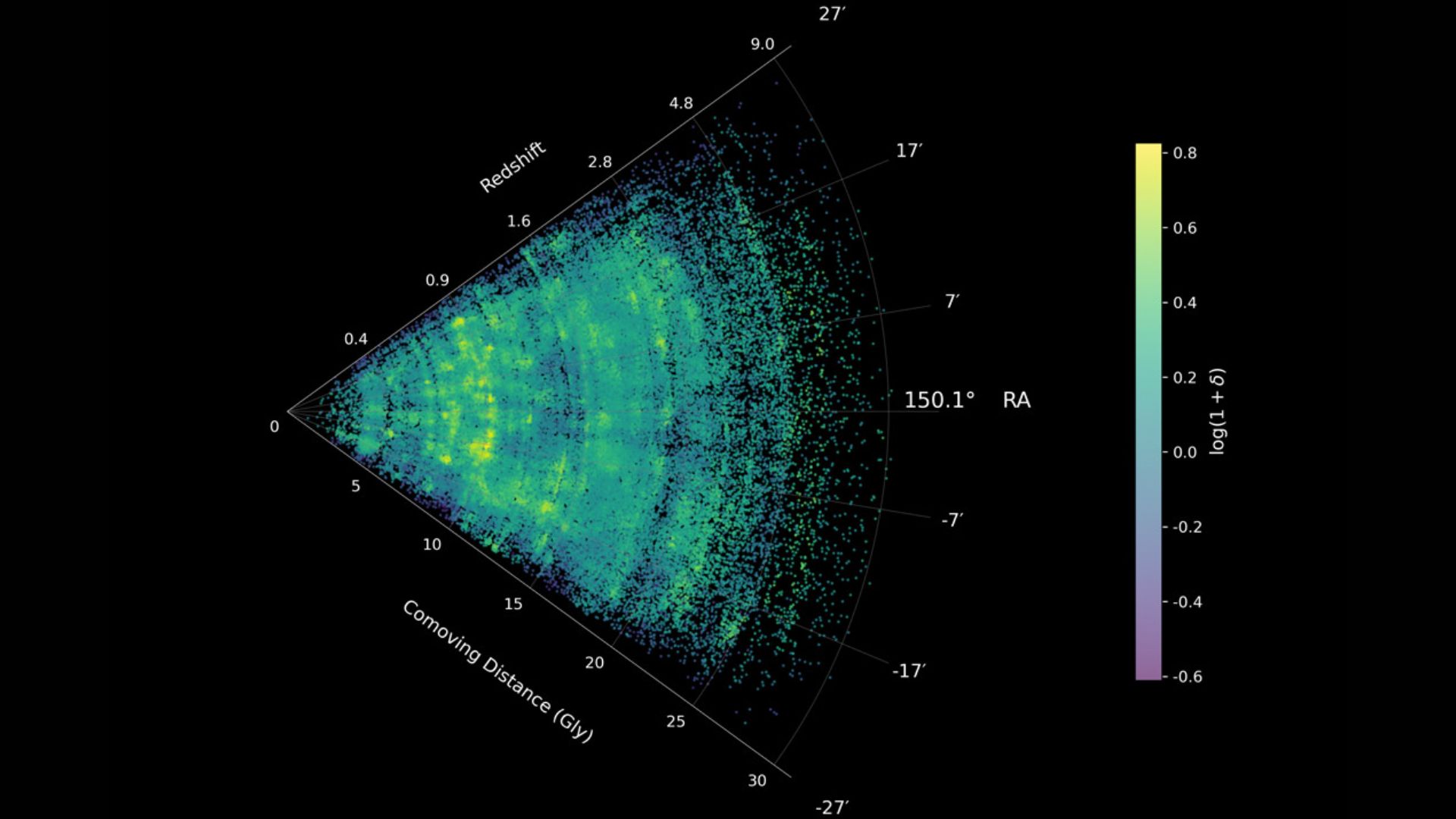
Rochester, New York – Astronomers have unveiled what is being described as the most detailed map ever created of the cosmic web, offering an extraordinary new look at how galaxies have formed and evolved across nearly the entire history of the universe.
The breakthrough comes from the international COSMOS-Web research team using observations gathered by the powerful James Webb Space Telescope, whose deep-space capabilities continue to transform modern astronomy. The newly released reconstruction reveals the hidden large-scale structure of the universe with an unprecedented level of precision, tracing how galaxies are distributed across 13.7 billion years of cosmic time.
Scientists say the map goes far beyond a simple snapshot of space. Instead, it provides a sweeping three-dimensional portrait of the universe stretching back close to the aftermath of the Big Bang itself.
The cosmic web — one of the most important structures in cosmology — acts as the framework holding the universe together. It is made up of enormous filaments and sheets of dark matter and gas that weave across space, surrounding gigantic empty regions known as voids. Galaxies and galaxy clusters gather along these filaments, creating an immense interconnected network that spans the cosmos.
Researchers involved in the project say the new reconstruction is the clearest view yet of that hidden architecture.
The findings were published in The Astrophysical Journal, where scientists detailed how galaxies formed, clustered, and evolved throughout cosmic history. The study highlights the growing influence of large-scale structures on galaxy development over billions of years.
According to the research team, dense regions within the cosmic web appear to accelerate the early growth of galaxies by helping them gather mass more rapidly. At later stages in the universe’s evolution, however, these same environments increasingly suppress star formation in smaller galaxies.
That discovery gives astronomers new clues about why galaxies evolve differently depending on where they are located in the universe.
Jeyhan Kartaltepe, a professor in the School of Physics and Astronomy and co-leader of the Cosmic Evolution Survey, said the project was specifically designed to take advantage of the remarkable capabilities of the James Webb telescope.
“One of the major goals of the COSMOS-Web survey is to take advantage of JWST’s remarkable sensitivity and resolution to trace the evolution of structure over the age of the universe,” said Kartaltepe. “The data have enabled just that – an exquisite three-dimensional view of our universe from a few million years after the Big Bang to today.”
The COSMOS-Web program itself has become one of the most ambitious scientific efforts tied to the James Webb mission. It was selected as the telescope’s largest General Observer program and has already produced major discoveries since its launch.
Nearly a year ago, the same research collaboration released the largest-ever view of the universe, showcasing Webb’s ability to peer deeper into space and further back in time than previous observatories. This latest achievement pushes that work even further, giving astronomers an incredibly refined picture of how matter is arranged on the grandest scales imaginable.
In addition to mapping galaxies, the team also released one of the most detailed high-resolution maps of dark matter ever produced. Although dark matter cannot be directly observed, scientists can infer its presence through the gravitational effects it has on galaxies and light traveling across space.
The new dark matter map is expected to help researchers better understand how invisible matter shapes the formation and movement of galaxies throughout the universe.
The project brought together scientists from institutions across the United States and around the world, reflecting the massive international collaboration required for modern astronomical research. Researchers from Denmark, Chile, France, Finland, Switzerland, Japan, China, Germany, and Italy contributed to the effort.
Among the co-authors were Santosh Harish, Ali Ahmad Khostovan, and Lilian Wang. The paper’s lead author was Hossein Hatamnia.
As astronomers continue exploring the enormous COSMOS-Web dataset, researchers believe even more discoveries may emerge about the origins of galaxies, the behavior of dark matter, and the evolution of the universe itself.
For now, the newly released cosmic web map stands as one of the clearest demonstrations yet of how the James Webb Space Telescope is reshaping humanity’s understanding of the cosmos.


-

 Local News2 years ago
Monroe County announces legal proceedings against properties listed in official public notice of foreclosure
-

 Local News2 years ago
New ALDI store close to Rochester to begin construction in late 2025 or early 2026
-

 Local News1 year ago
County Executive Adam Bello and members of the county legislature celebrate exceptional young leaders and advocates at the 2025 Monroe County Youth Awards
-

 Local News1 year ago
The 2025 Public Market Food Truck Rodeo series will begin this Wednesday with live music by the Royal Bromleys