Local News
PhD graduate advances reconstructive surgery through groundbreaking use of 3D printed bio metals

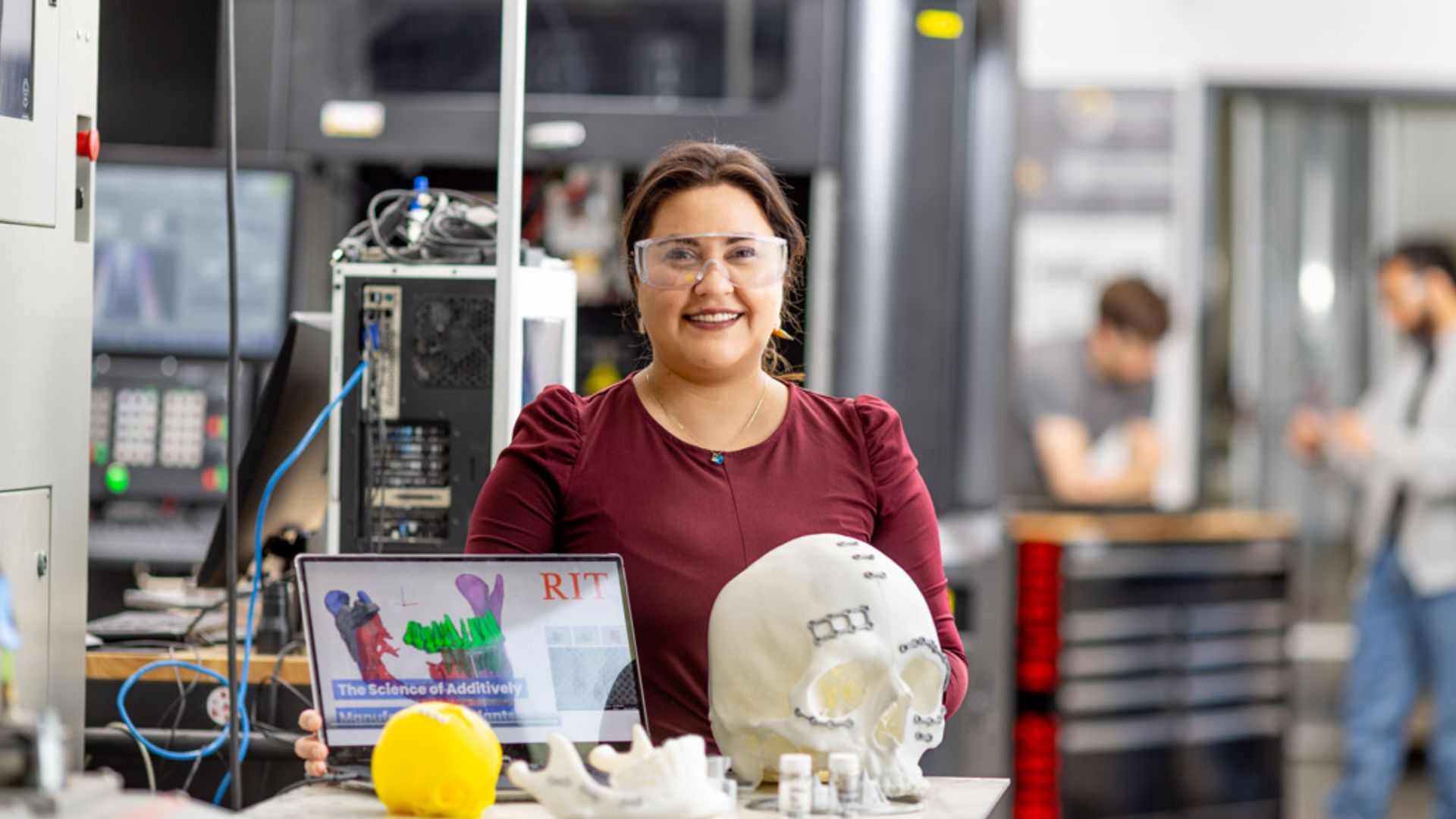
Rochester, New York – A young engineer’s journey from Colombia to one of the United States’ leading technology universities is now shaping what could become a major leap forward in reconstructive surgery. At the center of that journey is Valeria Marin Montealegre, a newly minted Ph.D. graduate whose work with 3D-printed metals is opening new possibilities for patients in need of craniofacial implants.
Her path into advanced research did not begin in a laboratory alone—it started in operating rooms and entrepreneurial workshops. Back in 2020, while still a graduate student in Colombia, Marin Montealegre was already balancing two demanding worlds. By day, she worked through the early stages of a startup she co-founded, HumanBX, a company focused on custom implantable devices. By night, she attended classes in product development. In between, she found herself observing surgeons use prosthetics she had personally helped design.
Those early experiences left a lasting impression. The impact was immediate and deeply human: patients, including children, were receiving life-changing reconstructive solutions. Yet for Marin Montealegre, it wasn’t enough to simply contribute—she wanted to understand more, to push the boundaries further.
“I was working in research, but coming back to academia with the knowledge I had from industry was a very impactful thing,” she said. “I was involved in the manufacturing process. But I wasn’t deep on the materials science side. I just knew what it was. But then when I came here that is when everything transformed.”
That turning point came when she enrolled at Rochester Institute of Technology (RIT), first as part of an exchange program and later as a doctoral student. What began as a step toward refining her technical skills quickly turned into a full immersion in the science behind manufacturing and materials.
Her academic journey at RIT was anything but narrow. She explored a wide range of subjects, from engineering fundamentals to fine arts, building a multidisciplinary understanding that would later shape her research approach.
“If you saw my transcripts, you’d think I did another undergraduate degree. I just enjoyed them,” said Marin Montealegre. “I was good at designing, listening to the doctors’ requirements. I had good understanding of the applications, but when I came here, I discovered an entire world about manufacturing processes, materials science, and production.”
By 2022, she had officially entered RIT’s Ph.D. program in mechanical and industrial engineering. Within a year, her research direction became clear—and ambitious. She began focusing on molten metal jet printing, a cutting-edge form of additive manufacturing, using zinc as a primary material.
Working under the guidance of Professor Denis Cormier, a recognized leader in the field, Marin Montealegre stepped into a largely unexplored scientific space. Her work centers on using zinc, a bio-compatible metal, to create implants that can safely dissolve within the human body over time.
“Dr. Cormier is the pioneer in molten metal jet printing and also a leader in the use of a lattice design for 3D printing. That structural technology is being used in multiple areas, but in this instance, it can be used to engineer bone,” she said. “It is very deep science in how to print with zinc, a bio-metal that can be used for bone healing regeneration. There is a huge gap in the knowledge.”
That gap is precisely where her research is making its mark.
Traditional implants often require additional surgeries for removal, especially when used to support healing bones. The approach Marin Montealegre is helping develop aims to change that. By designing implants that gradually degrade as the body heals, surgeons could one day eliminate the need for follow-up procedures, reducing risk and recovery time for patients.
“There’s a trend now for bio-metals, those that can be absorbed in your body such as magnesium, iron, and zinc,” she explained.
Her focus on zinc is particularly promising. The material offers a balance between strength and biodegradability, making it suitable for temporary structural support. Through advanced 3D printing techniques, these implants can also be customized to match the exact anatomical needs of individual patients—a crucial factor in craniofacial reconstruction.
Still, the work is not without its challenges. Molten metal jet printing itself is a relatively new process, and applying it to bio-metals adds an additional layer of complexity. According to Marin Montealegre, very few research groups worldwide are exploring this combination.
“There are few places in the world that are working with molten metal jetting, none working with bio-metals—yet. We recognized an opportunity to explore these materials using a different technology, and we are helping pioneer in this space,” she said. “My lab mates are even more impressive, as they are developing the technology from its conception through manufacturing to make this possible. I think this is awesome.”
Her research is part of a broader shift in medicine toward personalized, technology-driven care. The idea of tailoring implants to each patient’s anatomy, while also ensuring they naturally dissolve after serving their purpose, represents a significant departure from conventional methods.
But for Marin Montealegre, the work is not just about innovation—it is about access. She remains closely connected to her entrepreneurial roots and is already planning the next phase of her journey.
After completing her Ph.D., she intends to expand HumanBX, potentially moving parts of its clinical research and manufacturing operations to the United States. Her goal is to scale the impact of 3D-printed biomedical solutions beyond one region.
“The possibilities are huge! I’ve had the privilege of being in this lab. I just feel we are helping the world.”
That sense of purpose has been a constant thread throughout her career—from the early days of designing implants in Colombia to her advanced research in the U.S. It reflects a broader vision: one where technology is not just about progress, but about people.
As she joins the ranks of 76 doctoral graduates this year, Marin Montealegre leaves behind more than just academic work. She brings forward a model of what modern engineering can look like—deeply technical, globally connected, and firmly grounded in real-world impact.
In operating rooms of the future, where implants are not only precisely designed but also biologically integrated and temporary, her work may quietly play a role. For patients, that could mean fewer surgeries, faster recoveries, and better outcomes.
And for one engineer who started by watching surgeons use her designs, it marks the continuation of a journey that is far from over.


-
 Local News2 years ago
Monroe County announces legal proceedings against properties listed in official public notice of foreclosure
-

 Local News2 years ago
New ALDI store close to Rochester to begin construction in late 2025 or early 2026
-

 Local News2 years ago
County Executive Adam Bello and members of the county legislature celebrate exceptional young leaders and advocates at the 2025 Monroe County Youth Awards
-

 Local News1 year ago
The 2025 Public Market Food Truck Rodeo series will begin this Wednesday with live music by the Royal Bromleys