Local News
Student investors at RIT expand university portfolio through hands on financial management and real market decision making

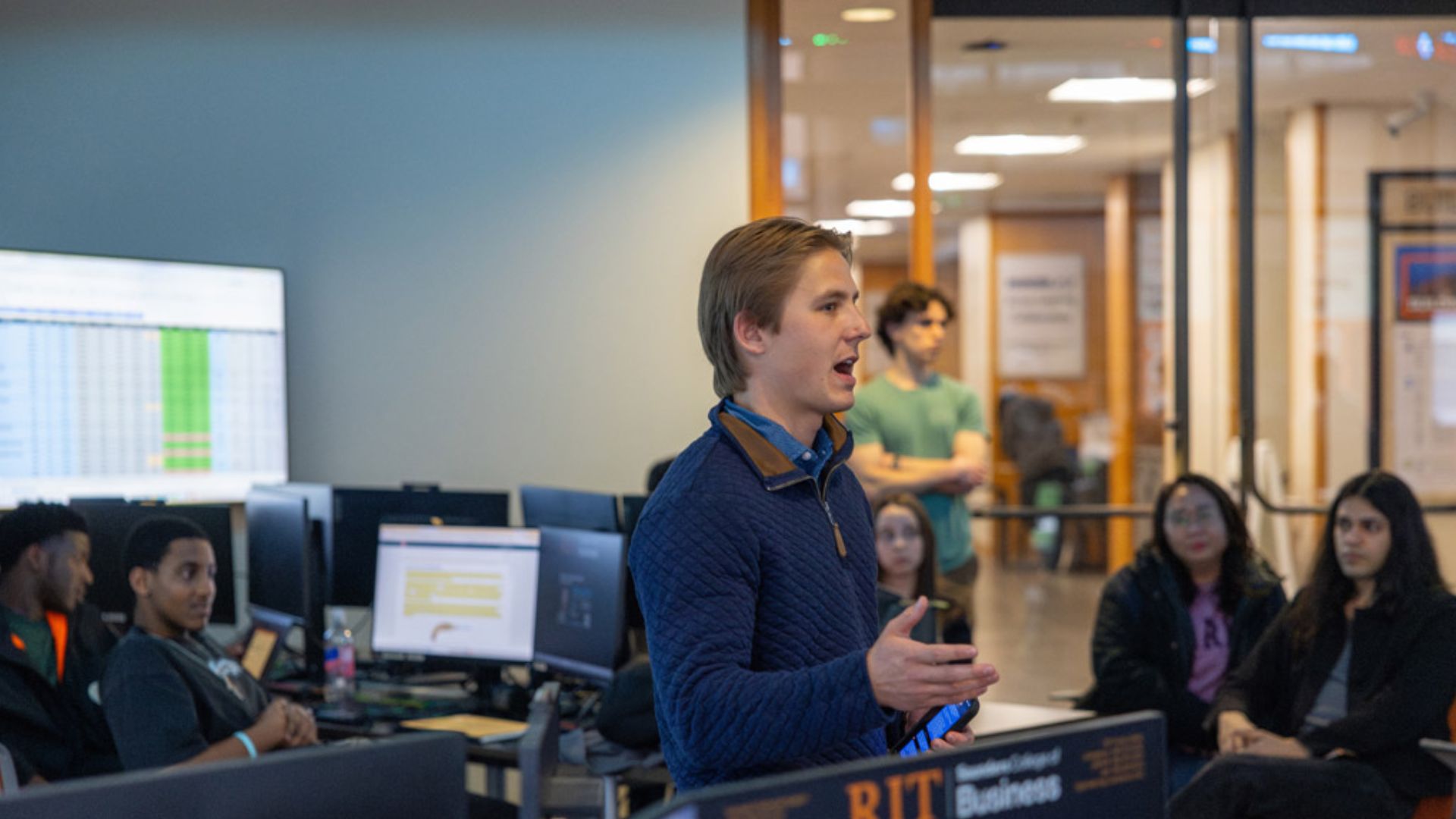
Rochester, New York – Inside a classroom at the Rochester Institute of Technology, the atmosphere feels less like a lecture and more like a trading floor in miniature. Laptops glow with financial charts, discussions ripple across the room, and one student stands at the front, making a case—not for a grade, but for an investment.
That student, Shane Girolamo, came prepared. The second-year finance and computer science major didn’t just bring an idea; he brought analysis. His stock pitch was built on a discounted cash flow model, backed by data pulled from Bloomberg terminals, and delivered with the kind of conviction usually reserved for seasoned analysts. Around him sat fellow students, listening closely, questioning assumptions, and ultimately deciding whether his idea deserved a place in a real investment portfolio.
This is not a simulation. It is part of a growing, student-managed investment effort under the university’s Financial Management Association, where students take direct responsibility for managing a portion of the institution’s endowment. Over the years, that portfolio has grown significantly—from roughly $100,000 in 2010 to nearly $450,000 today—driven entirely by student decisions.
“It’s real, tangible money,” said Owen Cavo, a fourth-year finance and management information systems student and FMA president. “That’s pretty much the core of the club.”
That sense of realism changes everything. Decisions carry weight. Discussions become sharper. And the learning—far from theoretical—becomes immediate and practical. Students are not just studying markets; they are participating in them.
Weekly meetings, typically held in the Saunders College of Business Sklarsky Center for Business Analytics, follow a rhythm that blends structure with spontaneity. They often begin with a review of current market news, where any member can bring forward a headline, a trend, or a sudden shift worth examining. From there, the session might evolve into a workshop, a guest lecture, or a detailed stock pitch like Girolamo’s, complete with questions and a formal vote.
Yet what stands out most is not the format, but the energy. Conversations do not end when meetings adjourn. Students linger, forming small clusters, continuing debates, and building connections that extend beyond the classroom.
“People are really interested in the topics,” said Rachel O’Connor, a fourth-year global business management student and the club’s vice president. “We try to structure our meetings so that people can get involved, because they’re very curious.”
That curiosity has drawn a diverse crowd. While finance students form the backbone of the group, a growing share of members now come from engineering, computing, and other technical fields. The shift reflects a broader trend—one where financial analysis increasingly intersects with data science, programming, and advanced analytics.
Hao Zhang, a finance professor and director of both undergraduate and graduate finance programs at RIT, has observed this change firsthand. Students from computing disciplines are no longer just interested—they are actively seeking ways to apply their technical expertise within financial contexts.
“Computing plus finance is a powerful combination,” said Zhang.
That combination is already proving effective. Student teams have taken part in competitive, real-world challenges such as the Bloomberg Global Trading Challenge and the CFA Research Challenge, where collaboration between finance-minded students and technically skilled peers has produced strong results. In some cases, students are even using artificial intelligence tools to analyze corporate filings, uncovering insights that might otherwise remain hidden.
For Zhang, who has advised the club for nearly 15 years, the organization represents more than a student activity. It is a bridge—connecting disciplines, linking theory with practice, and preparing students for a financial world that demands both analytical depth and adaptability.
“There are a lot of skills that you’re not going to learn in the classroom,” Cavo said. “The most important part of the club is being able to help younger students figure out what they want to do with their careers.”
That mentorship aspect quietly shapes the club’s culture. New members are not just observers; they are encouraged to ask questions, test ideas, and gradually step into more active roles. Over time, they move from listening to leading—from learning about investments to making them.
Zhang sees long-term value in that approach, not just for students pursuing careers in finance, but for anyone navigating an increasingly complex financial landscape.
“It’s beneficial for everyone to learn more about finance, whether they are managing a retirement account, a savings account, or their daily spending,” he said. “Through the club’s activities, our students are getting the education and hands-on experience early enough to make a difference when they get into the real world.”
In a space where theory meets responsibility, and curiosity meets consequence, these student investors are doing more than growing a portfolio. They are building confidence, sharpening judgment, and quietly preparing for the moment when the stakes—and the opportunities—become even greater.


-
 Local News2 years ago
Monroe County announces legal proceedings against properties listed in official public notice of foreclosure
-

 Local News2 years ago
New ALDI store close to Rochester to begin construction in late 2025 or early 2026
-

 Local News2 years ago
County Executive Adam Bello and members of the county legislature celebrate exceptional young leaders and advocates at the 2025 Monroe County Youth Awards
-

 Local News1 year ago
The 2025 Public Market Food Truck Rodeo series will begin this Wednesday with live music by the Royal Bromleys