Local News
RIT alumna blends art and imaging science to transform complex algorithms into colorful visual masterpieces

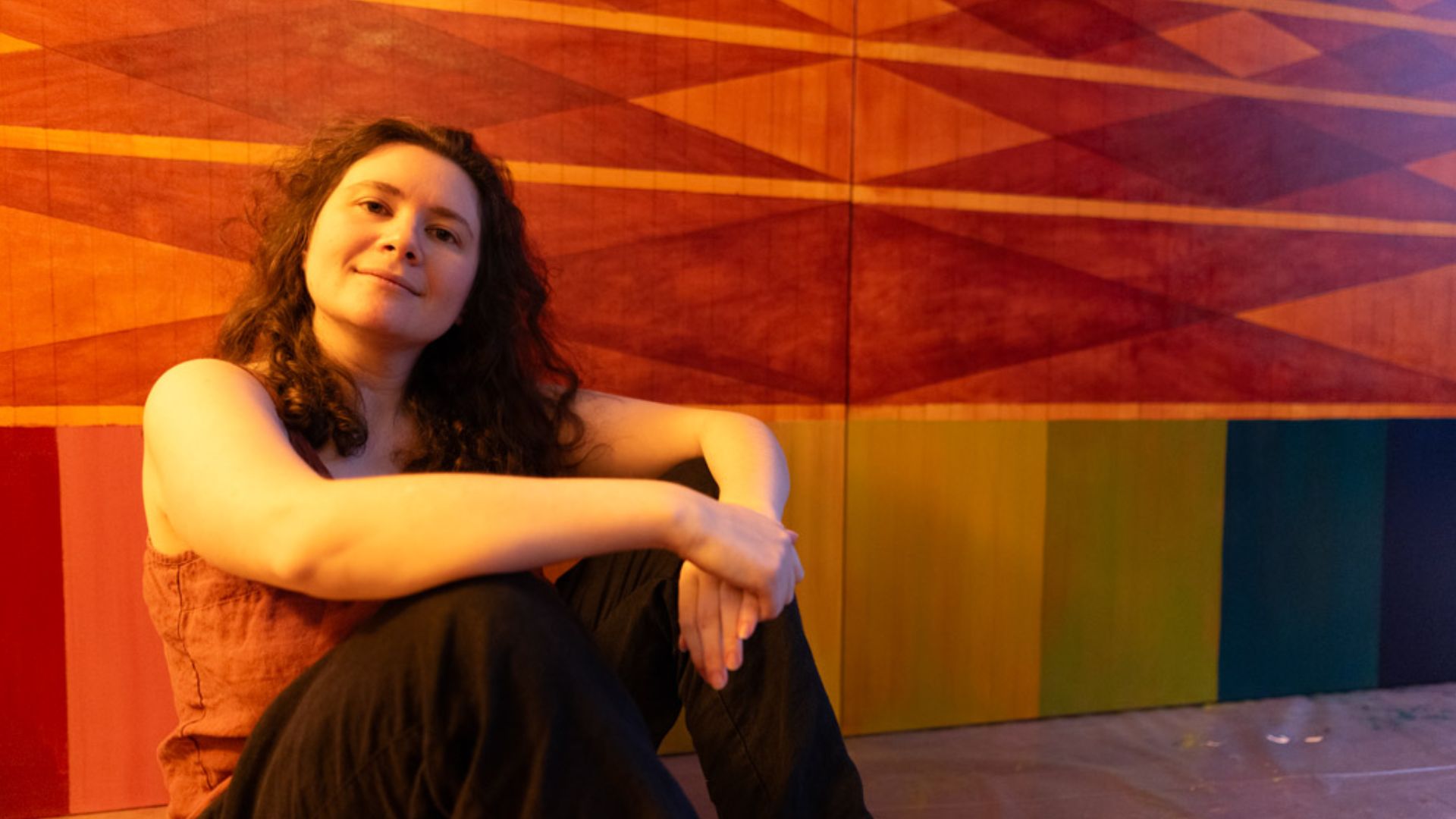
Rochester, New York – In a quiet hallway at the Rochester Institute of Technology, students entering the Chester F. Carlson Center for Imaging Science are greeted by something unusual. Instead of charts or diagrams explaining complex algorithms, they encounter vibrant paintings—swirling shapes, layered patterns, and bursts of color that look more like modern art than mathematics. Yet behind every brushstroke lies a deep scientific idea.
The artwork belongs to Juliet Fiss, a 2009 graduate of RIT’s imaging science program. Her work stands at the crossroads of two worlds that many people assume are separate: art and science. For Fiss, however, the connection feels natural. She blends the precision of mathematics with the creativity of painting, translating complicated scientific concepts into visual experiences.
The centerpiece of her work in the building focuses on a key concept used in imaging science known as the Fast Fourier Transform, often referred to simply as FFT. The algorithm plays a major role in analyzing signals and images, but it can be difficult for students to fully grasp when it is presented only as equations or computer code.
Fiss decided to approach the concept differently—through color, pattern, and movement on canvas.
“It’s easy to think of it as a black box and not really think about what’s going on under the hood,” said Fiss. “It’s interesting to think about how it works and what’s really happening with the data. All the paintings in my FFT series are about the visual intuition of how the FFT works.”
Her paintings attempt to capture what happens as signals shift between domains—something students normally see through graphs or mathematical formulas. In Fiss’ hands, the abstract becomes visible. Waves become shapes. Transformations appear as bursts of structure and color.
The path that led her to this unusual blend of art and science began long before she arrived at RIT. Fiss grew up in a household where scientific curiosity was encouraged. Her father worked as an imaging scientist, and she naturally developed an interest in math and technology. When she later transferred from Minnesota to New York, she did so not only to pursue her academic interests but also to be closer to the person who would become her husband, Xander Fiss.
At RIT, she quickly became involved in research and technical development. As a student, she worked under the guidance of Roger Easton Jr., helping update a visualization program used in imaging science courses. The software, called SignalShow, was rewritten in Java to modernize an older system. Years later, the program continues to be used in classrooms, helping students better understand signals and image processing.
After completing her undergraduate studies, Fiss continued her academic journey across the country. She earned a Ph.D. in computer science and engineering at the University of Washington, where she worked in a graphics and imaging laboratory.
It was during those intense graduate school years that her life took an unexpected turn. Facing a medical challenge and frequent doctor visits, she searched for a way to step away—at least temporarily—from the pressure of research and recovery. Painting, something she had always enjoyed, suddenly became much more meaningful.
“Art is healing in many ways,” Fiss said. “It’s a form of escapism, but it’s very healthy to have that. It’s healthy to have that balance.”
The experience reshaped how she thought about both art and science. Instead of treating them as separate pursuits, she began to merge them. Her paintings became visual explorations of algorithms and signals—mathematical ideas expressed in form and color.
Today, Fiss continues that work while living in Kirkland, Washington. Her days often involve both coding and painting. She is currently updating SignalShow once again, this time developing a web-based version that will make the tool easier to access for students and educators.
At the same time, her artistic project continues to grow. More paintings are on the way, many of which will eventually return to the halls of RIT where her journey in imaging science began.
“For the imaging science students, I want to inspire them to learn about the Fast Fourier Transform,” added Fiss. “To produce this body of work that will end up in the building is so cool. I’m going to keep painting and keep sending them. I’m really excited about it.”
For the students who walk past her artwork every day, those colorful canvases may offer more than decoration. They serve as a reminder that science does not always live only in textbooks or equations. Sometimes, it appears in unexpected places—on a wall, in a painting, where creativity and logic meet.


-

 Local News1 year ago
New ALDI store close to Rochester to begin construction in late 2025 or early 2026
-

 Local News11 months ago
County Executive Adam Bello and members of the county legislature celebrate exceptional young leaders and advocates at the 2025 Monroe County Youth Awards
-

 Local News1 year ago
Rochester Lilac Festival announces exciting 127th edition headliners
-

 Local News11 months ago
The 2025 Public Market Food Truck Rodeo series will begin this Wednesday with live music by the Royal Bromleys