Local News
RIT honors dedicated staff members for outstanding service leadership and commitment to student success

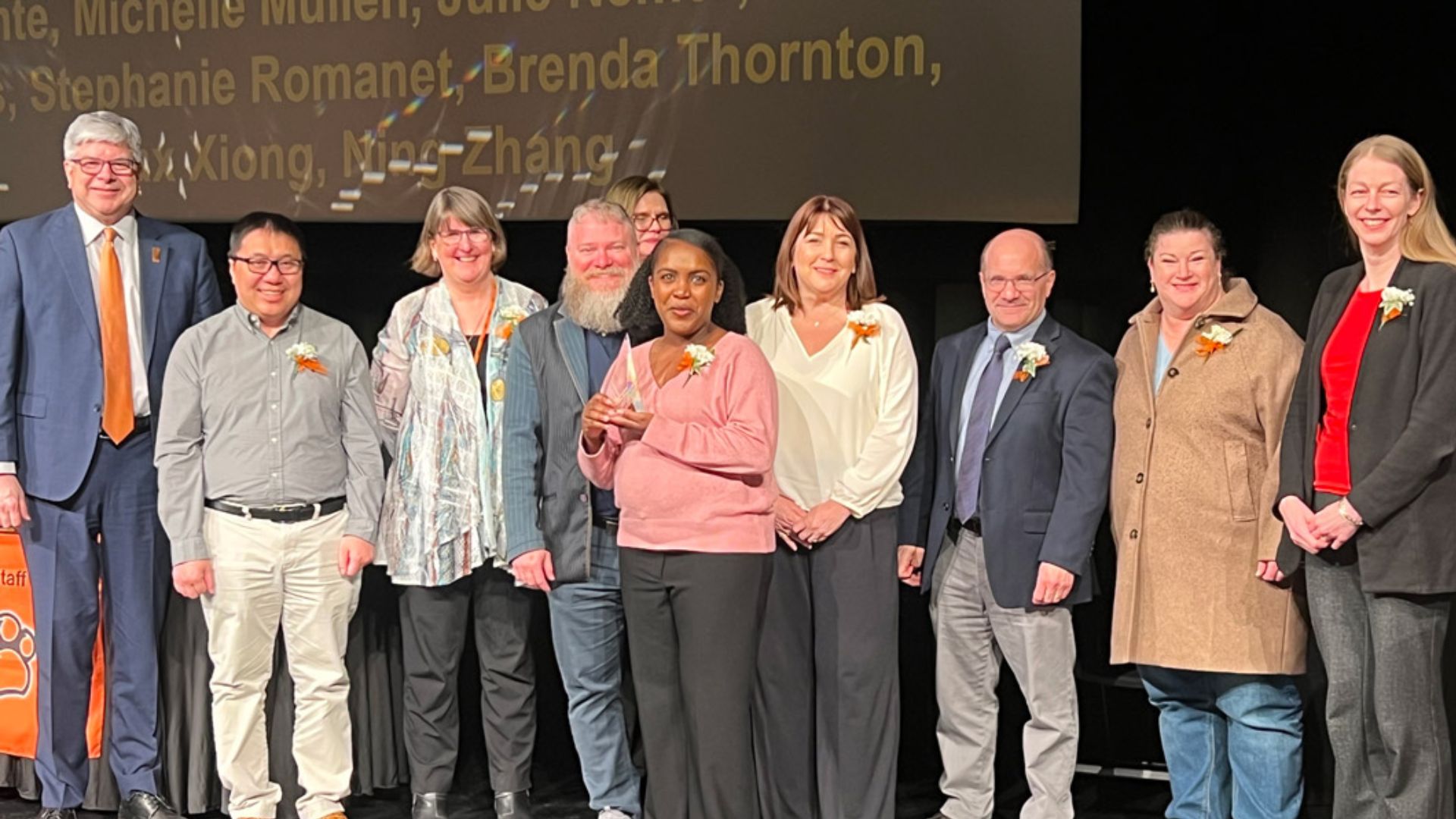
Rochester, New York – On a spring afternoon filled with gratitude and reflection, the Rochester Institute of Technology gathered to celebrate the people who quietly shape the university every day. Staff members from across departments—some new to campus, others who have spent decades helping the institution grow—were recognized during the Presidential Awards for Outstanding Staff ceremony on March 19.
The annual event is more than a formal recognition. It is a moment when the university pauses to acknowledge the individuals who keep its academic, administrative, and student-support systems moving forward. From improving campus programs to building stronger communities for students, the recipients honored this year represent the diverse and often unseen work that supports student success.
University leaders described the awards as a tribute to dedication, integrity, and collaboration. Each recipient, whether an individual staff member or a team, demonstrated not only professional excellence but also a commitment to the broader mission of the university—ensuring that students thrive academically, socially, and personally.
A rising voice in student success
Among the honorees was Makenna Payton, associate director of Student Transitions and Success in the Center for Campus Life, who received the Rising Star Award. The recognition is reserved for employees who have served the university for three years or less but who already demonstrate extraordinary initiative and impact.
Payton’s work centers on helping students navigate one of the most important transitions in college life: the move into university culture during orientation. According to colleagues, she has taken a program that touches thousands of students each year and strengthened it through thoughtful redesign.
Read also: Mayor Malik Evans expresses relief after Rochester police officer survives morning shooting
Her nomination highlighted how she forged partnerships across departments while leading a comprehensive restructuring of staffing and training for the orientation program. Instead of making small adjustments, Payton examined the system from the ground up. Through careful analysis and creative thinking, she implemented a streamlined process that improves efficiency while creating a better experience for student leaders and participants alike.
Those who work with her say she embodies the collaborative spirit that defines the award—bringing imagination, organization, and empathy to programs designed to welcome students to campus.
Celebrating teamwork through excellence awards
Several Excellence Awards were also presented, recognizing staff members and teams whose efforts inspire collaboration and innovation across the university.
One of the most significant recognitions went to the Courseleaf Catalogue Implementation Team, a cross-departmental group that transformed how academic course information is managed. The team includes Deja Campbell, Laura Cummings, Christine Licata, Joe Loffredo, Jared Lyon, Rebecca Montante, Michelle Mullen, Julie Nemer, Marla Roberts, Stephanie Romanet, Brenda Thornton, Max Xiong, and Ning Zhang.
For years, course cataloguing relied on systems that were increasingly outdated and cumbersome. The team tackled the challenge by designing a dynamic, data-driven platform capable of integrating with the university’s Student Information System.
The result is a secure and reliable method for retrieving and managing academic data. Beyond improving accuracy, the system lays the groundwork for future paperless workflows. University officials say the shift will save hundreds of hours of administrative work for both the Registrar’s Office and marketing teams while improving the accessibility of course information for students and faculty.
Just as important as the technology itself was the collaborative process behind it. The project brought together technical specialists, academic leaders, and administrative staff, illustrating how teamwork across disciplines can lead to transformative improvements.
Building community through leadership and mentorship
Another Excellence Award went to Brandy Cunningham, senior staff assistant in the College of Liberal Arts Dean’s Office. Colleagues say Cunningham has become a central figure in strengthening connections within the college community.
Her nomination captured the impact of her work with a simple observation: “she has quickly moved from being a ‘connector’ of people to a true linchpin for the college, cultivating relationships that have created a much stronger sense of community.”
One of her most influential contributions involved rethinking the adjunct hiring process. Recognizing that many adjunct instructors felt disconnected from the broader academic structure, Cunningham developed a clear and intuitive system for hiring and onboarding.
The changes improved efficiency but also emphasized respect and inclusion. Adjunct faculty, often balancing teaching with other professional responsibilities, now experience a more welcoming and supportive process.
Colleagues also highlighted Cunningham’s dedication to mentorship. As one nominator explained, “Brandy is a gracious and skilled teacher. She doesn’t just offer to do things for someone; she offers to show them—and stick with them—until they understand how to do it themselves.”
A leader who builds morale and opportunity
Kara Grace, office manager for the Office of the Provost and Senior Vice President for Academic Affairs, was also recognized with an Excellence Award.
Grace’s work extends far beyond traditional administrative responsibilities. In addition to improving office operations, she mentors a team of student workers, helping them connect their daily tasks with long-term career goals.
For example, when a student employee demonstrated expertise in artificial intelligence, Grace helped facilitate a connection with the university’s AI Hub. The collaboration allowed the student to contribute to the development of a chatbot while gaining practical experience.
Her colleagues say Grace excels at cultivating a positive workplace environment. As one nomination described, “Kara is a master at building morale through what she calls ‘small, meaningful contributions.’ Her impact is just as much about efficiency as it is about atmosphere. Kara is a proactive problem solver who doesn’t wait for a request to take action.”
A program that transforms the first-year experience
The GCCIS FirstByte Committee Team also received an Excellence Award for a program designed to support first-year students in the Golisano College of Computing and Information Sciences.
The committee—composed of Denise Stade, Fran Broderick, Gina Shevchuk, Heidi Davis, Lana Verschage, Lynn Wildman, Melissa Woodhams, Olivia Nuccitelli, Micah Audycki, Shelby Trudeau, Lauren Shields, and Tyler Monica—came together three years ago with a simple but powerful goal: ensuring that every new student feels supported from the moment they arrive on campus.
That idea evolved into FirstByte, a comprehensive ecosystem for student success and retention. The initiative includes interactive events, community-building programs, and workshops designed to help students navigate the challenges of their first year.
Activities range from casual tabling events to interactive game shows. Other initiatives, such as Wellness Mondays and Failing Forward sessions, encourage students to talk openly about academic challenges and resilience.
The impact has been measurable. In its first year, the program contributed to a 50 percent reduction in student losses between the first and second semesters and helped increase overall first-year retention by three percent.
Honoring a champion of inclusion
The Isaac L. Jordan Sr. Staff Award was presented to Peggy Tirrell, senior associate director of Graduate Business Programs and Admissions in the Saunders College of Business.
Named after the university leader who chaired the President’s Commission for Promoting Pluralism, the award recognizes individuals who advance inclusion and belonging through their work.
For more than four decades, Tirrell has helped shape the experiences of graduate business students. Her approach to admissions focuses not only on credentials but also on recognizing potential.
Colleagues say she has built meaningful relationships with students and consistently advocates for them during difficult moments.
One colleague captured her impact in the nomination, saying, “It is not uncommon for students to seek Peggy out specifically to serve as their advocate during some of the most stressful and vulnerable moments of their academic careers. Her advocacy is grounded in empathy, clarity, and an unwavering respect for students’ dignity.”
Inspiring civic engagement and community impact
Another major honor, the Dancy Duffus Award for Outstanding Citizenship within the RIT Community, went to Kathryn Cilano, director of Student Engagement and Community Life in the Division of Student Affairs.
Cilano’s work focuses on helping students connect with the world beyond campus. Under her leadership, programs that encourage civic engagement and community involvement have expanded significantly.
One such initiative, Into the ROC, connects students with organizations and experiences throughout the Rochester region. More than 1,500 students participate annually, and the program has seen participation increase by an astonishing 545 percent.
Cilano has also played a major role in expanding civic learning initiatives through the ROAR the Vote program, encouraging students to become active and informed participants in democracy.
Her leadership extends into addressing real challenges faced by students. In 2022, she guided the strategic transition of RIT FoodShare, expanding the university’s ability to combat food insecurity among students.
Colleagues also credit her with helping the university navigate complex moments through the creation of the Demonstration Response Team and the Natural and Environmental Response Protocols.
A legacy built over decades
The ceremony concluded with the Albert J. Simone Legacy Award, honoring a staff member whose contributions have shaped the university for at least 25 years.
This year’s recipient, Laura Watts, has spent nearly three decades helping design and implement the systems that support the university’s admissions and enrollment operations.
Since joining the university in 1996, Watts has played a leading role in launching several critical technology systems, including the PeopleSoft/Campus Solutions platform, the Hyland OnBase paperless review system, and the university’s transition to Slate.
According to her nomination, “Watts is defined by what she calls her ‘internal moral compass.’ Raised with a mentality of giving 100 percent effort, she approaches every task—no matter how great or small—with a pursuit of excellence.”
Beyond technology and systems, colleagues say Watts has created a culture of community within her team. She encourages professional development, teaches staff members to become confident and self-sufficient, and always keeps the success of students at the center of her work.
Recognizing the people behind the university
While awards and titles were part of the ceremony, the deeper message was clear: universities are built not only by professors and students but also by the dedicated staff who guide programs, solve problems, and support the campus community every day.
At Rochester Institute of Technology, those contributions were celebrated in a room filled with applause, appreciation, and stories of commitment that stretch across departments and decades.
The honorees represented a wide range of roles—from technology specialists and administrators to student-life leaders and admissions professionals. Yet they shared a common thread: a commitment to helping students succeed and to strengthening the university community.
In recognizing their work, the university acknowledged something often overlooked in higher education—the quiet but powerful impact of staff members who shape the student experience in ways both visible and unseen.


-

 Local News1 year ago
New ALDI store close to Rochester to begin construction in late 2025 or early 2026
-

 Local News11 months ago
County Executive Adam Bello and members of the county legislature celebrate exceptional young leaders and advocates at the 2025 Monroe County Youth Awards
-

 Local News1 year ago
Rochester Lilac Festival announces exciting 127th edition headliners
-

 Local News11 months ago
The 2025 Public Market Food Truck Rodeo series will begin this Wednesday with live music by the Royal Bromleys