Local News
City of Rochester moves forward with the next major phase of the long-awaited Vacuum Oil brownfield cleanup project

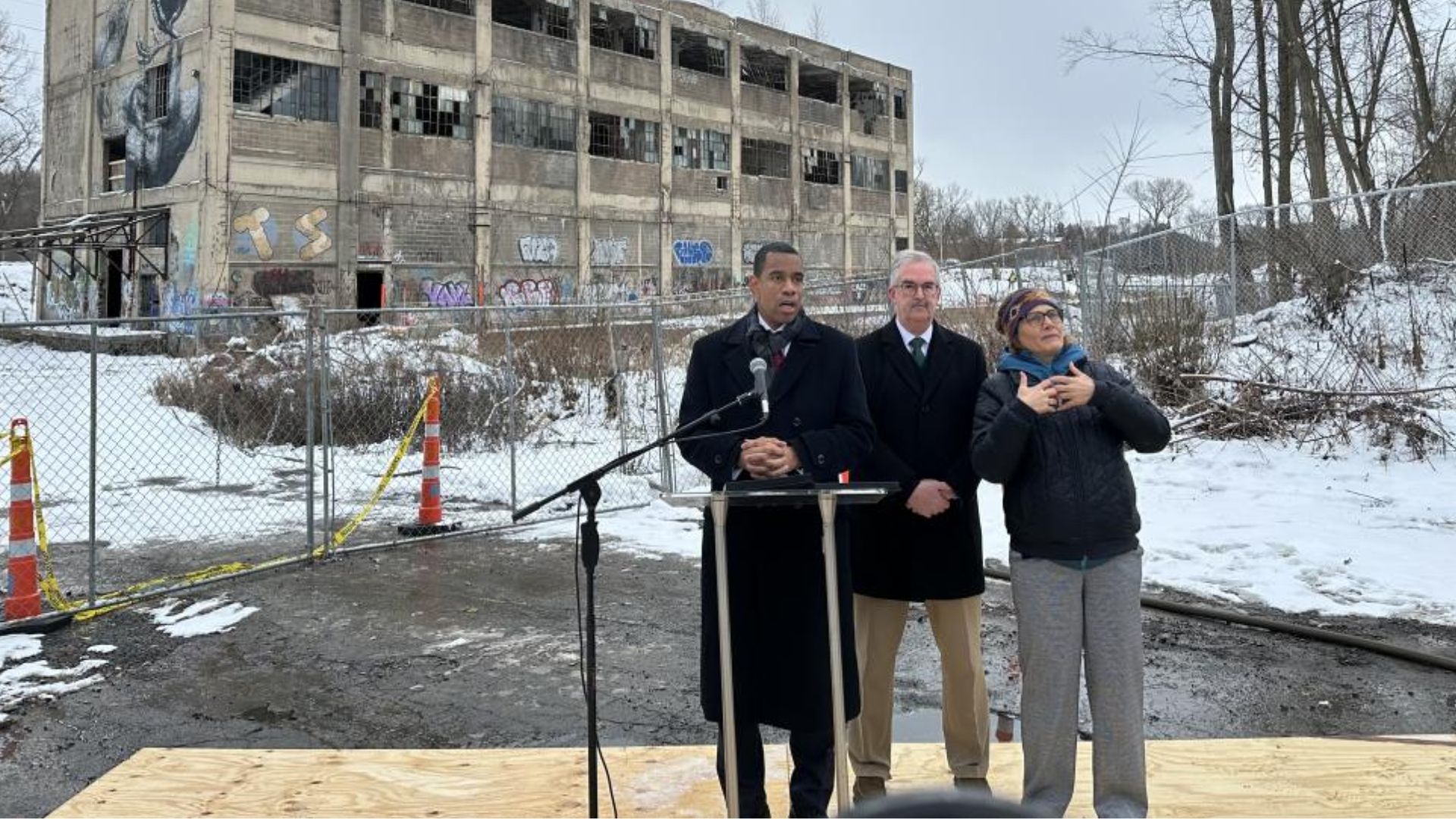
Rochester, New York – Rochester is preparing to take another significant step in its long-running effort to repair and reclaim one of the most environmentally troubled corners of its riverfront. City leaders announced today that a new phase of remediation is beginning at the former Vacuum Oil property, a site that has carried the burden of decades-old contamination and community frustration. With the launch of this next chapter, officials say they are pushing closer to a future where the Genesee River’s western bank becomes cleaner, safer, and more accessible for everyone.
Mayor Malik D. Evans stood alongside representatives from Roux Associates, Inc. and the New York State Department of Environmental Conservation (NYSDEC) to outline the work that will soon unfold near South Plymouth Avenue and Flint Street. The location—long fenced, overgrown, and avoided by nearby residents—sits in a part of the city where industrial history left behind a difficult legacy. After years of planning, testing, and coordination between agencies at every level, Rochester says it is ready to make visible progress.
“This project represents another important step toward healing our riverfront and transforming a once-contaminated site into an asset for the people of Rochester,” said Mayor Malik D. Evans. “By cleaning up the land and restoring it for future use, we’re protecting public health, honoring our environmental responsibility, and reconnecting our neighborhoods to the Genesee River. This project shows what’s possible when government, business, and residents come together with a shared commitment to renewal and justice.”
The cleanup is part of the New York State Brownfield Cleanup Program (BCP), one of the state’s most widely used pathways for transforming polluted land into new beginnings. For years, the BCP has been the backbone of redevelopment projects across New York, offering financial, technical, and regulatory support to communities tackling lingering environmental damage. The former Vacuum Oil site fits squarely into that mission: a vacant span of land shaped by its industrial past and positioned within reach of major redevelopment once it is restored.
Roux Associates, a remediation and environmental consulting firm with deep experience in this field, is overseeing the cleanup. With offices in Buffalo and Pittsford, the company has led similar projects across the state, including major efforts at long-abandoned refineries and petroleum terminals. Their experience with heavily polluted properties has earned them a reputation for working through complex environmental challenges without losing sight of public safety.
“Roux’s goal is to provide the highest-quality environmental services, which includes protecting the health and safety of our employees, on-site partners, and the surrounding community,” said Ian Reed, Vice President, Roux Associates, Inc. “Led by a team of talented and highly trained professionals, we have a proven track record of success with complex brownfield cleanup projects like the former Vacuum Oil site here in Rochester.”
Officials from the NYSDEC echoed that sentiment and highlighted the cooperation that has allowed the project to reach this point. The agency, which provides oversight and ensures that the cleanup meets state environmental standards, emphasized the long-term importance of the work taking place along the river.
“The NYSDEC and the City of Rochester’s Division of Environmental Quality have worked seamlessly together to get to this point in the process to clean up and connect the region to the Genesee riverfront,” NYSDEC Region 8 Director Timothy P. Walsh said. “The Brownfield Cleanup Program’s goal is to enhance blighted properties and return them to productive use for the benefit of the community. DEC applauds the work underway by the City and its partners and looks forward to continuing our oversight to ensure the goals of the cleanup are achieved to fully protect public health and the environment.”
The phase now beginning will focus on the areas closest to the Genesee Riverway Trail. From the eastern end of Flint Street and stretching south toward South Plymouth Avenue, crews will take on a series of tasks meant to fully identify, contain, and remove lingering pollutants. The plan includes conducting additional investigation to map environmental impacts more precisely, treating soil where possible, excavating contaminated material for proper disposal, and replacing it with clean fill that meets state standards. Once the contaminated soil is removed and replaced, the land will be covered with at least two feet of clean material and then graded and seeded to prevent erosion.
In tandem with the physical cleanup, officials will develop a Site Management Plan designed to guide future activities, ensure long-term monitoring, and establish the health and safety protocols needed once redevelopment begins.
Some preliminary work has already started. Crews have been clearing trees, installing security fencing, and setting up the area for heavier machinery. Demolition of a remaining building at 5 Flint Street began earlier today. The structure is expected to come down over the next three to four weeks, though weather could affect that timeline.
Community members should expect some short-term inconveniences as the work progresses. Portions of the Genesee Riverway Trail between Violetta Street and South Plymouth Avenue may close temporarily, and construction traffic along Flint Street and South Plymouth Avenue will increase. The city is asking drivers, cyclists, and pedestrians to pay close attention to detours, parking restrictions, and posted signage. Weekly updates will be provided on the city’s “Street Beat” page, which lists construction impacts and suggested alternate routes.
This latest phase of remediation is expected to span 18 to 24 months. Once complete, the city intends to advance the Restore the Shore: West River Wall Segment II project, a major component of the broader ROC the Riverway initiative. That long-term effort aims to transform the entire river corridor into a more vibrant, accessible, and resilient public space.
According to city officials, the finished work will open the door to new recreational spaces, safer trails, and improved connections with the Plymouth-Exchange (PLEX) neighborhood. Plans call for a new riverfront park, enhanced flood protection, erosion control measures, and the preparation of roughly 13.5 acres for future redevelopment. The project also supports the city’s goal of reshaping the riverfront into a more natural setting, replacing industrial remnants with open spaces designed for public enjoyment.
As Rochester continues to shift from its industrial past toward a future centered on community access and environmental stewardship, the cleanup at the former Vacuum Oil site stands as one of the clearest examples of that transition. Today’s announcement marks not just another milestone in a complex restoration process, but a renewed commitment to ensuring that the Genesee River becomes a shared asset—healthy, vibrant, and accessible to all.


-

 Local News12 months ago
New ALDI store close to Rochester to begin construction in late 2025 or early 2026
-

 Local News11 months ago
Rochester Lilac Festival announces exciting 127th edition headliners
-

 Local News9 months ago
County Executive Adam Bello and members of the county legislature celebrate exceptional young leaders and advocates at the 2025 Monroe County Youth Awards
-

 Local News9 months ago
The 2025 Public Market Food Truck Rodeo series will begin this Wednesday with live music by the Royal Bromleys